









Relocating 10 kilometres of cables and pipelines
Text Roel van GilsImage VeenIX
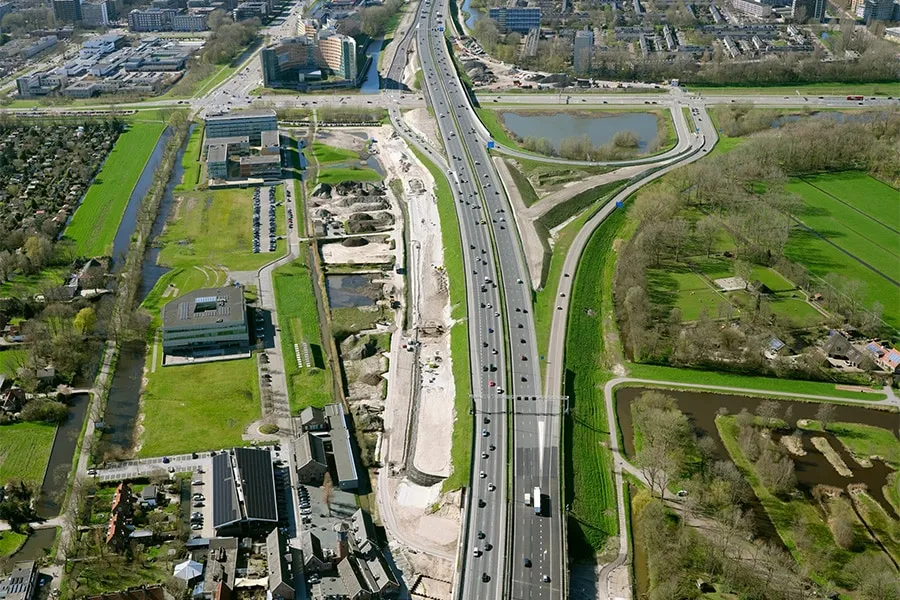
A large number of cables and pipelines run alongside and beneath the bridges and viaducts on the existing A9 between Badhoevedorp and Holendrecht. To keep them accessible after the road is widened, they need to be relocated. Van Baarsen Buisleidingen, Liander’s framework contractor, was brought in at an early stage. Not long afterwards, PWN, Waternet and Stedin also came forward, allowing work to be coordinated very efficiently.
Van Baarsen Buisleidingen is something of an outlier within the project. “Although the request to relocate the cables and pipelines came from construction consortium VeenIX, we are working for Liander to relocate the signal, medium-voltage and low-voltage cables,” explains René van der Sluis, process manager at Van Baarsen Buisleidingen. “During the project, PWN, Waternet and Stedin also came on board as clients, asking us to relocate sections of their pipelines. The trench was open anyway.”
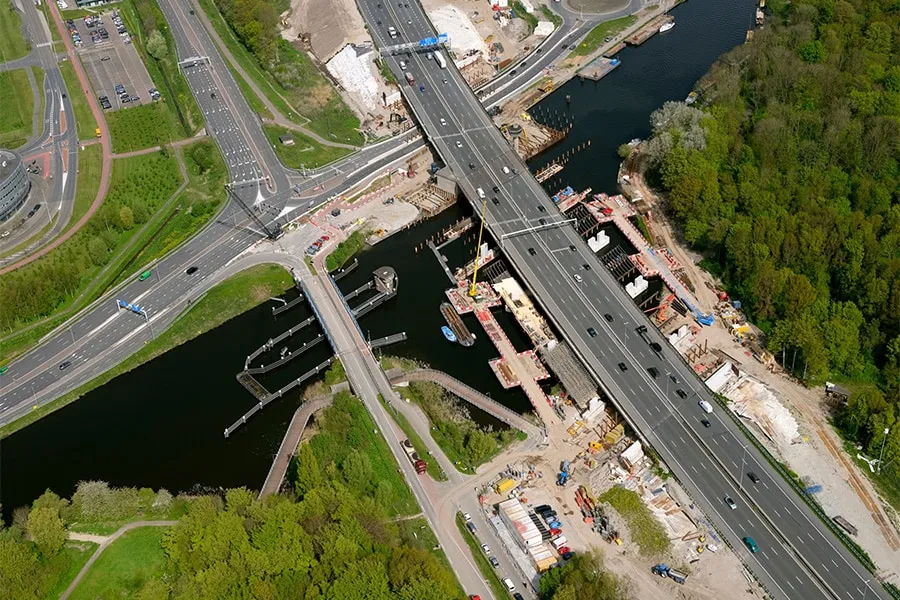
Project team
Van Baarsen Buisleidingen and construction consortium VeenIX have formed a project team. “We meet every fortnight to discuss progress and planning. As we have seen over the past two years of working on the project, the schedule is subject to frequent change,” says Van der Sluis. Matthijs Cappendijk, project coordinator at Van Baarsen Buisleidingen, adds: “The flexible schedule is mainly due to the fact that the project has not been set in stone. There is no detailed design or construction design underpinning it. It is our job to keep adapting to changes, but that is something we are well equipped to do. René and I are Van Baarsen’s points of contact for the entire process, from A to Z: from cost estimating and preparation through to engineering, permit applications, planning and execution. This allows us to respond quickly.”
Horizontal directional drilling
Van Baarsen Buisleidingen is constantly moving between locations along the route from Badhoevedorp to Holendrecht. “We follow the contractor’s schedule and relocate short sections at a time,” says Cappendijk. “By now, we have relocated around 10 kilometres of cables and pipelines, all in phases. Each diverted section is then connected to the existing network. So we move around the project almost at random. One section takes a week, another several months, so that varies too.” Van der Sluis adds: “We have also completed around twenty horizontal directional drills beneath the A9. All in all, it is quite a substantial project for us, with a long duration of more than two years so far. We are now working towards the end. Most of the cables and pipelines are in their new locations. We will remain active on the project until the end of this year, although not continuously. By then, we will have been involved for around three years, usually with one or two crews, but at peak times with three or four. All in all, it is another great project to add to our portfolio.”
Question about this story? Ask your question
Keep following this
Get an email when a new story is published. No account needed.
- SubjectRoad construction







