









Proof of concept for geopolymer concrete in railway underpass in Heiloo
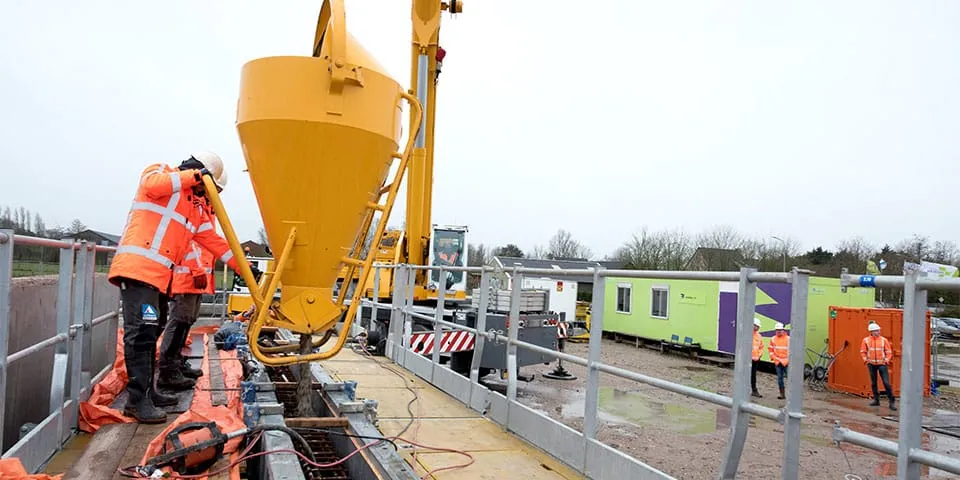
For the first time in Western Europe, reinforced geopolymer concrete partition walls have been built in a railway underpass currently under construction in Heiloo. One of the major advantages of this concrete is its significantly lower CO2 footprint compared with conventional cement concrete. The project in Heiloo achieves a 50 per cent reduction.
Mobilis is the first civil engineering contractor in the Netherlands to build part of a railway underpass using reinforced geopolymer concrete. “The partition wall in Heiloo is our first ‘proof of concept’, demonstrating that Geo-beton™ can be readily produced, transported and placed, even up to 3 hours after it has been manufactured at a ready-mix concrete plant,” says Mobilis initiator Herman van den Noort.
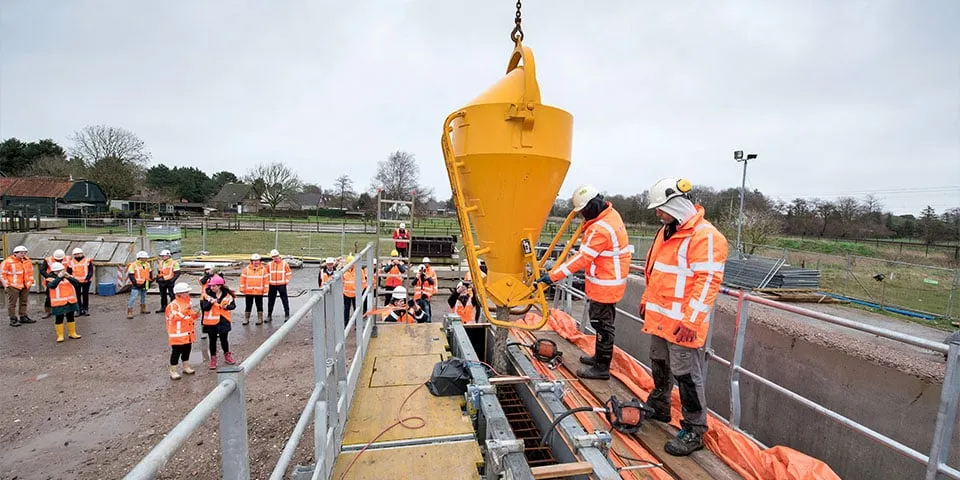
Part of the railway underpass is being built using reinforced geopolymer concrete.
Fully equivalent
Conventional concrete made from cement, sand, gravel and water is responsible for at least 8 per cent of all human-caused CO2 emissions worldwide. Most of these emissions come from producing cement, the binder, which requires large amounts of energy to power the kilns. Van den Noort says: “Geopolymer concrete contains no cement at all. Instead, it combines mineral substances that replace cement, sourced from familiar industrial by-products such as blast-furnace slag and fly ash, and from natural sources such as biomass ash or sediments like river silt. These substances are ‘alkali-activated’ using materials such as waterglass and caustic soda.”
According to Van den Noort, the type of geopolymer concrete developed by Mobilis in collaboration with Delta Concrete Consult is fully equivalent to conventional concrete. “We do not need to use any primary raw materials from far-flung countries, and the hardened concrete remains suitable for circular use and recycling, all at comparable production and construction costs.” Mobilis was one of three finalists for the 2018 TBI Innovation Award with this new type of concrete.
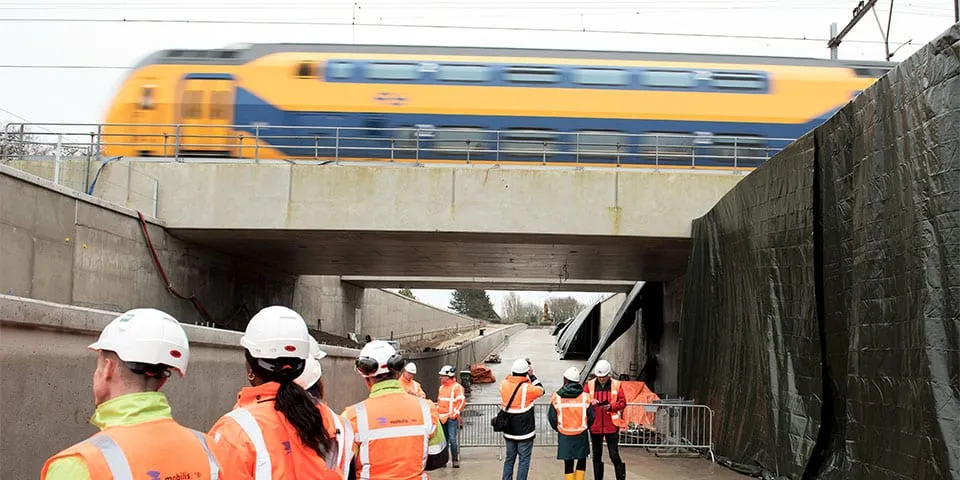
Following a minor adjustment to the mix design, six sections of the partition wall have now been cast, each approximately 20 metres long.
Successful field trials
Mobilis first carried out successful field trials using its own Geo-beton™ in reinforced structural components. It then put the material forward for government projects on its own initiative and contacted Rijkswaterstaat and ProRail. Van den Noort says: “Major public-sector clients such as Rijkswaterstaat and ProRail are very interested in Mobilis’s initiative. In the Netherlands, following the signing of the international Paris climate agreement and the national Concrete Agreement, which Mobilis also signed, major market players are increasingly looking for sustainable alternatives to conventional raw materials and products.”
In October 2019, a trial pour was carried out in Heiloo for a wall in reinforced Geo-beton™ as part of the railway underpass on Vennewatersweg. Van den Noort says: “This is a new product, and everyone involved needs time to get used to it at every stage.” Following a minor adjustment to the mix design, six sections of the partition wall have now been cast, each approximately 20 metres long. In this tunnel project, the partition wall is a component with a lower risk profile, and the sections can in principle be replaced easily if necessary. Sensors installed in two of the sections will make it possible to monitor the behaviour of the geopolymer concrete over the next ten years.
Validated product
Mobilis is now in discussions with several clients about a project. Van den Noort says: “The structural safety of Geo-beton™ is assured: it is a validated product. We will continue to develop and test it extensively, but we want to commit to it now and accelerate the use of geopolymer concrete.”
Have a business enquiry for Mobilis? Get in touch
Companies in this story

Keep following this
Get an email when a new story is published. No account needed.
- SubjectRoad construction
- CompanyMobilis







