









Optimising the ‘Second Ring of Amsterdam’
Text Roel van GilsImage Rijkswaterstaat
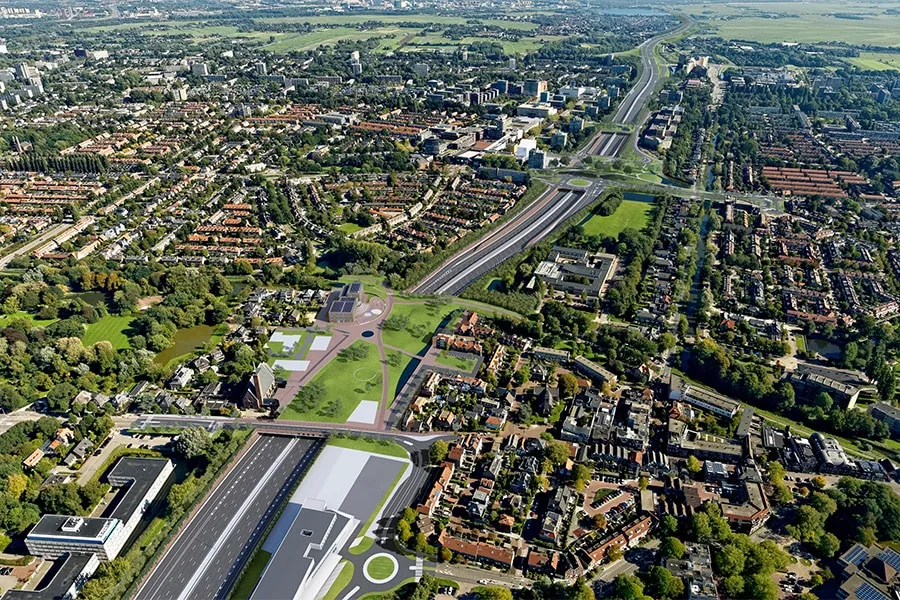
The Schiphol-Amsterdam-Almere road expansion programme (SAA) is the largest road construction project in the Netherlands. Widening the A9 between Badhoevedorp and Holendrecht is the fifth and final project in this extensive programme, and certainly no small undertaking. The ‘Second Ring of Amsterdam’ runs straight through Amstelveen. Every effort is therefore being made to minimise disruption for the surrounding area. We speak to Lammert Postma, stakeholder manager at Rijkswaterstaat, about the many challenges involved in optimising the A9.
There are several reasons behind the SAA programme. “The northern part of the Randstad is experiencing significant growth,” Postma begins. “The Spatial Planning Policy Document decided that Almere would grow to become the fifth-largest city in the Netherlands, Amsterdam faces a major inner-city housing challenge, and employment around Schiphol is growing rapidly. The aim of the SAA programme is to accommodate the growth in mobility resulting from these developments. A second objective is to integrate the motorway better into its surroundings wherever possible, improving quality of life along the route.” The latter is also evident on the A9, which will soon be largely out of sight in Amstelveen.
Express lane
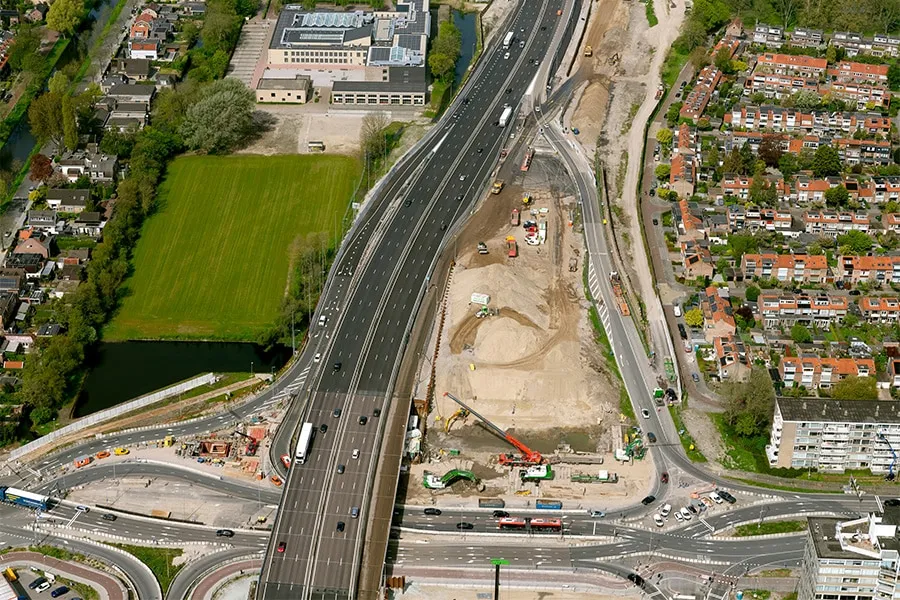
The A9 is being widened over a length of 11 kilometres, from 2×3 to 2×4 lanes plus a reversible lane. “The existing reversible lane, which currently runs from Almere along the A1 and ends at Diemen interchange, will be extended through the Gaasperdammertunnel to Ouderkerk aan de Amstel,” Postma explains. “Depending on the rush-hour traffic management system, the reversible lane provides an ‘express lane’ for through traffic. The widening means that ten structures will be completely demolished and rebuilt in a wider form, one structure will be reused and widened (the Schipholbrug), a new underpass for the reversible lane will be built at Holendrecht interchange, and one new structure will be built in the form of the 1.6-kilometre sunken section in Amstelveen. Finally, all noise barriers will be replaced with new, higher barriers, totalling around 14 kilometres in Ouder-Amstel and Amstelveen. The project is being delivered under a DBFM contract awarded to the VeenIX construction consortium. This means that they are responsible for the design and arranging the upfront financing. In return, we will pay an availability fee during the 14-year maintenance period, enabling the consortium to pay off its ‘mortgage’, as it were.”
Compensation scheme
The A9 is one of the most important and busiest motorways in the Netherlands. “The aim is to keep as many 2×3 lanes open to traffic as possible during construction,” says Postma. “The limited space makes for complex traffic management phasing. A project of this kind also involves a lot of dust, noise and vibration. Even so, we are trying to keep living conditions tolerable for residents alongside the motorway. We provide extensive communications at neighbourhood level, and the contractor is also taking a number of measures to reduce disruption. For example, the piles for the sunken section are being drilled rather than driven. Sometimes, however, it is impossible to avoid affecting residents, such as when demolishing structures or installing sheet piles. We have introduced a compensation scheme based on the number of decibels measured at the façade. This ranges from providing ‘noise-cancelling’ headphones to, in some cases, offering an overnight hotel stay.”
Saline seepage
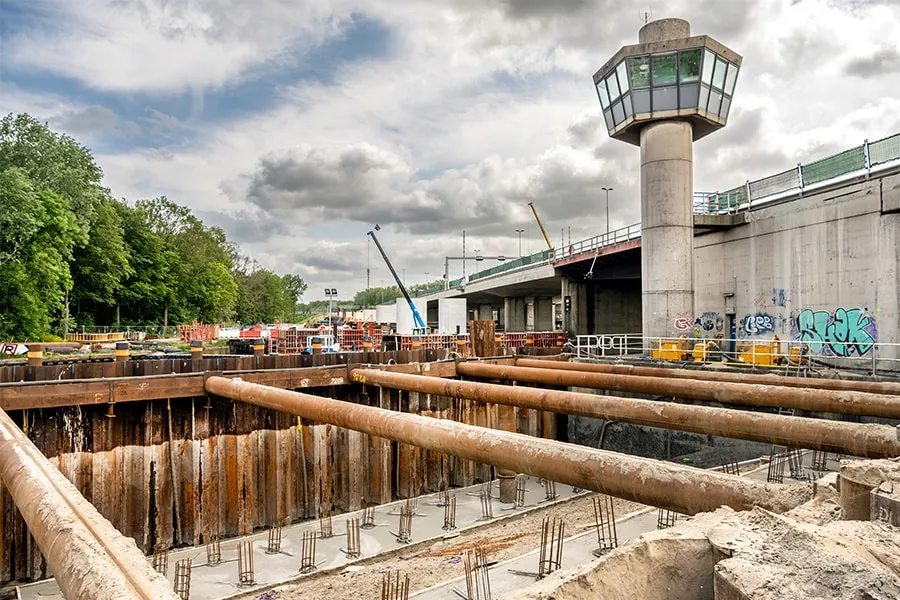
Another factor that makes this project particularly complex is the very poor ground and the many different polder water levels, Postma acknowledges. “Our Spanish contractor sometimes jokes that ‘your underground is absolute hell’. It requires intensive consultation and coordination with numerous stakeholders, including the Hoogheemraadschap Rijnland and the Waterschap Amstel, Gooi en Vecht. In practice, it can take a very long time for a stable earth embankment to form. It is also why an underwater concrete floor is being used in the sunken section, to rule out saline seepage from the outset.”
According to Postma, construction is progressing well. “We have experienced some delays in Amstelveen due to Covid. Staff absences and working from home extended the design phase, which means that the availability date for the central section has shifted from 2026 to 2027. We are on schedule for the eastern and western sections to be completed by the end of 2026. There is plenty to see on and around the A9 at the moment. The first section of the sunken route is already taking clear shape, foundations for the new structures over the Amstel and Bullewijk are gradually rising in the east, and work is also in full swing on the Schipholbrug. The project is attracting a great deal of interest from the surrounding area, and we are happy to respond. A retired colleague regularly leads cycling tours, for example, and we share a lot of information online. People can follow progress live via several webcams.”
Question about this story? Ask your question
Who worked on it
Schiphol-Amsterdam-Almere (SAA) in Amstelveen
- construction consortiumVeenIX
Keep following this
Get an email when a new story is published. No account needed.
- ProjectSchiphol-Amsterdam-Almere (SAA)
- SubjectRoad construction
- CompanyVeenIX







