









Interreg V project Rolling Solar gets under way
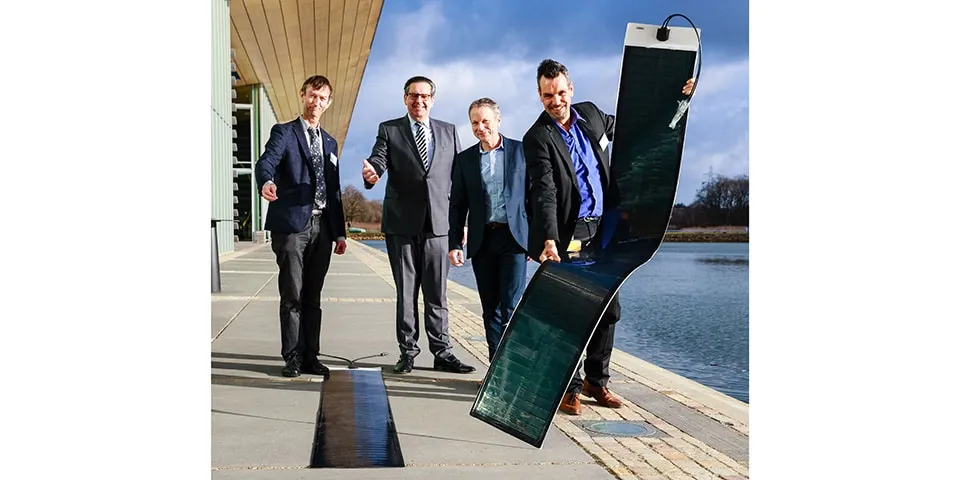
A regional consortium of more than 20 research institutions, road authorities and companies has launched the European cooperation project “Rolling Solar”. With a budget of €5.7 million, the consortium aims to enable the integration of thin-film solar cells into infrastructure. The goal? To integrate thin-film solar cells on a large scale into roads and cycle paths, as well as into crash barriers and noise barriers.
The 3-year Rolling Solar project is being delivered under the Interreg V Euregio Maas-Rijn cooperation programme. It receives financial support from the European Regional Development Fund, the provinces of Noord-Brabant, Vlaams-Brabant, Vlaams-Limburg and Liège, and the Dutch Ministry of Economic Affairs.
Without using additional land
Rolling Solar is being delivered by Solliance, the public-private partnership of companies and research institutions in the Netherlands, Belgium and Germany focused on developing thin-film solar cells. Alongside project coordinator TNO, the participating research institutions are imec, Universiteit Hasselt, Forschungszentrum Jülich, RWTH Aachen, Zuyd Hogeschool and Centre de Recherche des Instituts Groupés (CRIG) de la Haute Ecole Libre Mosane (HELMo).
The research institutions aim to enable manufacturers and construction and engineering companies to integrate flexible solar cells into public infrastructure in a technically and cost-effective way. The intended outcome is to facilitate large-scale sustainable electricity generation close to users, without using additional land.
Field trials
The potential for generating solar energy from infrastructure is enormous. Belgium, Germany and the Netherlands are connected by a road network stretching around 1 million kilometres. Together with street furniture such as crash barriers and noise barriers, these roads offer huge potential for solar power generation. The rise of electric cars and intelligent traffic systems also creates opportunities to use decentralised solar energy locally.
‘The examples of solar energy in infrastructure demonstrated to date, such as integrating crystalline silicon solar cells into cycle paths, are still relatively costly,’ says Peter Toonssen, programme manager at Solliance. ‘This is not only because production volumes are low, but above all because of the materials required to protect this type of solar cell. Through Rolling Solar, we aim to reduce those costs by using thin-film solar cells, which are not only flexible but also less vulnerable. As part of the project, several field trials will be carried out, with the aim of presenting viable business concepts for thin-film solar cells in infrastructure in 3 years.’
35,000 kilometres
Toonssen points out that thin-film solar cells can be produced on flexible materials measuring up to several hundred metres in length. The Euregio Maas-Rijn also has industrial companies and clusters that can adapt the solar cells for roll-to-roll production, enabling them to be installed directly from rolls.
As noted, the potential for bringing these products to market is considerable. Toonssen says: ‘For example, integrating solar cells across the entire Dutch cycle network, which spans around 35,000 kilometres, could generate 15 terawatt-hours of solar power a year. This would amount to a reduction of 500 million tonnes of CO2 per year.’
Societal challenges
Bert Pauli, Provincial Executive member for Economy and Internationalisation for the province of Noord-Brabant, welcomes the international nature of the Rolling Solar project: ‘As a provincial government, we have an important role to play in making innovative projects like this financially possible. For the Euregio Maas-Rijn, to which Noord-Brabant belongs, cooperation across provincial and national borders is becoming increasingly important as we scale up the energy transition. The Rolling Solar consortium is an excellent example of this. It shows how the energy transition can mobilise not only owners of homes and buildings to generate sustainable energy, but also convince infrastructure operators to move towards large-scale energy production. This European innovation project is therefore an answer to the major societal challenges facing us as a society. The industry in this region can also create a multiplier effect, making an important contribution to the energy transition while generating jobs locally.’
Question about this story? Ask your question
Keep following this
Get an email when a new story is published. No account needed.
- SubjectRoad construction







