









How difficult can it be?
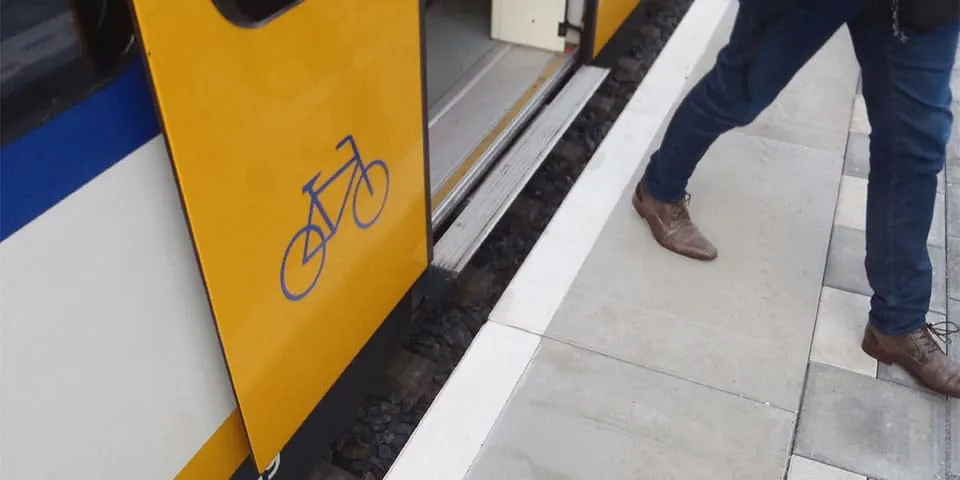
ProRail believes that everyone in the Netherlands should be able to travel independently, including people with a disability. That is why ProRail wants all stations to be accessible to everyone by 2030. In the coming years, major maintenance will be combined with measures to remove barriers to rail travel. ProRail has drawn up a framework agreement for this, and Iv-Infra’s Rail sector is part of it. In the coming years, dozens of platform renewals will be carried out under this framework agreement.
Platform renewal
Major maintenance in the form of platform renewal includes, among other things, installing retaining walls and paving the platform. We have often heard the response, ‘How difficult can that be?’ We are happy to explain that there is rather more to it than meets the eye.
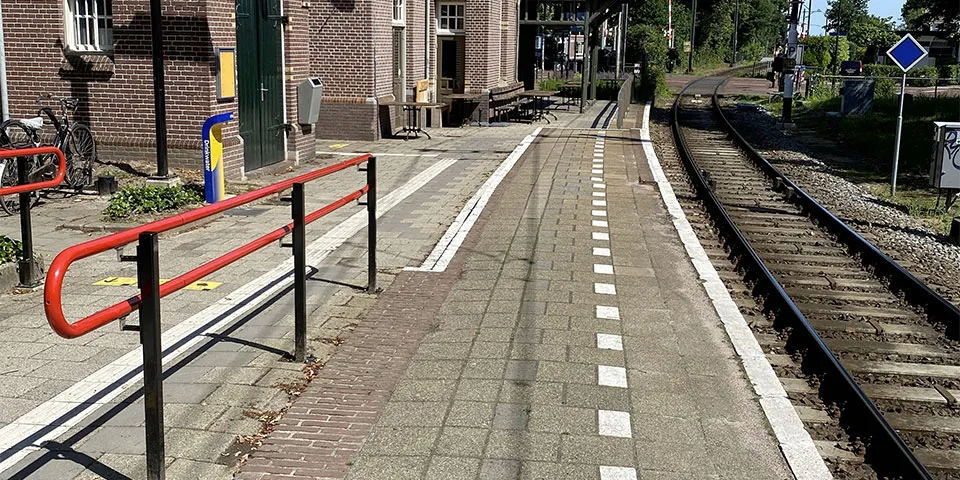
There are 404 stations in the Netherlands, as well as a few stations used only for special occasions, such as Rotterdam Stadion station. To enable people to travel independently, various measures are needed, such as level platforms and handrails with braille information. Station facilities, such as toilets, must also be safe and accessible for everyone to use independently. Two measures included in platform renewals stand out. The first is providing step-free boarding and alighting from trains: the P76 standard. Among other things, this standard requires platforms to be 76 centimetres high. The second measure is making platforms accessible by installing ramps. Platform renewals also include other measures, such as replacing and/or installing tactile guidance lines, safety and platform-edge markings, platform equipment, public address systems and lighting. Each measure has its own regulations and associated requirements. This calls for thorough preparation and good design. An integrated design is important because of the interfaces between the different systems.
Jargon and certification
As in various other industries, work around and on the railway involves jargon, abbreviations, company regulations, product specifications, certifications and much more. As an accredited engineering consultancy, Iv-Infra has access to ProRail’s RailinfraCatalogus, which contains hundreds of these company regulations and product specifications. Before the design is drawn up, all relevant regulations and requirements must be identified. This is also necessary to carry out verification and validation.
Design standard
‘OVS00067 Ontwerpvoorschrift perrons’ states that a platform can be built as a stand-alone structure or integrated into an engineering structure. Examples of platforms integrated into an engineering structure include the railway viaduct at Voorburg station, Best station in the Best railway tunnel, and Barendrecht station in the above-ground tunnel (Kap van Barendrecht).
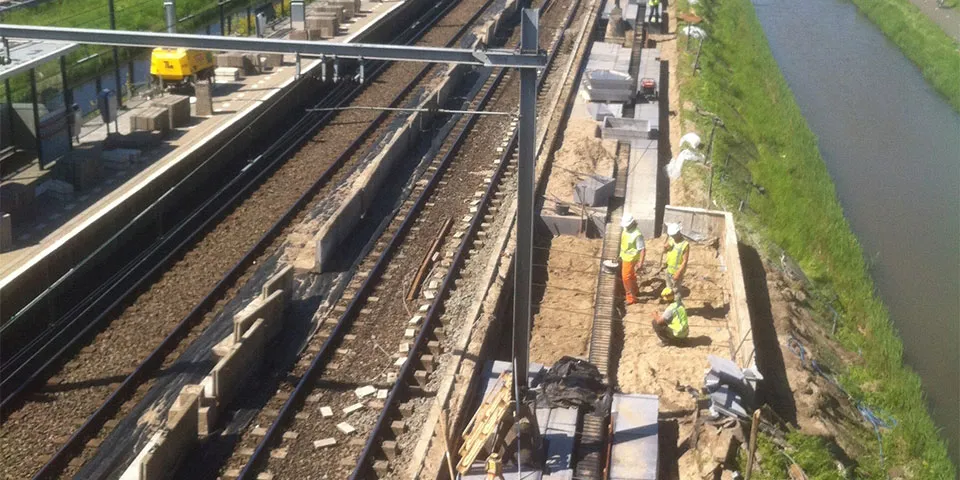
Platforms may be below, above or level with the surrounding ground. Their construction depends on the location and, in particular, on the stability of the subsoil. They are usually built as earth-filled platforms. This means that concrete retaining walls run along the full length of the platform and across its ends. The space between them is filled with sand, and the surface is finished with concrete paving slabs and/or concrete floor units. Where settlement is likely, the platform is built using lightweight materials such as EPS (expanded polystyrene). The framework agreement mainly covers major maintenance of earth-filled platforms enclosed by concrete platform retaining walls.
Platform retaining walls
Before installing platform retaining walls, it is important to establish the current layout of the track and platform, as well as any constraints. They are therefore scanned in accordance with RLN00296. The survey data are used to identify opportunities to optimise the alignment. An alignment is a mathematical description of the theoretical position of the track, determined on the basis of the requirements in OVS00056-4.1. The actual position almost always differs from this. Depending on its status, different alignments may be used as the basis for platform height and clearance: PVS-tracé, doeltracé, nul-tracé, projectdoeltracé and verbeterd nul-tracé.
If the existing subsoil has adequate bearing capacity, the platform retaining walls are installed on a 20-centimetre layer of stabilised sand. The retaining walls are set out on the basis of platform height and clearance. Platform height is the height of the platform edge: nominally 760 mm +BS (top of rail). Platform clearance is the nominal distance of 1,700 mm between the platform edge and the track centreline. For platforms on curved tracks, the nominal clearance between the track centreline and the platform edge must be adjusted by a width allowance. This allowance depends on the cant of the platform track. The platform clearance must be increased or reduced when the platform is located on the inside or outside of the curve, respectively.
Older platforms
On older platforms, the retaining walls often sit directly on the underlying sand or soil. Older platforms may also have brick retaining walls. These are wide at the bottom and step inwards towards the top. The top is finished with a capping beam or a brick coping course. Old drawings should be consulted to establish the exact construction of the brick retaining wall. If they do not provide the necessary information, the wall must be excavated before the possession. A platform may also have listed status. In that case, the options must be agreed with ProRail, Monumentenzorg and the competent authority.
Ramps
Stations without lifts must have ramps. Platform renewals are combined with the installation, replacement and modification of ramps in accordance with current regulations. A ramp must have a gradient of 1:20 or shallower, with a level landing at least 1.5 metres long. Ramps must be at least 1.2 metres wide and fitted with a double tubular handrail on both sides. Modifying a ramp may change the platform layout and/or platform length. As a result, train length signs may need to be moved.
Possession
Most work must be carried out during a possession in accordance with the Normenkader Veilig Werken. Because platforms are relatively narrow, the entire platform renewal must be carried out during a possession. This means passengers experience little disruption from the work. To minimise the impact on passengers, possessions usually last just a weekend. This requires detailed planning and a logistics plan. Nothing can go wrong over a weekend like that.
In short: the work itself, installing retaining walls and replacing platform paving, may not be that difficult, but the preparation beforehand... that is where the challenge lies!
Question about this story? Ask your question
Keep following this
Get an email when a new story is published. No account needed.
- ThemeMaterials and techniques for infrastructure
- SubjectRoad construction







