









“Everyone should be able to get home safely!”
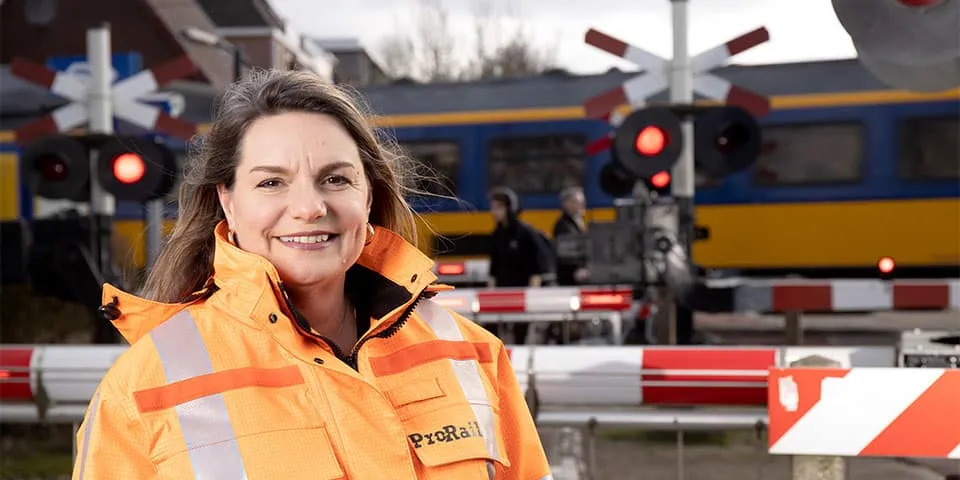
That was the motto Anne Zwiers brought with her when she took up her new role at ProRail. When she joined ProRail 20 years ago, she could never have imagined it would lead to her becoming ‘Director of Level Crossings’. “As of 1 June 2019, I can call myself that,” Anne begins. “Before that, I was a ‘Rail Infrastructure Project Manager’ for around 12 years, after holding various other positions at ProRail.”
Anne already had a connection with level crossings. She was closely involved in developing and building the additional express train service between Groningen and Leeuwarden. “We already had to modify level crossings to accommodate this extra train. Each crossing is dealt with through a set process: first an exploratory phase, then a planning study, followed by the actual works. I got a taste for it, and being able to contribute to everyone’s safety through my work was, and still is, the icing on the cake.”
Farewell to NABOs!
Non-actively protected level crossings, known as ‘NABOs’ in Dutch, must be removed or made safer, with public or publicly accessible crossings dealt with first. This applies throughout the Netherlands. As Director of Level Crossings, Anne is at the centre of efforts to successfully carry out this task, which has been set by the government. Familiar with the processes involved in closing crossings or providing them with additional protection, Anne feels right at home. “The focus was already on working faster and better, and I recognise myself in that too. I always want to work faster and better, with a clear objective. You can think of me as the link between all the parties involved, both internally and externally.”
Anne’s unwavering motivation stems from her desire to ensure everyone gets home safely. “I don’t just mean road users, but also our own staff, passengers and the people who work on or alongside the railway,” she explains. “There are around 300 NABOs in the Netherlands, divided into 170 crossings used by private individuals and 130 public crossings still in use today. There were 180 public crossings at the start of the project. We are tackling the latter group: by the end of 2024, these crossings must either be removed or made safer. A sound, systematic approach to level crossings is important to guarantee safety on the railway and to make it possible to run more and faster trains in the future.”
Three options
Anne outlines the three possible approaches. “A NABO can be closed with no alternative route, closed with an alternative route to the nearest AHOB, existing tunnel or bridge, or left open but protected.” Every crossing needs its own approach, so each process is tailored to the circumstances. First, we inform the local authority and explain that we need its help. The local authority works with us to identify the stakeholders in the exploratory process. Together, we look at how best to involve them. We then consider the options and choices together, with financial viability of course also taken into account. The national government pays half the costs, while the provincial and local authorities each pay a quarter. Where necessary, the local authority formally decides to close the road. This process must be handled not only with great care, but above all quickly. My role is to act as a catalyst in these processes.”
National Level Crossing Improvement Programme
Is there life after the NABOs, we ask jokingly. Anne laughs and replies: “Absolutely. I’ll continue to work on the National Level Crossing Improvement Programme. Crossings that are currently considered safe can, and must, be made even safer and less prone to failure. A level crossing can cause disruption on the rail network and directly affect availability. We are prioritising crossings on busy lines or those most prone to failure. We have already completed the classification.”
Anne concludes: “Our shared ultimate goal is zero casualties and zero disruptions, despite much busier rail traffic. By 2040, level crossings will no longer fit into our infrastructure, so we are going to tackle this systematically!”
Question about this story? Ask your question
Keep following this
Get an email when a new story is published. No account needed.
- SubjectRoad construction







