









Don’t think in terms of standard solutions
Text Tony VosImage DELTABLOC
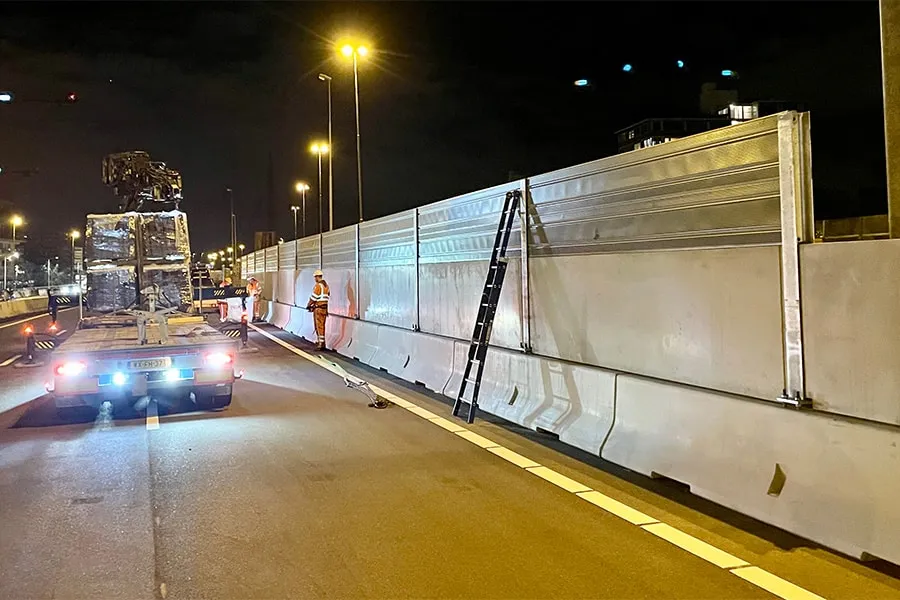
The first few hundred metres of DELTABLOC’s special vehicle restraint systems have now been installed as part of the widening and sunken construction of the A9 Badhoevedorp-Holendrecht. Managing Director Kees Hanegraaf is keen to explain his company’s specialism.
DELTABLOC specialises in passive vehicle restraint systems. Hanegraaf: “In many cases, the standard barrier systems available in the Netherlands are sufficient. However, road construction and reconstruction can present situations that cannot be addressed with standard solutions. That is where DELTABLOC comes in.”
Rijkswaterstaat sets requirements for safe containment. These are expressed in performance classes. The required barrier performance depends on the traffic situation, the space available and the risks that can be expected in the event of a collision.

Noise barrier
Hanegraaf: “On the A9, we can safely say that 90% of the temporary vehicle restraint systems use standard solutions. But where there is too little room for these systems, smaller systems must be fitted, or systems that move less in a collision. That is the situation we are facing now. So far, we have deployed five different systems on the A9, making a significant contribution to the project’s road safety.”
The barrier with noise screen is particularly suitable where traffic noise needs to be reduced for nearby residential areas. This combined function was identified in Rijkswaterstaat’s requirements. DELTABLOC is installing these screens along a 1.6-kilometre stretch, of which 600 metres have now been completed.
All vehicle restraint systems have been tested in full-scale crash tests to demonstrate their performance, including the barrier with integrated noise screen. Hanegraaf: “The barrier has now proved in practice that it really works. A car has already hit it at high speed, and everything stayed firmly in place.
Temporary and permanent
DELTABLOC distinguishes between temporary and permanent systems. But as soon as a so-called temporary system is installed for more than a year, it is configured as if it were permanent. The client buys some of the barriers, while DELTABLOC has also set up a rental pool for VeenIX. “We point out that barriers already supplied may be reused in the permanent configuration. That fits perfectly with the principles of sustainability and cost savings.”
Where there is a significant risk of serious consequences behind a barrier at a particular location, DELTABLOC uses a more robust system in the higher H4b performance class. Such a system is designed to contain lorries too. “Think, for example, of a system on a bridge deck or right next to an embankment. These barriers can be anchored and, as a result, move very little, if at all, in a collision.”
The smaller, narrower systems are used mainly for temporary applications. DELTABLOC has a large rental pool of these systems. They are primarily intended to separate traffic flows where there is no room for a heavier barrier in the middle of the road.
Finally, Hanegraaf illustrates DELTABLOC’s commitment to the environment. “The large walls for the A9 are being produced at Strukton Prefab beton in Utrecht. They do not have to be transported over long distances, keeping the environmental impact (MKI value) of transport modest.”
Question about this story? Ask your question
Keep following this
Get an email when a new story is published. No account needed.
- SubjectRoad construction







