









1,500 tonnes of reinforcing steel for A27 project
Text Roel van Gils Images Holterman Wapeningsstaal
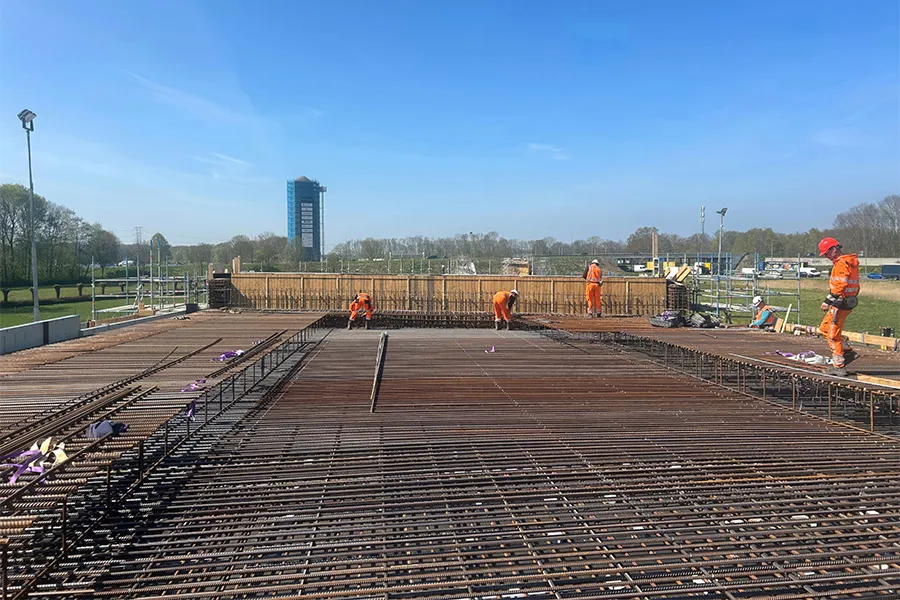
Strong focus on innovative prefabrication
The A27 is vital to traffic flow and regional accessibility, making it an essential link in the Dutch road network. For Holterman Wapeningsstaal, the A27 project is an exciting challenge and an opportunity to show how it makes a difference as a specialist in reinforcing steel.
As a long-standing partner to various infrastructure contractors, we were approached by the ALSÉÉN joint venture to apply our expertise to several structures along the route, says Patrick Hofland, site manager at Holterman Wapeningsstaal. “Our experience, reliable deliveries and innovative prefabricated solutions make us an ideal fit for the exacting requirements of this project.”
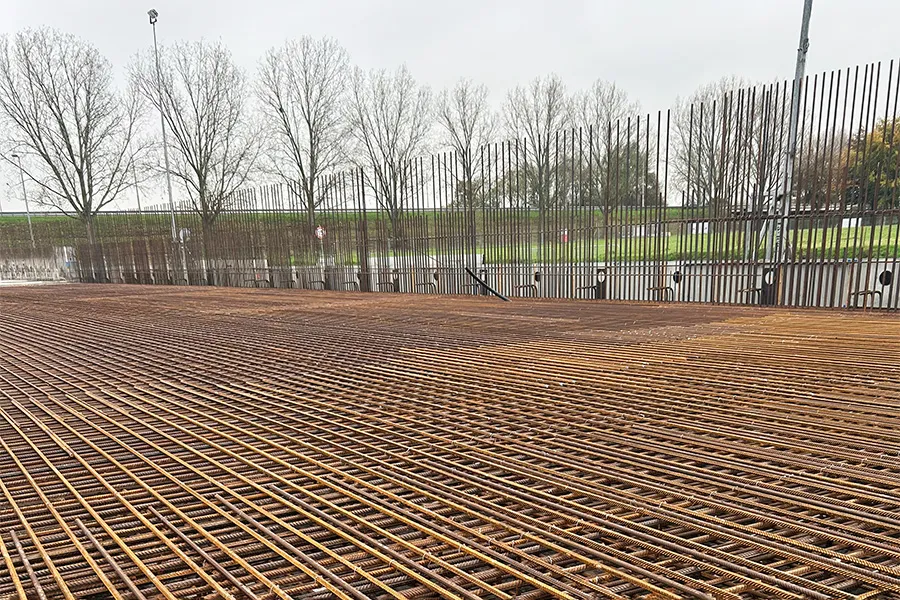
From engineering to logistics
Holterman’s contribution to this project goes far beyond simply supplying steel. “We are responsible for the entire process: from engineering and 3D modelling of the reinforcing steel to production, prefabrication and logistics coordination,” Hofland explains. “By handling all of this in-house, we can guarantee short lead times and take care of everything for the joint venture. This integrated process also allows us to contribute ideas early in the project. In consultation with structural engineers and contractors, we look for the most efficient solutions, considering not only strength and safety, but also sustainability, cost savings and ease of construction.”
Involved in several structures
Along the A27 route, Holterman Wapeningsstaal is supplying reinforcing steel for several structures, including viaducts, underpasses and a bridge. The quantities are substantial, spread across different structures and phases:
- Hooipolder underpass: approximately 850 tonnes
- Hooipolder viaduct: approximately 160 tonnes
- Oosterhoutsweg viaduct: approximately 310 tonnes
- Julianaweg viaduct: approximately 50 tonnes
- Bridge over the Dongen: approximately 100 tonnes
- Kerklaan viaduct: approximately 35 tonnes
“We are supplying around 1,500 tonnes of steel in total,” Holfland says. “Our capacity and modern machinery enable us to process and deliver these large volumes quickly, accurately and just in time.”
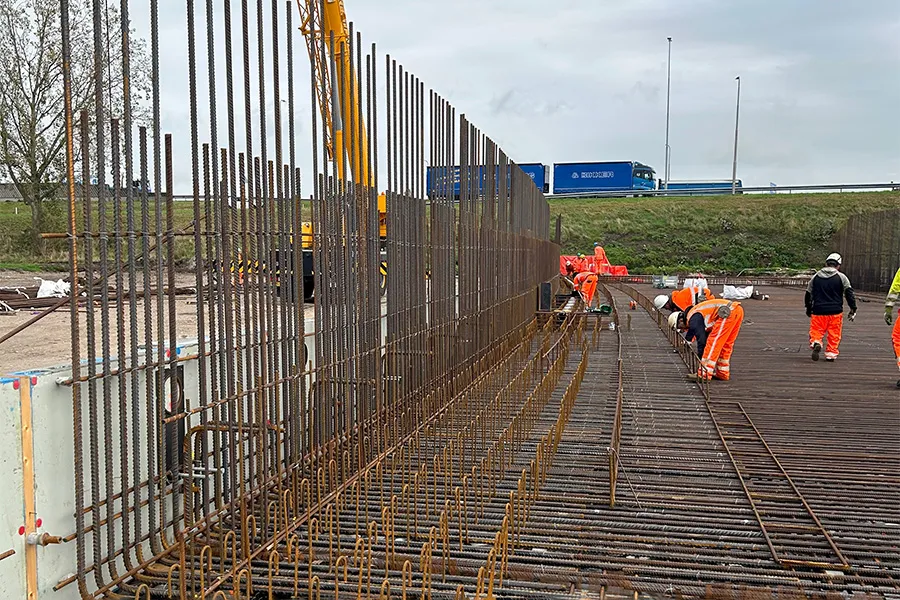
Optimisation
During the preliminary phase, we work with the structural engineer and the joint venture to identify opportunities for optimisation, Hofland says. “This often leads to more efficient detailing, saving material without compromising on quality or safety. Prefabrication is a key part of our approach. Components that can be prepared at our factories in Markelo and Hooge Zwaluwe only need to be assembled on site. This has several benefits: it speeds up construction, improves quality because work is carried out in controlled conditions, and contributes to safety on site. ′
For contractors, this means they can focus entirely on construction while we ensure that the components are available at the right time, in the right form and in the right place.”
Hooipolder underpass
Although every structure has its own complexities, the Hooipolder underpass clearly stood out, according to Hofland. “At around 850 tonnes of reinforcing steel, it was by far the largest part of our contract. Its size, shape and schedule made it the most challenging element of the project,” he says. “However, thanks to our scale, experience and innovative approach, we successfully rose to the challenge. Our automated production processes and flexible scheduling enabled us to meet the agreed delivery deadlines without compromising on quality or safety.
VPH hook
Holterman stands out in the market through its extensive use of automation, robotics and innovative solutions. “This enables us to work faster, more safely and more sustainably than with traditional methods.” One example of this innovation is the VPH hook. “With this solution, sharp ends on reinforcing steel are a thing of the past. This significantly improves safety on site by greatly reducing the risk of injury. This is typical of our approach: we prioritise every innovation that contributes to safety, efficiency and sustainability.”
Secondary raw materials
According to Hofland, Holterman Wapeningstaal’s strength lies not only in its scale and innovation. “We are committed to society and have a distinctive vision of sustainability. This is possible because we control the entire supply chain, from procurement to delivery. For example, as much of our steel as possible comes from secondary raw materials, scrap rather than iron ore, and our production sites run largely on solar energy. With this approach, we are not only supplying steel for tomorrow’s infrastructure, but also helping to make the construction sector more sustainable and reduce CO2 emissions.”
For Holterman, the upgrade of the A27 is more than just a technical project. “We also see it as a responsibility to society,” says Hofland. “Improving accessibility and quality of life in the Netherlands affects us all. We are proud to contribute to this national project with our expertise, materials and innovative solutions. By supplying 1,500 tonnes of reinforcing steel for several structures, we are showing that we have the capacity and expertise to make large-scale, complex projects a success.”
Question about this story? Ask your question
Keep following this
Get an email when a new story is published. No account needed.
- ThemeMaterials and techniques for infrastructure
- SubjectRoad construction







