









Keeping the site dry at Aanpak Ring Zuid
Text Roel van GilsImage Henk van Tongeren Water & Techniek
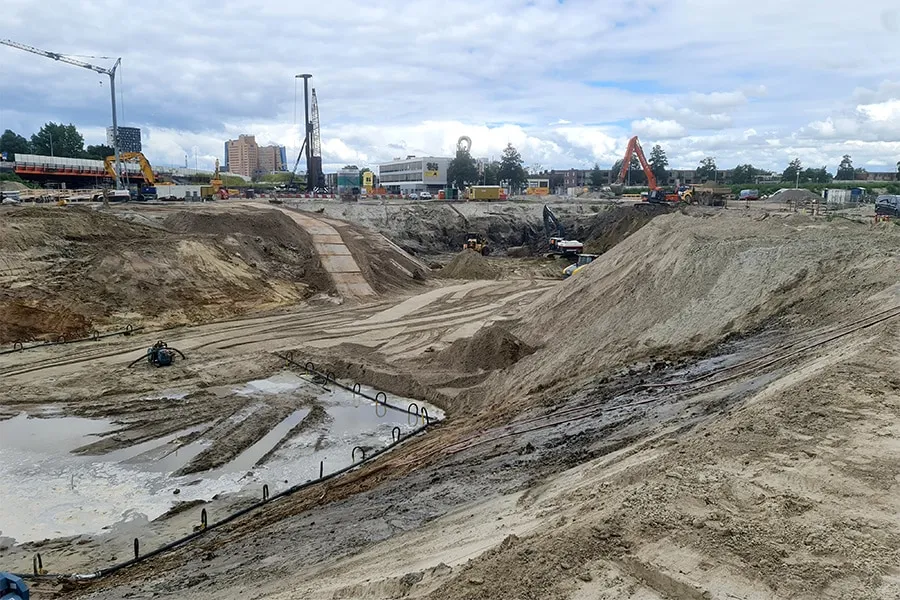
Aanpak Ring Zuid covers a 12-kilometre-long area and involves the extensive reconstruction of Groningen’s southern ring road. The large-scale project has been divided into five sections, each with its own specific challenges. Using a range of dewatering techniques, Henk van Tongeren Water & Techniek is keeping combination Herepoort’s feet dry as it delivers this landmark project.
The southern ring road runs right through the city of Groningen, roughly from Hoogkerk to Westerbroek. The road is important for traffic travelling to and from the city, as well as for traffic passing through Groningen. As the city continues to grow rapidly, its main gateway is at risk of becoming congested. Aanpak Ring Zuid aims to improve the city’s accessibility, traffic flow, liveability and safety. Some of the work is taking place below the groundwater level, and combination Herepoort is making good use of the expertise of Henk van Tongeren Water & Techniek.
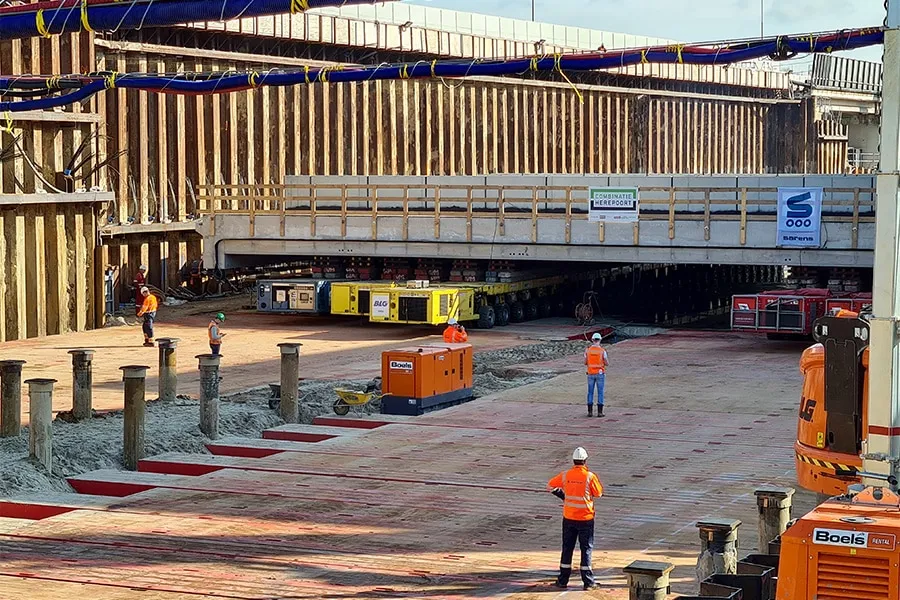
81 deep wells
“We are involved in the construction of three major structures: the reconstruction of Vrijheidsplein and Julianaplein, and the sunken section,” begins Jens Dikken, project manager at Henk van Tongeren Water & Techniek. “To start with the latter, the initial plan was to use wellpoint dewatering. In practice, the ground conditions turned out to be slightly different. Then the entire construction sequence was changed, and the tunnel was to be built in a different order, so we switched to deep well dewatering. In hindsight, it was the only right choice, as it resulted in clean, dry pits. At the peak, 81 deep wells were pumping 140 m3 per hour. The groundwater was discharged into the Winschoterdiep via a main discharge pipeline. Dewatering began in October 2020 and ended in early July this year. The tunnel deck was also moved into place during this period. This was a tense moment, because the main discharge pipeline had to be reconfigured without interrupting the dewatering process. We resolved this by setting up a 120 m3 buffer on site and emptying it using tankers. The operation took 14 hours and went exactly to plan.”
Recharge dewatering
At Julianaplein, Henk van Tongeren Water & Techniek kept 34 deep well pumps running continuously from May 2022 to mid-June 2023. “The deep wells were arranged in a ring around the tunnel pit to lower the groundwater level. Outside this was a ring of 35 recharge wells. Of the 70 m3 pumped, around 25 m3 was returned to the ground, while the rest was discharged into the Noord-Willemskanaal,” Jens explains. A total of 2.5 kilometres of discharge pipelines were installed to carry the pumped groundwater to the recharge wells or the discharge point. Finally, at Vrijheidsplein, Henk van Tongeren Water & Techniek opted for a dewatering technique using 10-metre deep wellpoints and drainage. “It is a different and more cost-effective technique, made possible in part by the shallow pit and the existing sheet-pile wall. Unlike at Julianaplein, where the dewatering system was installed in stages, we were able to set up the system for the Vrijheidsplein construction pit all at once. It ran for about a year, from February 2022 to February 2023, at a capacity of around 50 m3 per hour. To prevent settlement of a sewer that had already been installed in an earlier phase, we also set up a section of recharge dewatering here.”
Henk van Tongeren Water & Techniek has therefore largely completed its work on Aanpak Ring Zuid. The project is scheduled for completion in 2024. “It will really benefit the city and the province, partly because so much attention is being given to improving liveability,” says Jens. “It is unique by Dutch standards that you will soon be able to drive into the city through a park. It is great that we at Henk van Tongeren Water & Techniek have also been able to contribute.”
Een zakelijke vraag aan Henk van Tongeren Water & Techniek? Get in touch
Who worked on Aanpak Ring Zuid
- clientalliantie van Rijkswaterstaat, de gemeente en de provincie GroningenMentioned in Exceptional safety culture at Aanpak Ring Zuid
- contractorKnol AkkrumMentioned in Tailor-made foundation solution with a special 452-pile pile mattress
- construction consortiumHerepoortMentioned in 11,000 m3 of underwater concrete for Groningen ring road

Keep following this
Get an email when a new story is published. No account needed.
- ProjectAanpak Ring Zuid
- SubjectNews
- CompanyHenk van Tongeren Water & Techniek







