Breakwaters made from sustainable concrete mixes at Zuidpier IJmuiden
Text Roel van Gils Image Rijkswaterstaat
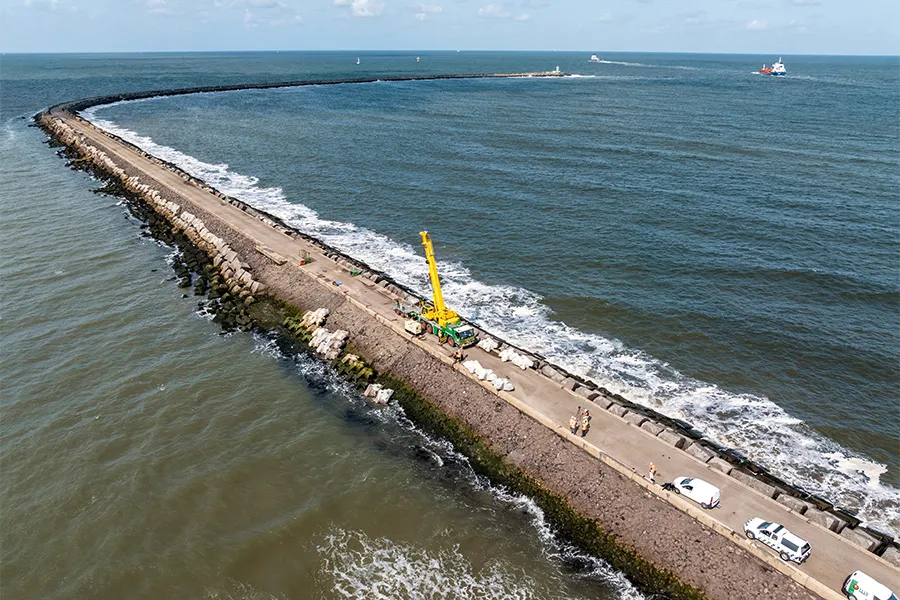
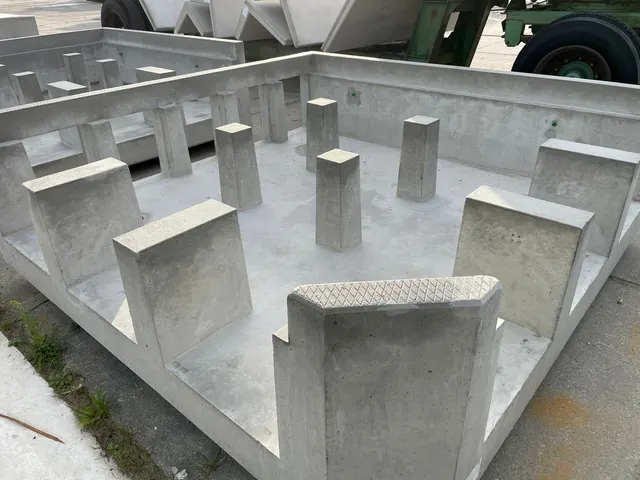
Concrete is one of the most widely used building materials in the world, but its environmental impact is substantial. Rijkswaterstaat is taking responsibility and making so-called ‘test sites’ available to accelerate the transition to more sustainable construction. In early August 2025, a milestone was reached in making the concrete sector more sustainable: concrete breakwater units made with more sustainable mixes were installed at Zuidpier in IJmuiden.
The test site at Zuidpier is linked to the large-scale reinforcement and renewal of the Afsluitdijk. “On the Afsluitdijk project, we took an initial step towards greater sustainability by producing a small proportion of the Levvel blocks (breakwater units, ed.) from more sustainable concrete mixes,” says Penny Pipilikaki, senior technical adviser at Rijkswaterstaat. “The requirements for these blocks were stringent because they play an important role in protecting the land from flooding. The innovative units therefore also had to reach Technology Readiness Level (TRL) 6. They were also required to perform as well as those made with conventional mixes.”
Twelve innovative mixes
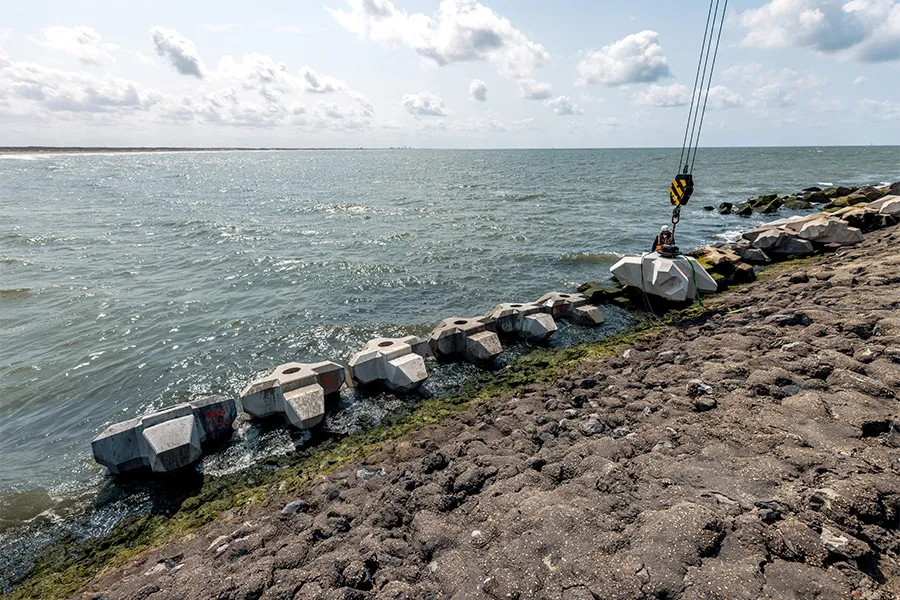
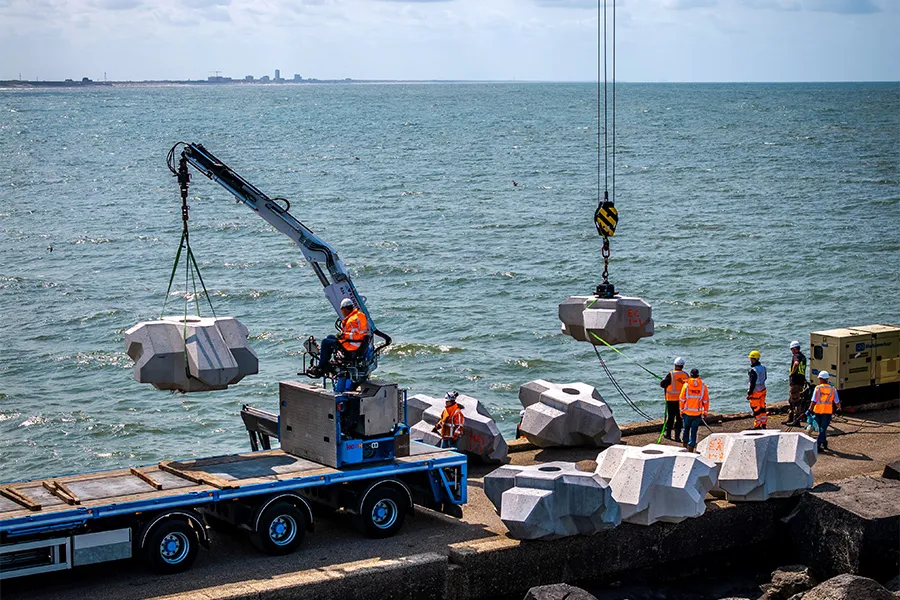
Setting such stringent requirements places limits on the development of new concrete mixes for applications of this kind, Pipilikaki points out. “That is why, in 2021, we decided to set up a second test site to evaluate different concrete variants in a realistic but less risky setting. This is how the test site at Zuidpier in IJmuiden came about. It is used to test mixes that may not meet the Afsluitdijk’s strict requirements but are exposed to the same conditions. The blocks in IJmuiden do not serve as flood defences; they are there purely for testing.” The breakwaters made with innovative concrete mixes were installed in two phases. Blocks made partly from surplus materials from the Afsluitdijk were installed in the summer of 2023, while last August saw the installation of Levvel blocks made with nine innovative mixes.
Environmental cost and service life
The concrete mixes differ in their use of alternative binders, cement types and/or aggregates. “Conventional concrete mixes have a relatively high Environmental Cost Indicator (MKI). The aim is to reduce the MKI of the mixes, for example by using alternatives to conventional cement,” says Pipilikaki. “The MKI of conventional concrete is above €20 per m3, while at this test site the MKI of the twelve mixes ranges from €6 to €17 per m3. Service life is also important. The aim is to optimise the ratio between the concrete’s service life and its MKI value, because the blocks also need to be durable enough to perform their intended function for a long time. Finally, we also want the sector to remain ‘clean’. No harmful materials may be used.”
Monitoring and testing
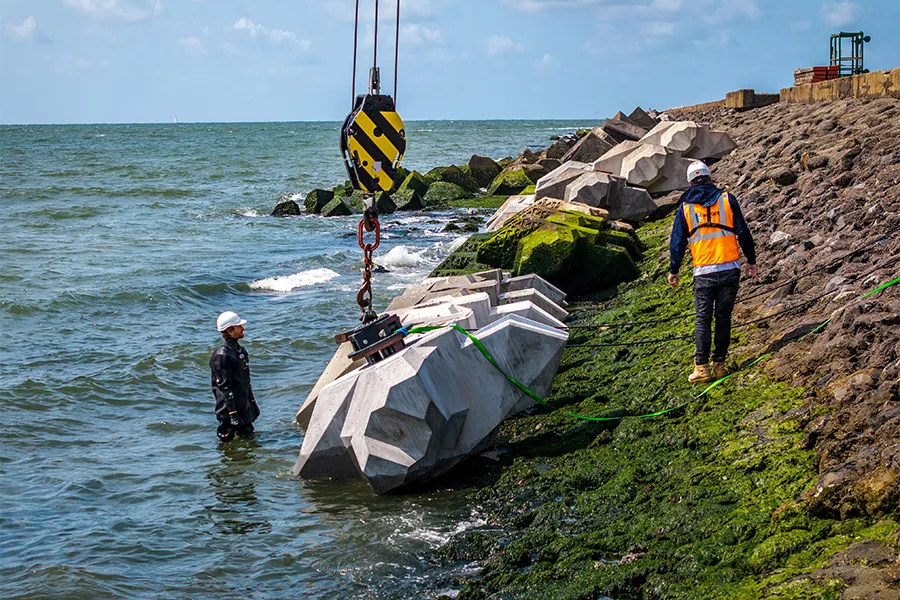
All the blocks were cast in the same way at the same batching plant. “This test site has two aims,” says Pipilikaki. “First, we want to encourage innovation at Rijkswaterstaat, and second, we want to monitor how the mixes behave under identical conditions. We do this by monitoring and testing them in the same way. A visual inspection is carried out every year, and every few years extensive laboratory tests are performed and cores are drilled to measure strength, carbonation and chloride ingress. Analyses are also carried out to determine whether the concrete’s microstructure remains intact under harsh environmental conditions such as salt water and erosion.”
The test site in IJmuiden offers a unique opportunity to test innovative concrete mixes in a realistic environment. “Here we test them under extreme conditions: salty seawater, strong winds and waves. It is ideal for seeing whether the new mixes remain strong and durable over the long term. In ten years, we need to know: can this concrete withstand the sea, and can we then use it safely in projects?”
Question about this story? Ask your question
Keep following this
Get an email when a new story is published. No account needed.
- ThemeLower emissions and more reuse
- SubjectConcrete