









Haarlemmermeer peak storage basin
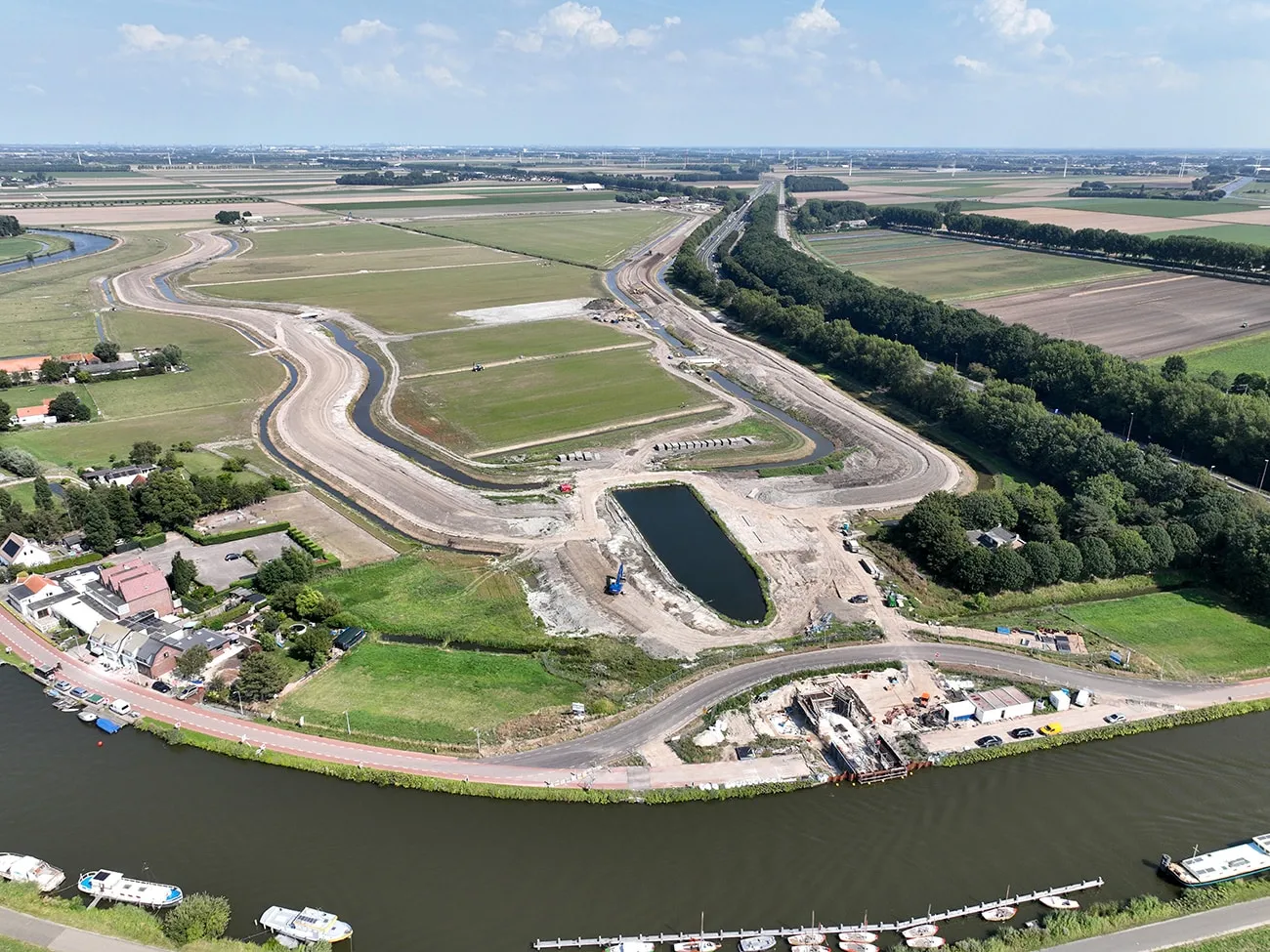
The central part of the Rijnland region is at risk of flooding. To relieve the four Rijnland pumping stations during extreme and prolonged rainfall, a peak storage basin is being built at the very lowest point of the Haarlemmermeerpolder to temporarily store 1 million cubic metres of water. Combination KWS, Van Hattum en Blankevoort is carrying out the work on behalf of Hoogheemraadschap van Rijnland. At first glance, it may seem like a relatively straightforward project, but it has a surprising range of functions.
A technical and hydraulic feat
The purpose of Piekberging Haarlemmermeer is to store excess water from the Ringvaart, on average once every fifteen years, to prevent waterways from overflowing or, worse, embankments from failing because of high water levels. The plan is to hold the water for up to ten days, after which the basin will be drained in a controlled manner and the water pumped away by the pumping stations. “Hoogheemraadschap van Rijnland prepared the project with exceptional care,” says Frank Boere, the combination’s design lead. “Various engineering firms spent more than ten years developing the plan to find the ideal system concept and suitable location.” This is largely due to its location in the Haarlemmermeer, adds René Jongejans, project manager for the combination. “It is a very vulnerable polder, given its depth and groundwater issues.”
Low embankment, large area
The system concept and location had therefore already been decided, Boere continues. “However, it was still a high-level plan that needed to be worked up in detail. Since the peak storage basin is expected to be used only once every fifteen years, the aim is to minimise its impact on everyday use. That is why a relatively low embankment, 2 metres high, was chosen, along with a large area of land (67 hectares). Apart from a few minor ‘obstacles’, there are no restrictions on using the fields within the peak storage basin for arable farming and livestock.” The location of the basin was carefully selected. The average ground level is 4 metres below NAP, while the Ringvaart water level is 0.5 metres below NAP. “This means that water can flow into the peak storage basin relatively easily by gravity through an inlet structure. The polder level, meaning the level of the ditches, is 6 metres below NAP, so water can also flow very easily from the peak storage basin through outlet channels into the polder ditches, from where the pumping stations pump it away,” Boere explains.
Critical ground conditions
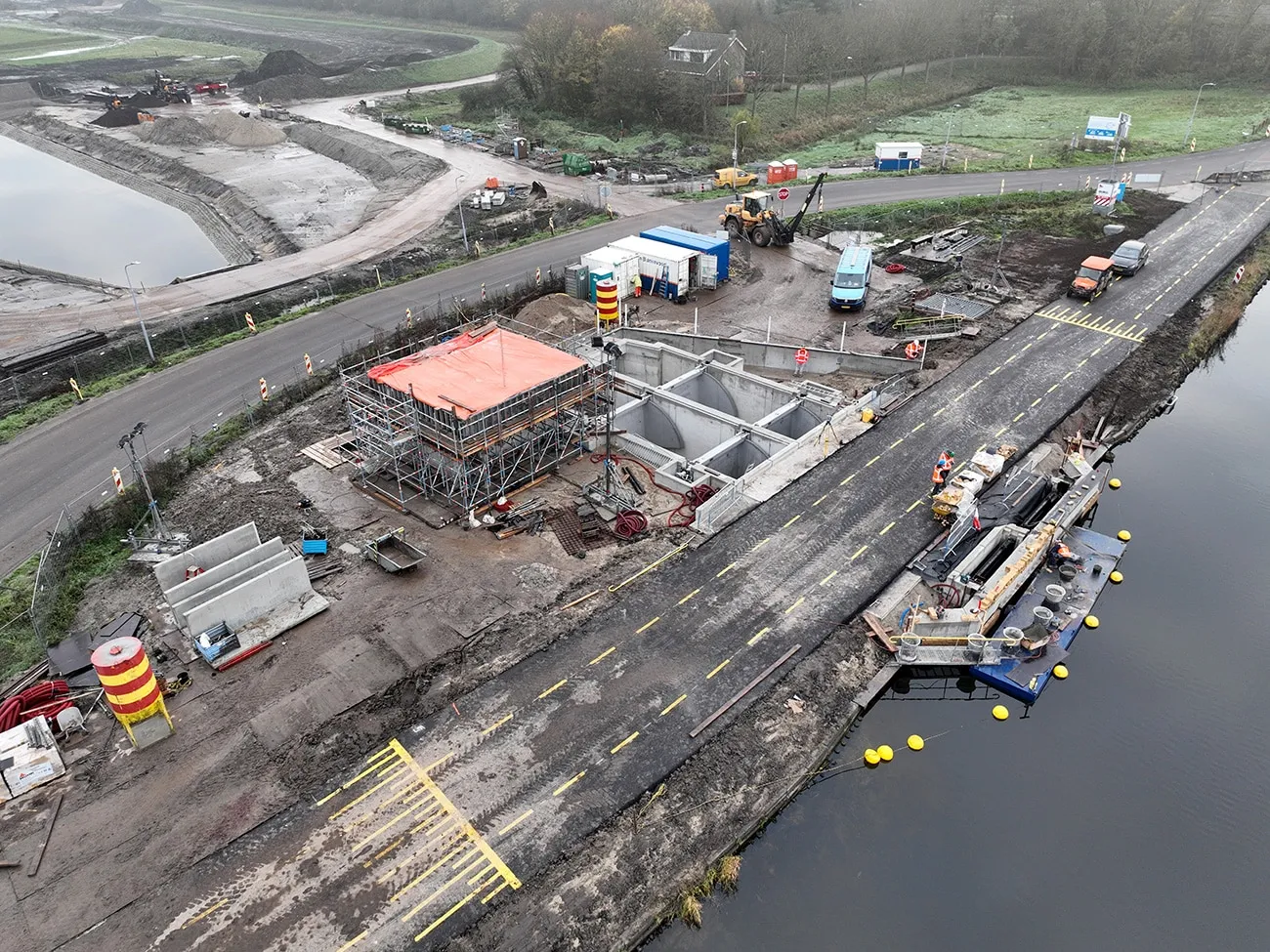
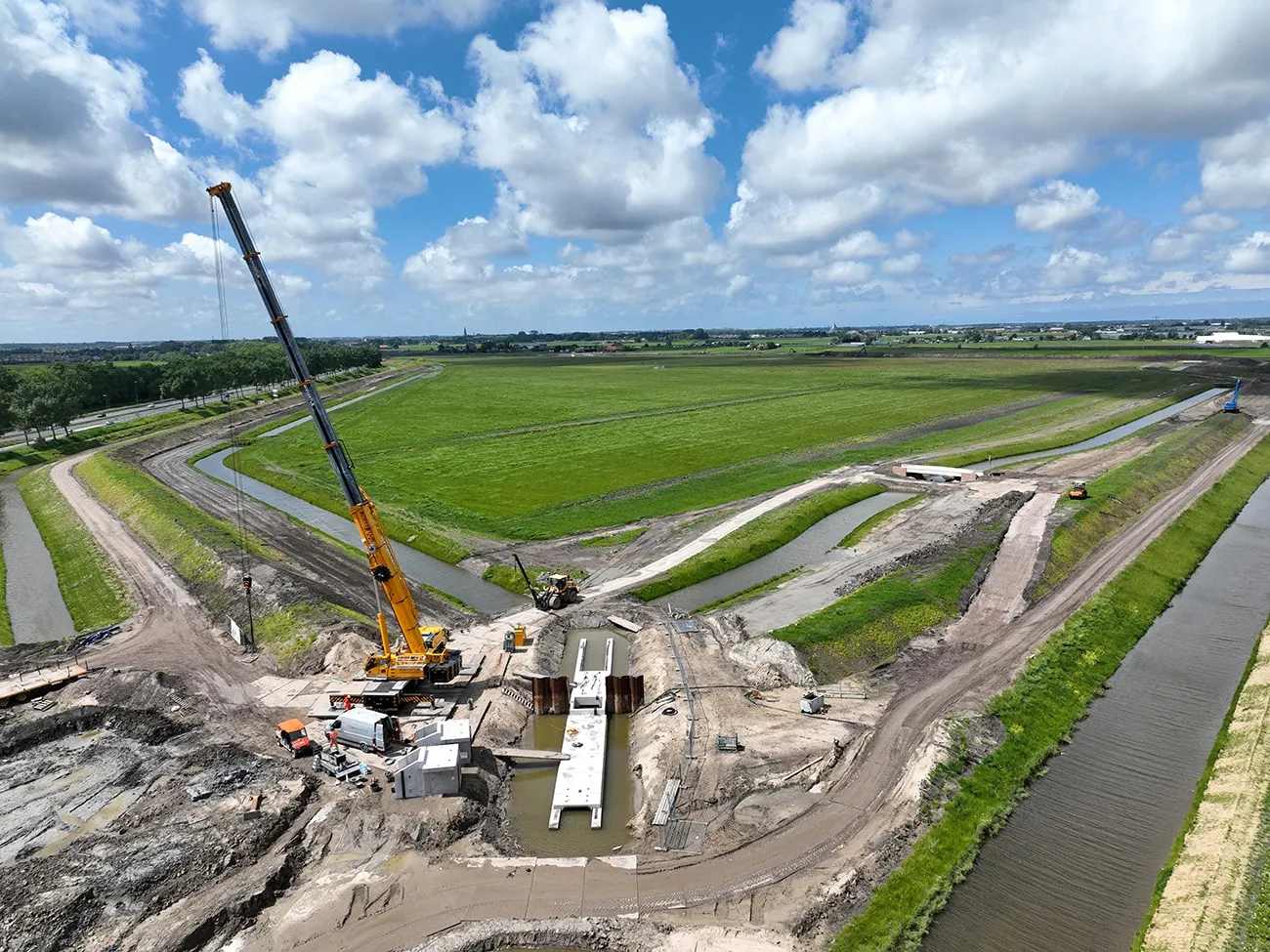
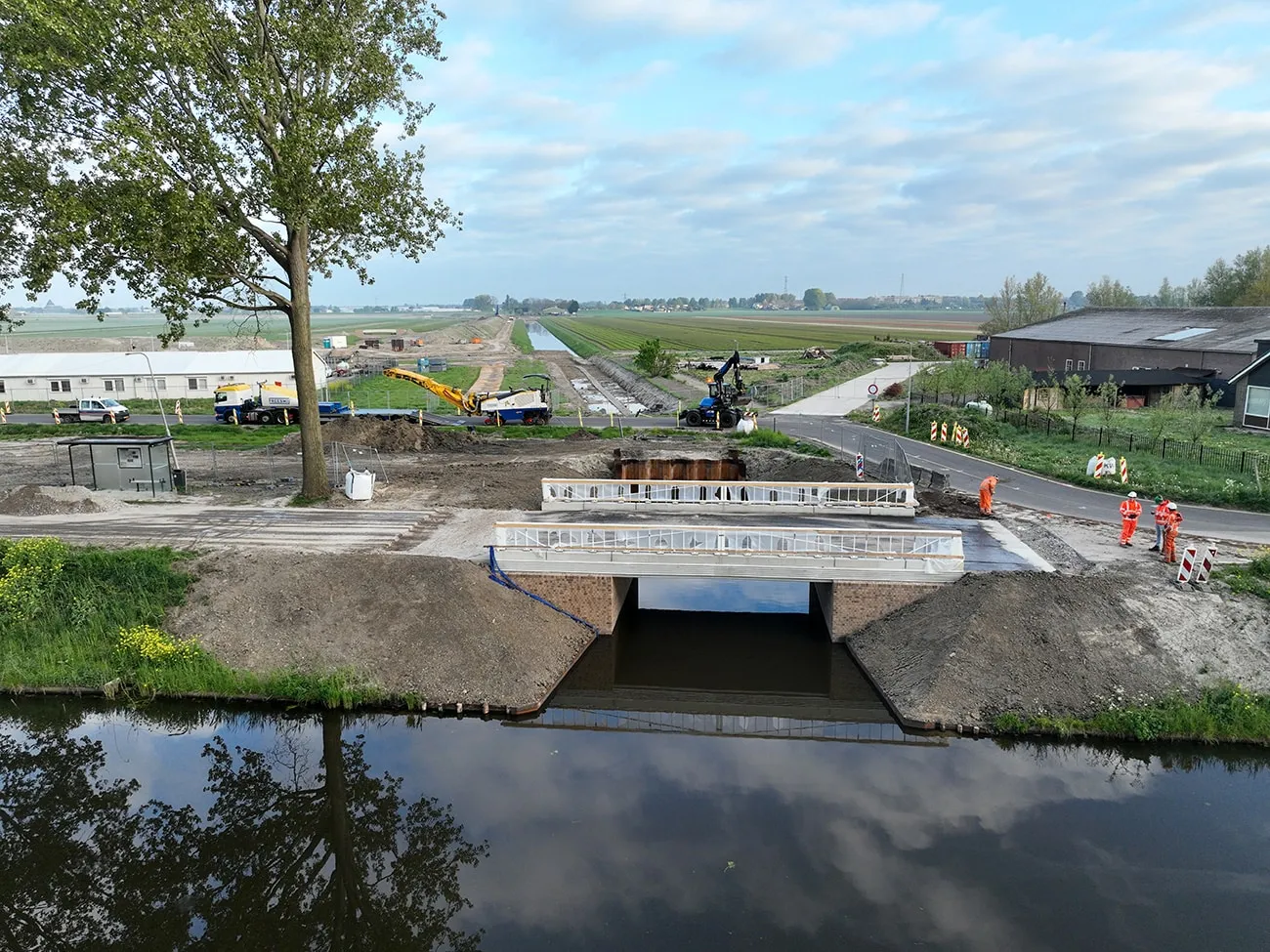
The work on the peak storage basin includes constructing a 3.8-kilometre embankment that winds across the site, with an inspection and maintenance track on either side. The combination is also constructing around 7 kilometres of waterways, several inlet, outlet and transfer structures, one road bridge and five small agricultural bridges. The design takes full account of the complex ground conditions and the constraints they impose. “Although the Haarlemmermeer has been reclaimed, water-bearing layers deep underground are still connected to the sea,” Boere explains. “If too much soil is removed, salt water can leak upwards, with all the consequences that entails.” Jongejans adds: “That is also why we have barely excavated below ground level, except for the inlet structure and stilling basin. These were excavated underwater and fitted with an underwater concrete structure. This structure has two functions: it counteracts the pressure from below and prevents scour caused by the incoming water.”
Carefully engineered inlet structure
The inlet structure and stilling basin are a technical and hydraulic feat. “The stilling basin dissipates the force of the water flowing through the inlet structure at 15 m3 per second via the tilting weirs, so that the peak storage basin fills at a controlled rate,” Boere explains. “Normally, an inlet structure of this kind is either fully open or fully enclosed. Here, we have chosen a combination of the two. Grilles above the tilting weirs allow the process to be monitored, while the inlet culvert itself is enclosed and buried underground to meet the landscape integration requirement. A great deal of attention went into designing the culvert to eliminate the risk of a vacuum forming. For example, a ‘corner’ has been incorporated behind the weirs to trap enough air. If that does not work as intended, the culvert can also be aerated. This is a back-up measure that we do not expect to need. A sill has also been built at the end of the culvert to create a wave and slow the water before it reaches the stilling basin.”
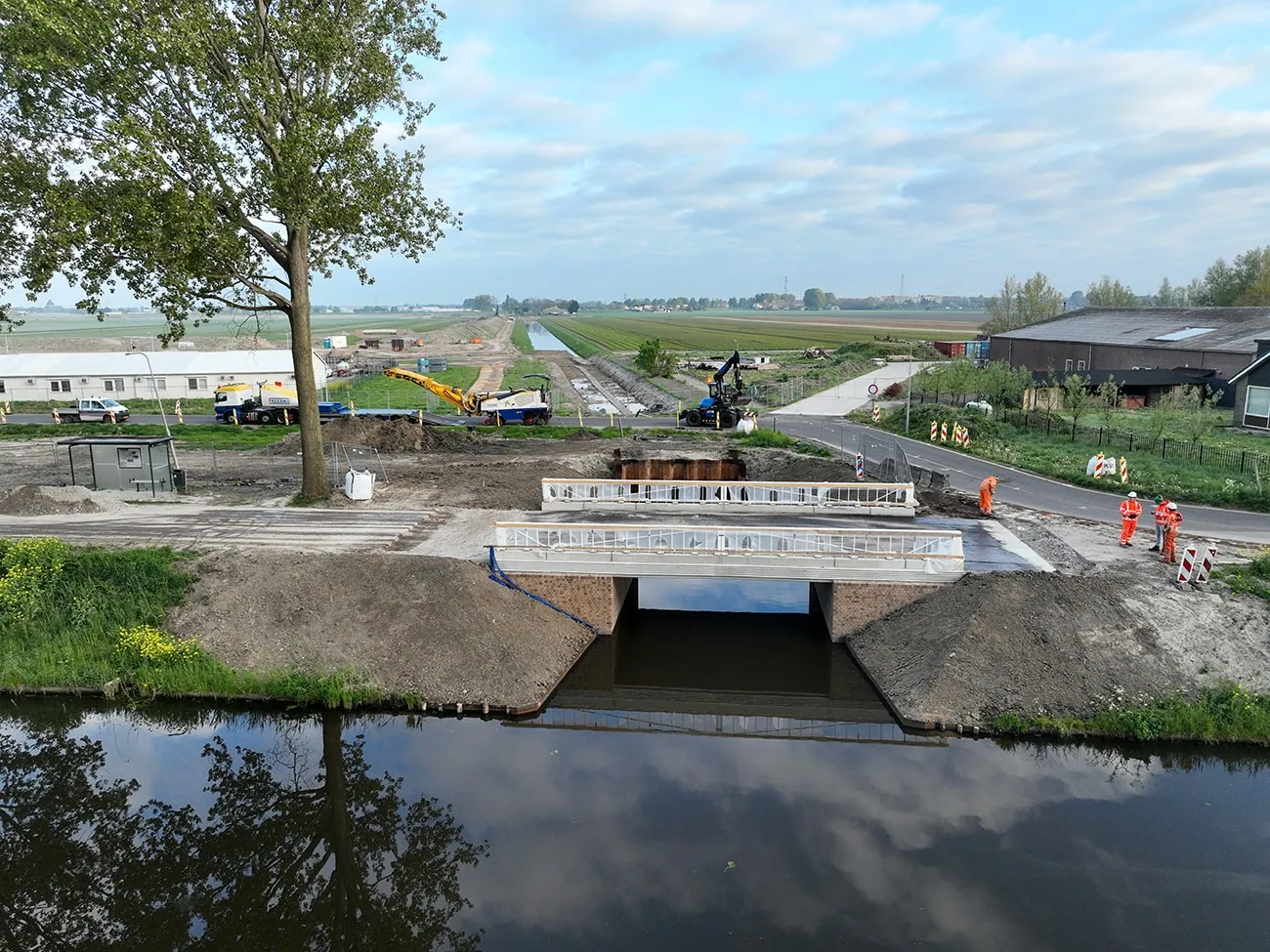
According to Jongejans, the key to designing and building the peak storage basin lies in organising, managing and controlling the process, with the right people in the right places. “That is the essence of a complex project like this. The complexity is all about the risk of heave. The entire project has therefore been modelled in 3D, and the 3D model is used to guide the machines. If we unexpectedly encounter soft ground during construction, we go back to the drawing board to manage the heave risks properly.” The project is now technically almost complete. “We will have no problem meeting the 1 May 2023 handover date. The grasses will then be given time to grow and establish their roots, and in December 2023 we will test and fill the peak storage basin. That will show whether the hydraulic concept works as intended and the basin functions according to plan. We have every confidence that it will. We are already looking forward to it,” Jongejans concludes.
Have a business enquiry for KWS? Get in touch
Who worked on Piekberging Haarlemmermeer
- tilting weirsKwaliteit Waterbeheersing Techniek (KWT)Mentioned in Tilting weirs: the heart valves of the peak storage basin
- clientHoogheemraadschap van RijnlandMentioned in Tilting weirs: the heart valves of the peak storage basin
Keep following this
Get an email when a new story is published. No account needed.
- ProjectPiekberging Haarlemmermeer
- SubjectBridge construction
- CompanyKWS







