









VR/AR and BIM are making our industry future-proof!
Economic growth is continuing and the need to innovate is greater than ever. Growing pressure on infrastructure and rising demand for smarter, cheaper solutions are the challenges of the future. Meeting them requires new skills. So the question is: are you just following the hype, or are you truly future-proof?
Jeffrey van Tol, BIM coordinator at TBI company Mobilis, has a clear answer: “Change in the construction sector is accelerating. 3D modelling, parametric design, cloud-based software solutions, drones, 3D printing, VR/AR and mobile mapping: it is all happening.” Civil engineering contractor Mobilis focuses on innovation both within the organisation and on projects in infrastructure, water management and industry.
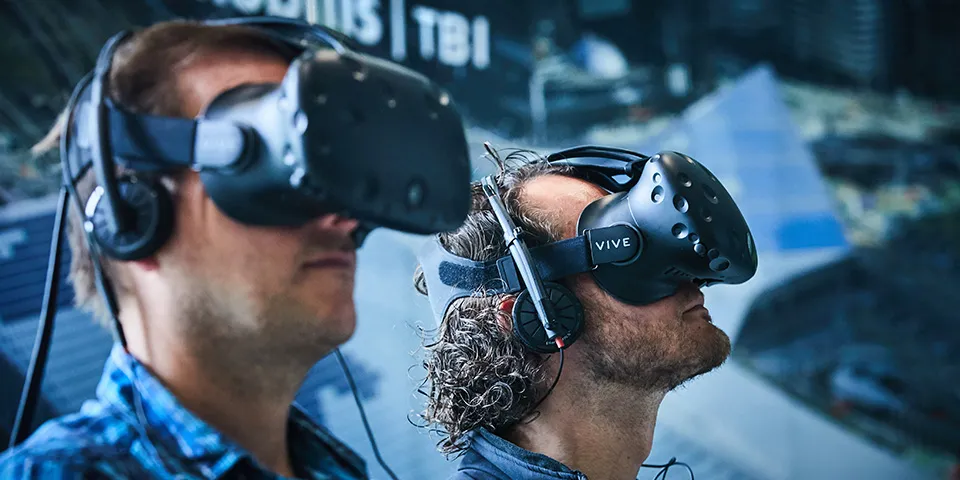
Using VR also creates a more immersive experience for the client. (Image: Vincent Basler)
Saving time and money
“By using these modern techniques in the right way, we help the construction sector save considerable amounts of time and money. We create a virtual representation of the existing environment, the end result and the stages in between. This gives clients and the communities around construction projects insight into, and a sense of, what is happening. The measurements we take provide the basis for design, visualisations, planning, volume calculations and more. Virtual construction enables faster decision-making and can lead to better decisions. Problems are also identified more quickly, allowing us to anticipate them. And using VR also creates a more immersive experience for the client. In the same way, AR instructions help construction workers stay on track and maintain the quality of their work. The data collected can be used in a shared data environment: BIM (Building Information Modelling). The insights gained make the work more efficient and improve the end product,” says Jeffrey.
BIM: a key role in complex projects
“BIM is playing an increasingly essential role in specific projects. The BIM process is not the same for every project. It can be tailored to what is needed or what the client requires,” Jeffrey continues. “We create our own BIM environment, where information about the different project disciplines is stored, shared, used and managed throughout the construction process. This gives us valuable insight, enabling us to provide advice at an early stage and inform certain decisions. The different disciplines within an integrated construction project are much easier to manage because we know when coordination between them is needed. Clients and stakeholders review the BIM model for validation: are they getting what they expect?”
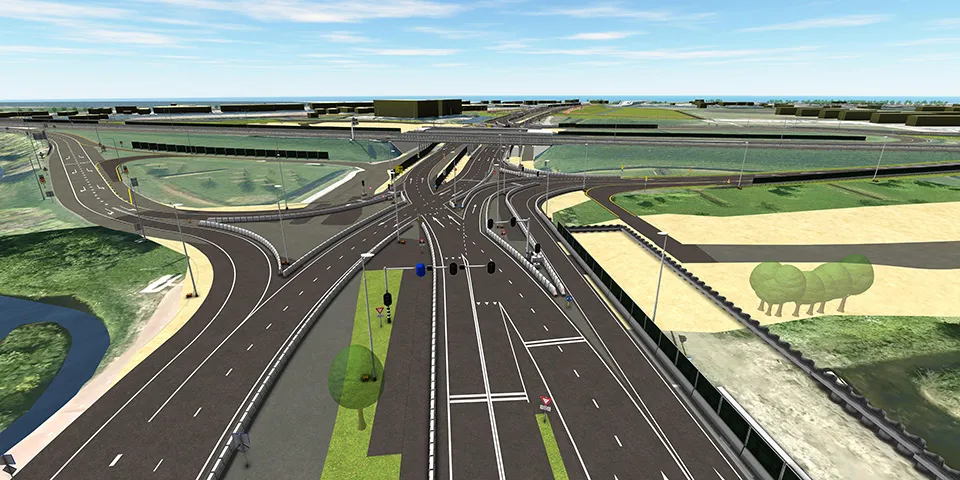
The Rijnlandroute coordination model was used for review, visualisation of interfaces and validation with the client and stakeholders.
Digital Twin
“Mobilis goes a step further still,” Jeffrey continues. “Together with Croonwolter&dros, we validate how certain systems work by linking the system architecture to the virtual model. This so-called Digital Twin is used to predict, test and potentially manage systems. We can simulate emergencies and use the insights gained to improve the design. This saves a great deal of time, helps create a better schedule, reduces costs and makes the testing and handover process run more smoothly.”
Rijnlandroute
“During the tender phase of this project, visualisations were created at various junctions along the route, allowing the client to look around in 360 degrees. The integrated coordination model was used extensively during the design phase and also served as the basis for the Digital Twin. The tunnel system’s operation was demonstrated in various scenarios. A virtual driving experience was also created to show the different road layouts during construction, allowing us to validate road users’ driving behaviour.” Jeffrey concludes: “You have to get phased, integrated construction right, and having a single central source of information is essential. Mobilis has proved to be very future-proof in this respect.”
Have a business enquiry for Mobilis? Get in touch
Companies in this story

Keep following this
Get an email when a new story is published. No account needed.
- ThemeDigitalisation from design to construction
- SubjectBouwMat
- CompanyMobilis
- CompanyCroonwolter&dros







