









The NLCS makes my work much more enjoyable
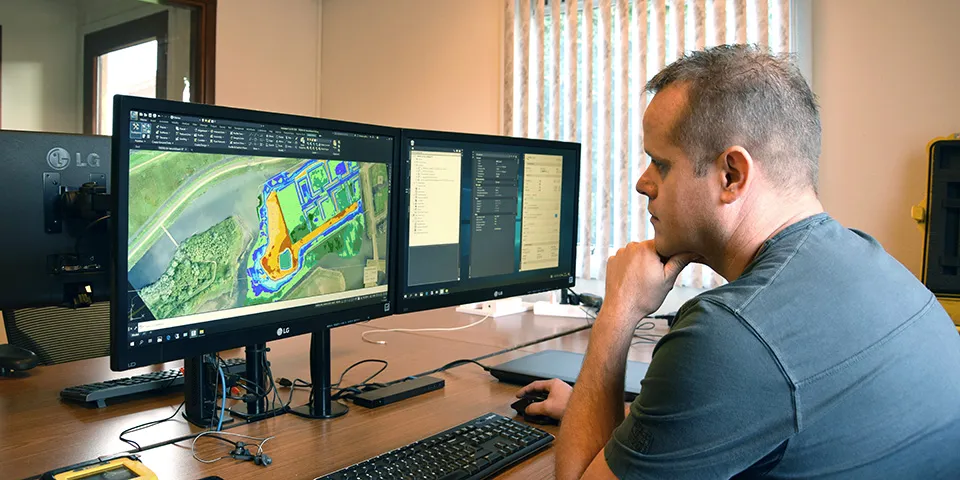
Eighty per cent. That is land surveyor and draughtsman Marien van Rodijnen’s estimate when asked how many professionals in the civil engineering sector now produce drawings in accordance with the NLCS. “Fortunately, that is now the vast majority. Because nothing is more frustrating than everyone speaking a different language.”
Four years ago, Van Rodijnen moved from a medium-sized engineering consultancy to Aannemingsbedrijf Verboon Maasland, a family business that has specialised in civil engineering for three generations. “There was one land surveyor on the team, and I joined to take over from him.” Van Rodijnen’s work is varied: he is often involved in projects from start to finish. “From the initial survey, calculating quantities and creating 3D machine models, right through to carrying out surveys and producing as-built drawings. I work in the office, but I’m also often on site to check and see whether the project is taking shape as we envisaged. It’s wonderful to see all your calculations and 3D modelling come to life in practice.”
Speaking the same language
Van Rodijnen works with drawings from third parties every day. These days, external parties deliver most of their designs in accordance with the NLCS. Yet it was only a few years ago that many parties were still using their own standards. “It was practically impossible to work with them,” he recalls. “Everyone used their own layout, layer structure, block names and so on. I remember one project where I had to interpret a drawing that was so complicated I spent two days studying it to untangle everything. It was unworkable! Thanks to the NLCS, we all speak the same language now.”
Fewer errors
“The biggest benefit of working in accordance with the NLCS is uniformity,” says Van Rodijnen. “Click on a layer and you can immediately see that it means ‘edge of asphalt’, not ‘edge of rubble base’, for example. So there’s no need to interpret it.” He adds that there are many more benefits. “Because drawings are so clear, you reduce the margin for error and save a lot of time and frustration. For example, you can tell at a glance whether something is existing, removed, new or as-built, thanks to the B, V, N and R labels. So you always know what you’re dealing with, however complex the drawing.”
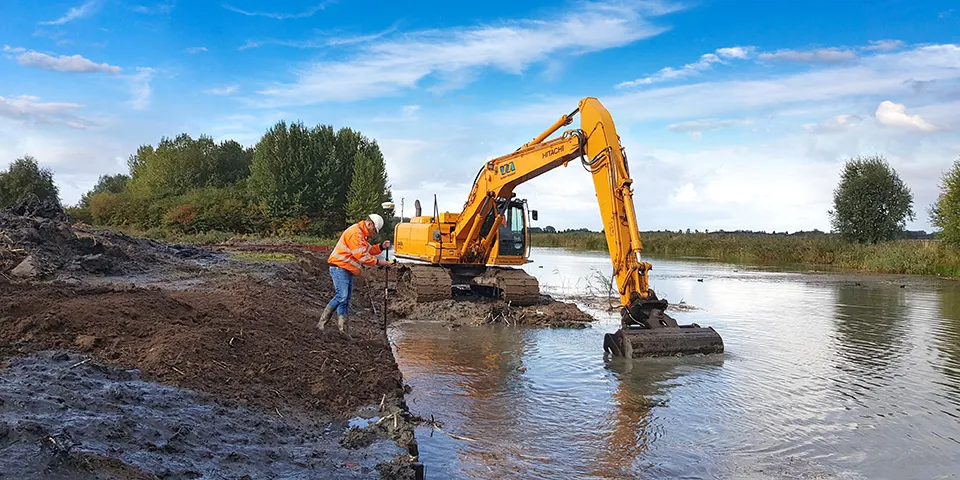
Verboon Maasland specialises in water-related works.
No room for misunderstanding
Although the NLCS has not yet been embraced by the entire sector, the land surveyor and draughtsman sees its adoption continuing to grow. “Public authorities require drawings to comply with the NLCS, and other parties are asking for it more and more often too. Interestingly, in my experience, it is often the larger consultancies that still insist on their own standards. I don’t think that’s right. It makes communication so much easier. Everyone communicates more easily when there’s no room for misunderstanding, don’t they?”
A well-organised tool
To work as effectively as possible in accordance with the NLCS, Van Rodijnen uses InfraCAD software. “A draughtsman colleague at another company recommended it to me. ‘This is going to make your work so much easier,’ he assured me. He was right. InfraCAD is a well-organised tool that lets you work in a highly structured way. Everything is predefined and largely set up already. InfraCAD also has plenty of useful tools, such as adding photos and adding items to the legend, which you can generate at the touch of a button. I know my way around InfraCAD pretty well, but I think I could get even more out of it. Creating my own library, for example, is still on my to-do list. That will save me even more time and make things easier.”
BIM Level 1 standard
The NLCS is what is known as a BIM Level 1 standard. At Verboon Maasland, they also link working with the NLCS to BIM modelling. “A few years ago, we ran a pilot project as part of a joint venture for the Municipality of Rotterdam: sewer renewal work on Schiedamsevest in central Rotterdam, an area with lots of pavement cafés. The municipality provided us with the 3D drawings, complete with all the relevant underlying information. We then agreed how we would carry out the work together. The pilot went well, but unfortunately we had to change our working methods during the project because spring was approaching and the pavement cafés had to reopen. We were able to deliver the as-built data in accordance with our agreements: a 3D drawing containing all the information and requirements. We then successfully exported this as-built drawing to a 2D drawing in the NLCS structure. We opted for 2D because the municipality works with 2D drawings, but we continued to build on what we had learned. BIM is a broad concept, after all, and people understand it at different levels.”
Consistency
On some projects, Van Rodijnen works with colleagues from the construction sector. That is when he notices the lack of a single, uniform language. “Think of building development or public spaces: projects that go beyond the traditional civil engineering sector. I regularly meet people in construction who have never heard of the NLCS. Yet I think the NLCS would be perfectly suitable for wider use. Why not? Everyone, whatever sector they work in, benefits from standards and consistency, don’t they? I can confidently say that the NLCS makes my work much more enjoyable. In the past, with all those different standards, drawings were often unclear and difficult to interpret; sometimes you couldn’t see the wood for the trees. Thanks to the NLCS, you can.”
Question about this story? Ask your question
Keep following this
Get an email when a new story is published. No account needed.
- ThemeDigitalisation from design to construction
- SubjectBouwMat







