Dredging using different energy sources
Text Roel van Gils Image Verboon Maasland
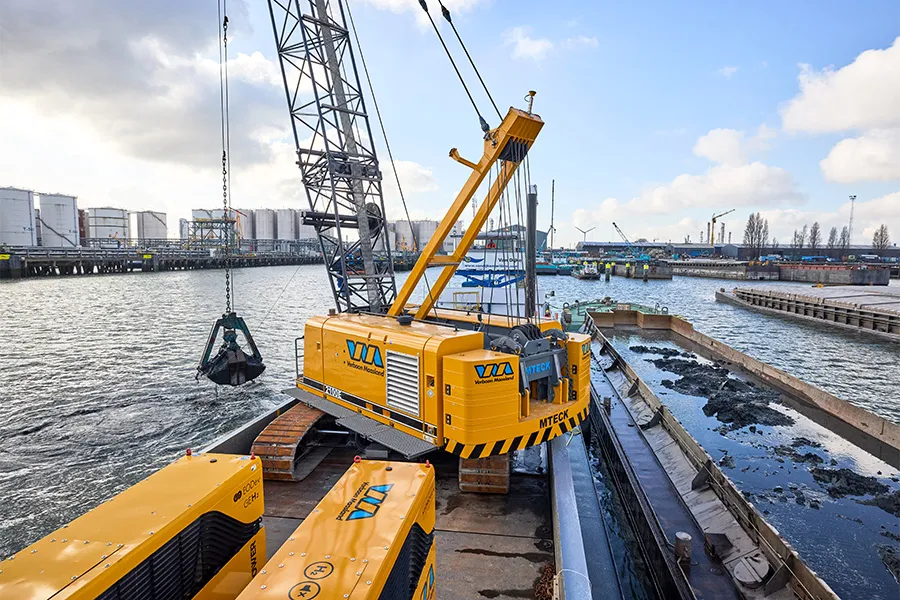
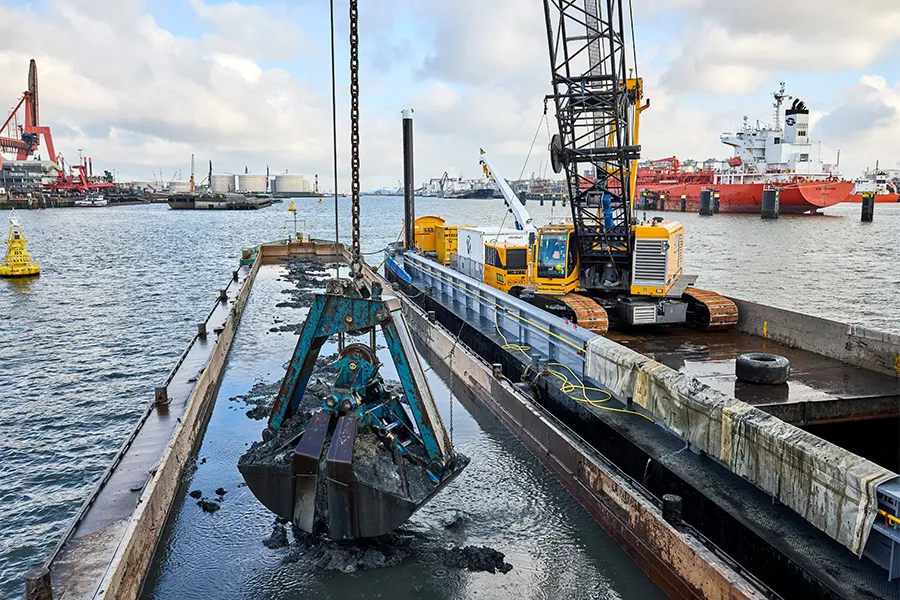
During a dredging pilot in Rotterdam’s Geulhaven, the Port of Rotterdam Authority, working with Verboon Maasland, compared the efficiency of three different energy sources in terms of CO2 and nitrogen emissions, productivity and costs. The main piece of equipment was a 100-tonne electric cable-operated crane, powered in turn by a battery pack, a hydrogen fuel cell and a diesel generator. Although work is still under way on an official report, Tom Maaskant, project manager at Verboon Maasland, is already sharing the key findings. And they are quite surprising.
The Port of Rotterdam Authority is responsible for maintaining the depth of berths and waterways in the Port of Rotterdam, and aims to do so as sustainably as possible. “For that to happen, the sector needs to gain experience,” says Maaskant. “After a fellow contractor had already carried out a pilot project on hydrogen-powered dredging in the Port of Rotterdam, we investigated the efficiency of three different energy sources for dredging and earthmoving work. The pilot findings will add to knowledge of sustainable dredging methods. Our electric cable-operated crane is ideal for this kind of pilot because it can be powered by different energy sources.”
Zero emissions
Verboon Maasland ordered the electric cable-operated crane in 2021. “Zero-emission working was still very much in its infancy at the time and was nowhere near as widespread as it is now. We therefore opted for an electric crane with its own generator. The idea was that we could drive the crane off the low-loader under its own power and operate it anywhere, at any time,” Maaskant explains. “At the same time, this concept gives us enough flexibility to use virtually any energy source in the future. The crane was delivered in 2023 and has run mainly on diesel ever since. With this pilot in the Port of Rotterdam, we are bringing the sustainable potential of our crane more into the spotlight.”
Reliable results
Verboon Maasland’s electric cable-operated crane was used for the pilot over a two-month period. “We tested all three energy sources during that time, measuring everything relevant,” says Maaskant. “We also kept all the environmental factors constant to ensure reliable results. In addition, we addressed the challenges of working with hydrogen beforehand. The laws and regulations make it a little more complicated, but together with our supplier Genpower, we worked out how to put it into practice. As well as producing the reports, we subsequently carried out Environmental Cost Indicator (MKI) calculations for the combination used, based on the actual figures.”
No hydraulics on board
And what were the pilot’s findings? Maaskant: “Based on average diesel consumption, we expected a certain level of consumption. The great thing about our cable-operated crane is that it has no hydraulics on board. Compared with a hydraulic crane using the same bucket, our cable-operated crane uses just 25 per cent as much power, regardless of the energy source. So, when it comes to sustainability and ‘the new way of working’, it is also important to consider which type of machine you use for each job. Looking at efficiency, the diesel generator scores 35 per cent, the fuel cell 39 per cent and the battery 71 per cent. We had expected a much higher figure from the battery, because there is no longer any need to convert the energy. In this case, a lot of energy was lost in the 24-volt system.”
More than 300 hours of operation
According to Maaskant, the battery performed worst, although he expects efficiency to improve with a different type of battery. “The efficiency of our hydrogen configuration could also be improved. We used two generators because of the peak power required, but we could also meet that demand with a small battery paired with a single generator. Our hydrogen configuration can run for more than 300 hours, whereas the largest battery on the market can run for a maximum of 87 hours. This makes hydrogen the most attractive alternative in terms of cost for off-grid, zero-emission applications.”
Towards the end of the pilot, Verboon Maasland held a market day for 125 fellow contractors. “The aim was to show what is possible and share what we have learned. You cannot make operations more sustainable on your own: the challenge is far too great. We need to help one another,” Maaskant concludes. Verboon Maasland is currently putting the finishing touches to a comprehensive report on the pilot, which will also be shared with the industry. The company is already looking for a client for its next pilot project, involving an electric cutter suction dredger.
Question about this story? Ask your question
Keep following this
Get an email when a new story is published. No account needed.
- ThemeFlood protection and climate-resilient water management
- SubjectSustainability & innovation