









“NLCS makes my work neater, clearer and more enjoyable” Wesley Kleinveld (DAGnl) on the Dutch CAD Standard
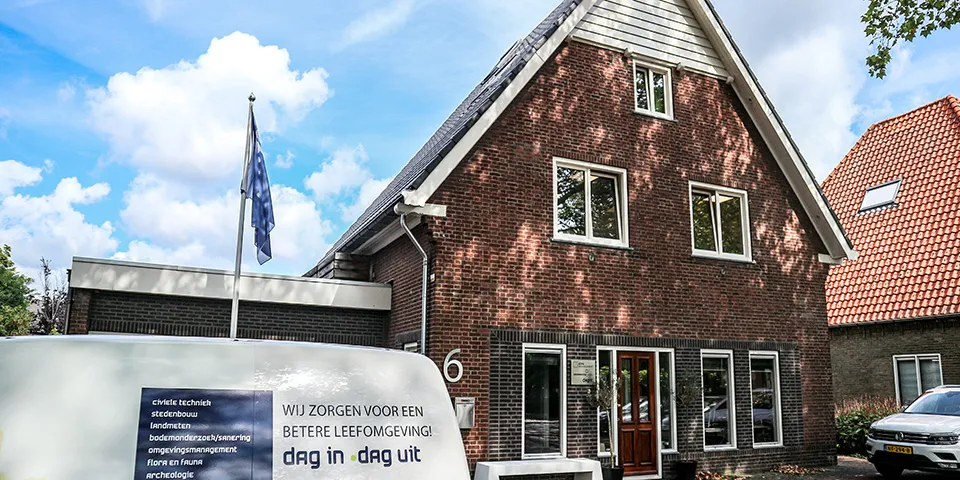
Wesley Kleinveld can no longer imagine a career without NLCS. The project leader at engineering consultancy Civil Management (Huissen) was one of the ‘early adopters’ of the Dutch CAD Standard. By far its biggest advantage is the interchangeability of drawings.
Kleinveld has been working at Civil Management since 2012. The integrated project management consultancy is, according to its own website, home to ‘professionals with a passion for their work and their field’. Civil Management is also one of the entities within DAGnl, a group of several consultancies, each with its own specialism in civil engineering (see box). The project leader explains: “DAGnl is a partnership between several market players. Thanks to our large network, we can take on projects of any size. Through our partners, we have all the expertise, skills and capacity we need, while still maintaining short lines of communication. Another advantage of this structure is that we can jointly procure services through DAGnl, such as IT solutions. Each company retains its own identity, but we all work in the same way.”

Wesley Kleinveld
Interchangeability
Kleinveld has been delivering drawings in accordance with NLCS for as long as he can remember. “Interchangeability is by far the biggest advantage of NLCS,” he says. “It is a clear drawing standard that everyone understands at a glance. That makes our work a lot easier. It also saves a great deal of time and, therefore, money.”
In the past, he could easily spend half a day working on a drawing from a third party before making it usable in his own work. “Nothing is more frustrating than a drawing that is not georeferenced and has no layer structure. In short, one that has not been produced to a fixed drawing standard. If you receive the same drawing in NLCS format, you can sort it out in 15 minutes. Working in accordance with NLCS therefore saves us a considerable amount of time. Take the project for the Municipality of Haaksbergen, in which we designed the road access to the new N18. Everything was done in accordance with NLCS. As a result, there were hardly any differences in interpretation and construction proceeded very smoothly.”
Consistent appearance
Within DAGnl, too, the interchangeability of drawings is one of the biggest advantages of NLCS. In addition, NLCS ensures that our external presentation is always consistent and recognisable. That consistency has improved even further since DAGnl started using InfraCAD, a tool for producing drawings in accordance with NLCS. Kleinveld says: “A few years ago, we started looking for a suitable tool for working with NLCS. We had developed our own tool in the past, but maintaining it took up a lot of our time and energy. NLCS continues to evolve, as does AutoCAD. And of course, we would rather spend our time on our work than on developing and maintaining software.”
In the end, they chose InfraCAD. “It is a very user-friendly, intuitive tool that has clearly been developed with the user’s needs in mind. After adjusting a few personal settings, you can get started.
Using symbols, creating layers and setting up a clear, company-specific library all come naturally. Our drawings are now instantly recognisable as DAGnl designs, regardless of where or by whom they were produced. That is the consistent appearance we had in mind.”
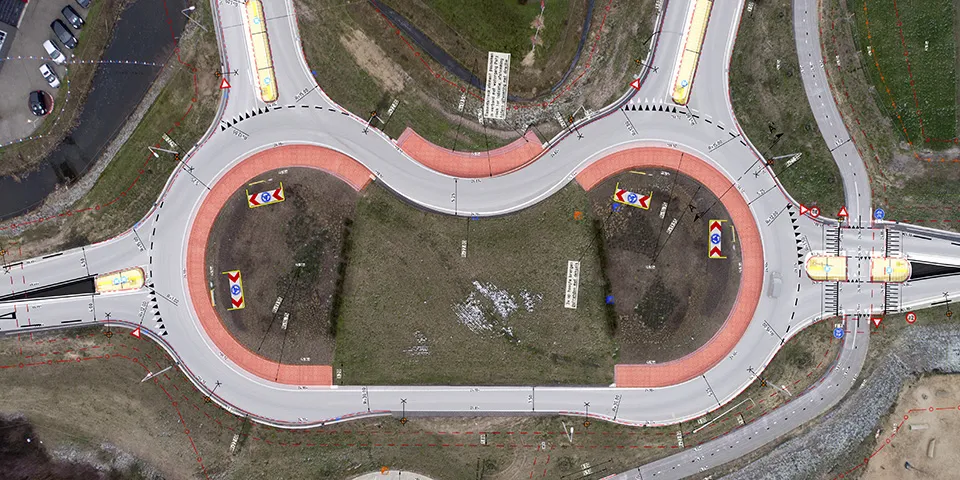
Road access to the new N18, commissioned by the Municipality of Haaksbergen: NLCS design overlaid on the completed works
NLCS and BIM
Kleinveld sees the benefits of the common language spoken at DAGnl every day in practice. “Take the development of Park 15, a 120-hectare sustainable business park on the A15, centrally located between the ports of Rotterdam and the German Ruhr area. The project has been under way since 2015. But because we delivered all the drawings in NLCS format from the outset, those designs can still be transferred without any problems, for example to a civil engineering contractor who needs the drawings to develop a plot.”
The fact that NLCS is also a BIM Level 1 standard plays a positive role. “Although BIM is a broad term,” the project leader says. “In principle, any piece of information you attach to a drawing object is already a form of BIM. We produce most of our 3D models in accordance with NLCS: we develop our 2D drawings into
3D models, while retaining the layer structure. This is useful, for example, when creating machine models for our construction
partners.”
Neater and clearer
All in all, Kleinveld sees a future for NLCS, even though not everyone in the civil engineering sector uses the Dutch CAD Standard yet. “But more and more are adopting it. After all, public authorities have made NLCS compulsory for drawing submissions. That is a good thing. If it were up to me, everyone would soon be working to this standard. There are still clients who use their own drawing standards, often because their entire system is built around them. I understand that they cannot simply abandon them, but at the same time, if we all speak the same language, the work becomes much clearer for everyone. Another advantage is that it reduces the risk of errors, because interpreting drawings raises far fewer questions. This also has a positive effect on the cost estimates you prepare and the contracts you draw up. Thanks to NLCS, your work is a lot neater, clearer and more enjoyable.”
Question about this story? Ask your question
Keep following this
Get an email when a new story is published. No account needed.
- ThemeDigitalisation from design to construction
- SubjectBouwMat







