Three-quarters of cranes sold are electric
Text Armand Landman Image SANY Cranes.Services
‘It’s not the crane, but the power supply that is the bottleneck’
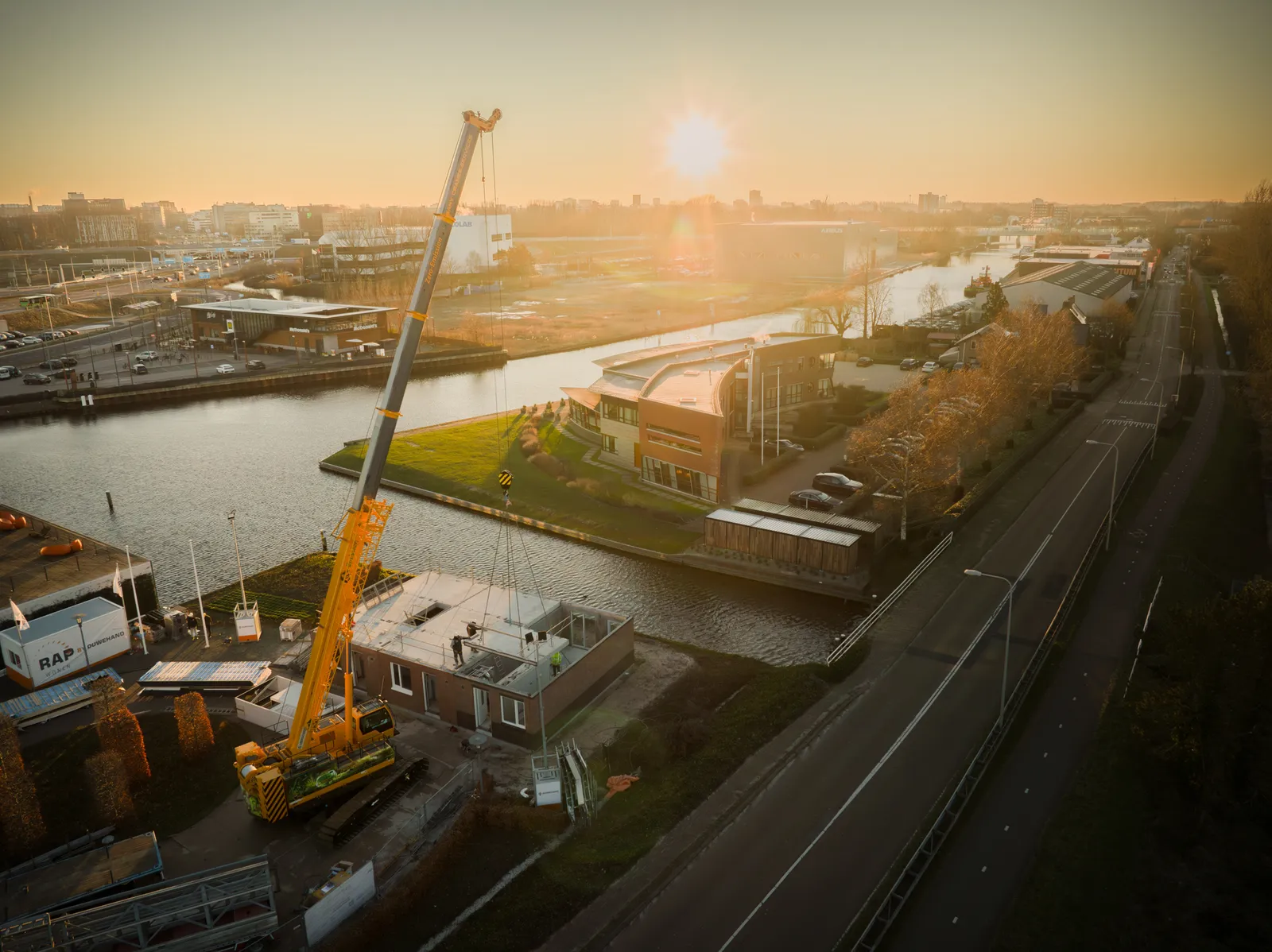
At SANY Cranes.Services, electric cranes are no longer the exception. According to Jack Donker, around three-quarters of cranes sold are now fully electric. This shifts the challenge from the technology in the machine to the power supply and organisation on site.
Three years ago, electric cranes were still a subject that required a great deal of explanation. SANY Cranes.Services now has seven fully electric models in its range, from 50 to 200 tonnes. These are telescopic and lattice-boom crawler cranes supplied as electric from the factory. “They’re selling very well,” says Jack. “You can see that more and more companies realise that zero-emission working is no longer some distant prospect, but a requirement for being able to win contracts.”
Operators’ acceptance of the technology also helps. According to Jack, the controls feel familiar, because the hydraulic functions and joysticks feel the same as on a conventional crane. The main difference is how quiet it is. “Operators say: it works just as I expect, but it’s wonderfully quiet all day.” The electric drive produces considerably less noise than a diesel engine, making a noticeable difference, especially on long-running projects.
A full working day as the benchmark
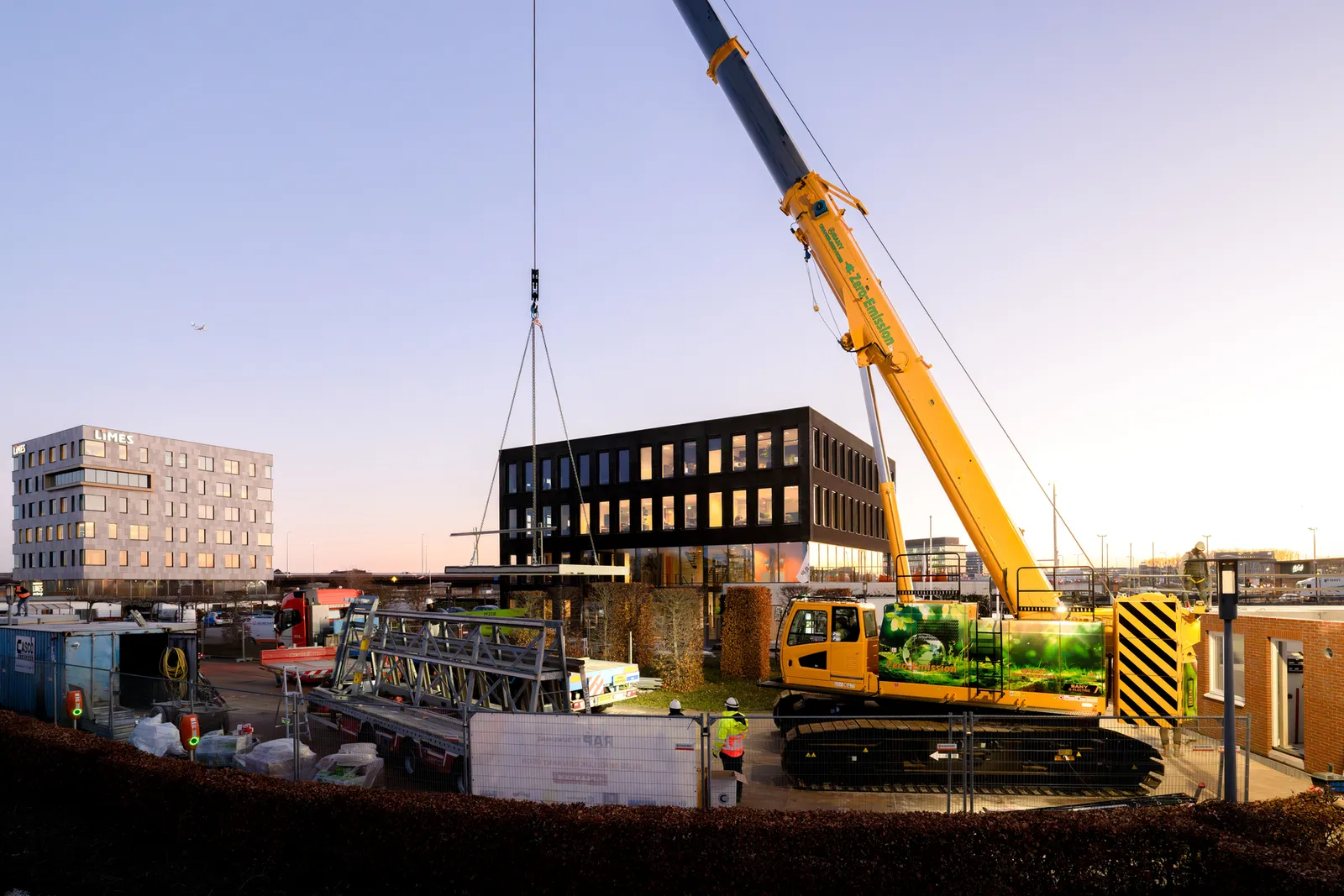
In practice, everything depends on the available battery capacity, according to Jack. A crane must be able to run for a full working day without the operator having to keep an eye on the battery while working. SANY therefore opts for relatively large battery packs. With normal use, around 45 per cent capacity often remains at the end of the day.
This approach is also evident in the largest electric crawler crane in the showroom: the SANY SCC2000A-EV. This 200-tonne crane has a 422 kWh battery pack. “Lifting itself uses relatively little energy,” Jack explains. “But travelling around a site requires a lot of power.”
He does not see battery swapping as the answer. The packs operate at high voltage and cannot simply be disconnected and reconnected, except by qualified technicians. In practice, swapping them also often takes longer than charging. SANY Cranes.Services therefore trains not only operators, but also technicians, in working safely with electric technology.
Site power remains a challenge
The biggest limitation is often not the crane, but the power supply available on site, according to Jack. With a 32A connection, a crane can be charged overnight in around six to seven hours. However, many sites have only 16A available, while several electric machines may need to charge at the same time.
If the grid connection is insufficient, external battery packs can provide a solution. They function as a mobile electricity supply and can be charged elsewhere using DC fast-charging technology. This means the crane can remain on site, rather than the entire machine having to be taken to a charging point.
Service is the foundation
For Jack, service is just as important as the electric drive. “Our sales stand or fall on service,” he says. SANY Cranes.Services operates from four service centres in the Netherlands and has its own parts warehouse in Sassenheim. This enables the dealer to respond quickly to maintenance needs, breakdowns or damage. There are close links with the factory; Jack says SANY engineers are also regularly present at the Dutch office. This matters to customers adding relatively new drive technology to their fleets.
Machines undergo independent inspection on delivery, and both operators and technicians can take a training course. For electric cranes, this includes safely isolating the machine from the power supply. According to Jack, this combination of local service, readily available parts and technical support also helps win over finance providers. Whereas leasing companies were previously hesitant about residual values and damage handling, he says confidence is now growing.
According to Jack, finance providers are also becoming less cautious. Leasing companies were initially wary of the residual value of Chinese machines, but now see that service, parts supply and damage handling are well organised. “Companies mainly want a crane they can rely on, one that can do a full day’s work,” he says. “If it can do that electrically, the choice makes more and more sense.”
Competition and trade policy
However, Jack still sees tensions beyond the construction site. At the end of 2025, following a complaint from European manufacturers, the European Commission launched an anti-dumping investigation into imports of new mobile cranes from China. The investigation covers self-propelled cranes of 30 tonnes and above, both wheeled and crawler-mounted. In February 2026, the imports concerned were made subject to registration. This is not yet a definitive import duty; the investigation is still under way.
According to Jack, the procedure feels like an attempt by established European brands to curb the advance of Chinese manufacturers. He points out that clients are increasingly demanding zero-emission equipment, while the range of fully electric cranes remains limited for now. SANY, he says, supplies these machines electric from the factory, rather than as conversions. “They simply want a product they can’t supply,” he says. The question, according to Jack, is how European ambitions for zero-emission construction sit alongside trade measures that could make access to this equipment more difficult.
Question about this story? Ask your question
Keep following this
Get an email when a new story is published. No account needed.
- ThemeLower emissions and more reuse
- SubjectMachines & equipment