









Craftsmanship on the dike
Text Roel van Gils Beeld Steenzetterij Ligthart
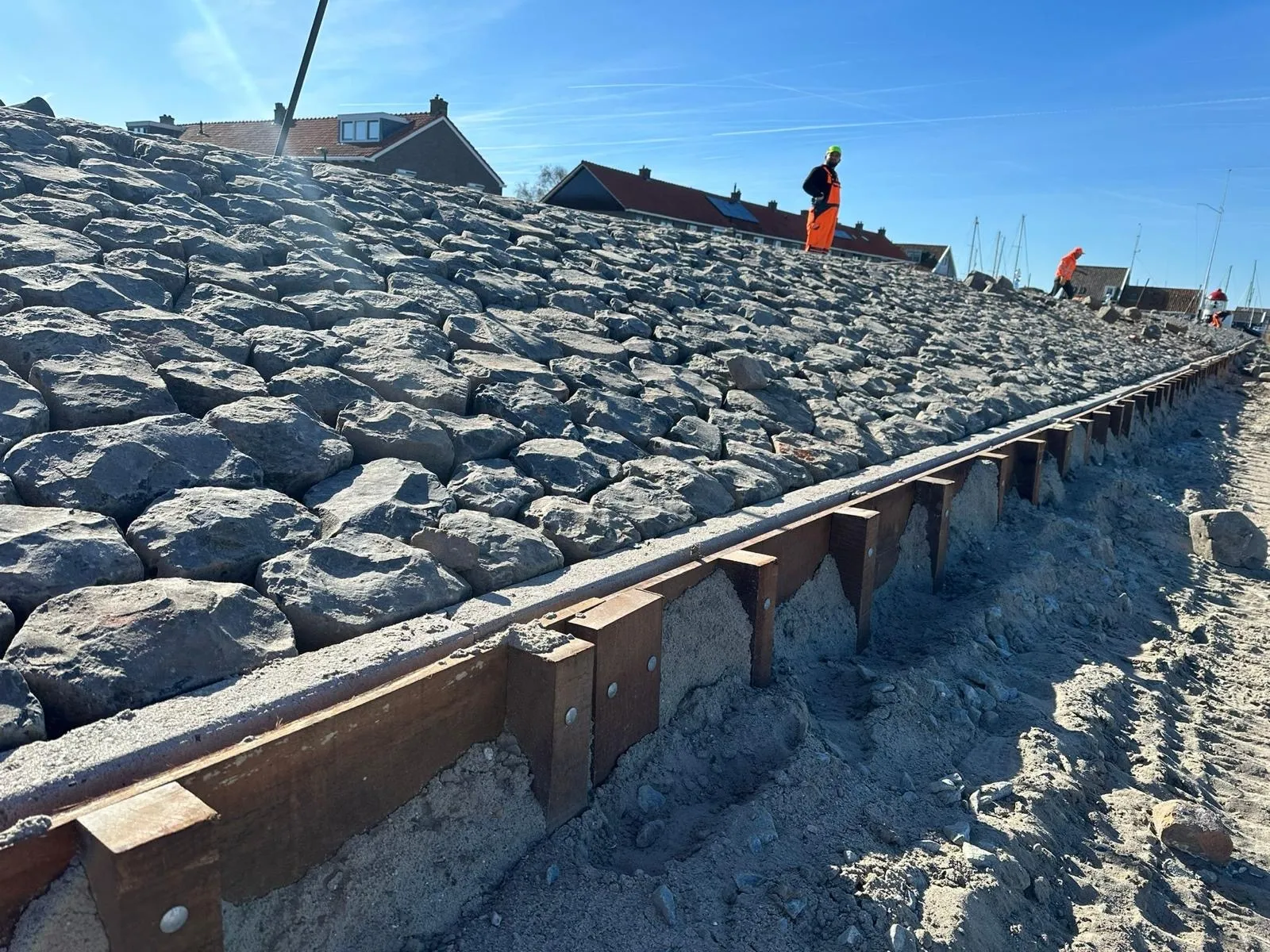
Fitting the basalt stone puzzle
For centuries, a distinctive craft has been practised on Dutch dikes: hand-setting basalt stone. The same traditional stone revetment was deliberately chosen for the reinforcement of the dike on Marken. Not only for its familiar, centuries-old appearance, but above all because of its strong sustainability credentials. Steenzetterij Ligthart is reusing 100 per cent of the existing basalt revetment.
There are several options for stone revetment in dike construction. “For the Dijkversterking Marken project, Rijkswaterstaat deliberately chose to reuse the old basalt revetment,” says Serge Ligthart, director of Steenzetterij Ligthart. “We were approached at an early stage to assess whether and how the basalt stone could be reused. We are familiar with projects of this scale, having contributed to the Afsluitdijk and the Houtribdijk, among others, as well as to dike reinforcement projects near Nijmegen, Arnhem and Tiel. Stone-setting is a craft in the truest sense. There are only around forty people left in the Netherlands who practise it.”
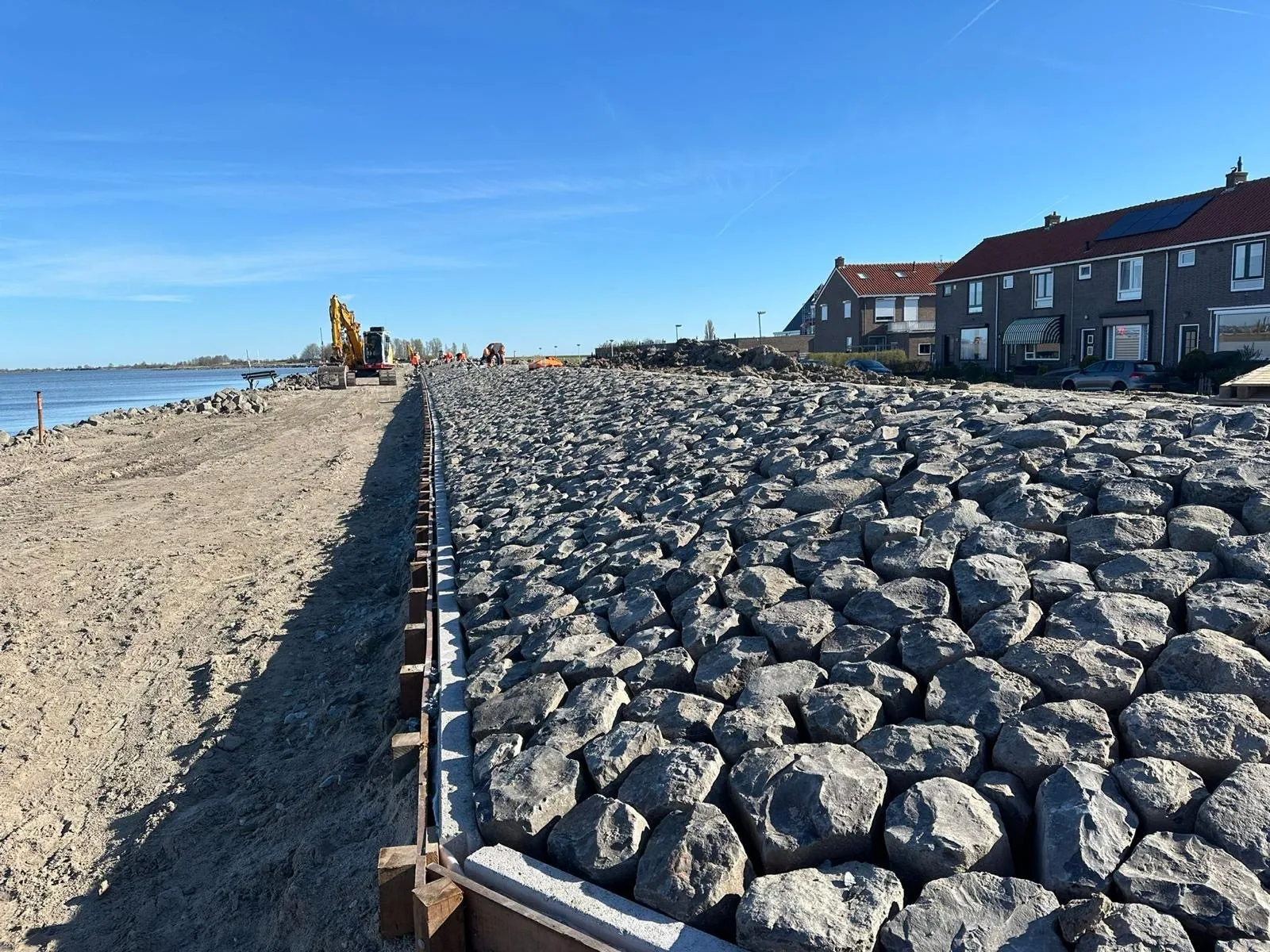
Endless lifespan
Before the natural stone revetment can be installed, the dike must first be fully prepared. “The body of the dike is built up with sand and carefully profiled to the correct slope,” Ligthart explains. “A geotextile is then laid, with a layer of coarse chippings on top. Only then does the real craft begin: our specialist stone-setters place the basalt stones.” The stones come from the old dike and were removed by the main contractor and temporarily stored in a stockpile. “These basalt blocks are now being used again. This means 100 per cent of the existing material is recycled, which is a major benefit of natural stone. Basalt has a virtually endless lifespan.”
A polygonal puzzle
The stones are first sorted using a crane vessel and transported from the stockpile to the dike. “The stones are then turned into position on site, and our stone-setters decide where each one will fit best. They push and roll the stones, sometimes using a small lifting aid, until each is precisely in place. It really is a puzzle.” This puzzle-like work is no coincidence. “Basalt is a volcanic rock that naturally solidifies into hexagonal shapes. This allows the stones to be fitted together like a polygonal puzzle. That structure is precisely what makes basalt so suitable for dike revetment: waves have very little purchase on it.”
A long tradition
According to Ligthart, strict requirements apply to setting the stones. “The evenness of the surface and the way the stones interlock are all checked. It takes experience and craftsmanship.” There are no longer any training courses. “We train new craftspeople in-house, usually through a programme lasting about two years.” Steenzetterij Ligthart also has a long tradition. The family has worked with natural stone for four generations. “Its roots go back even further, to the 1930s, when my great-grandfather was involved in building the Afsluitdijk.”
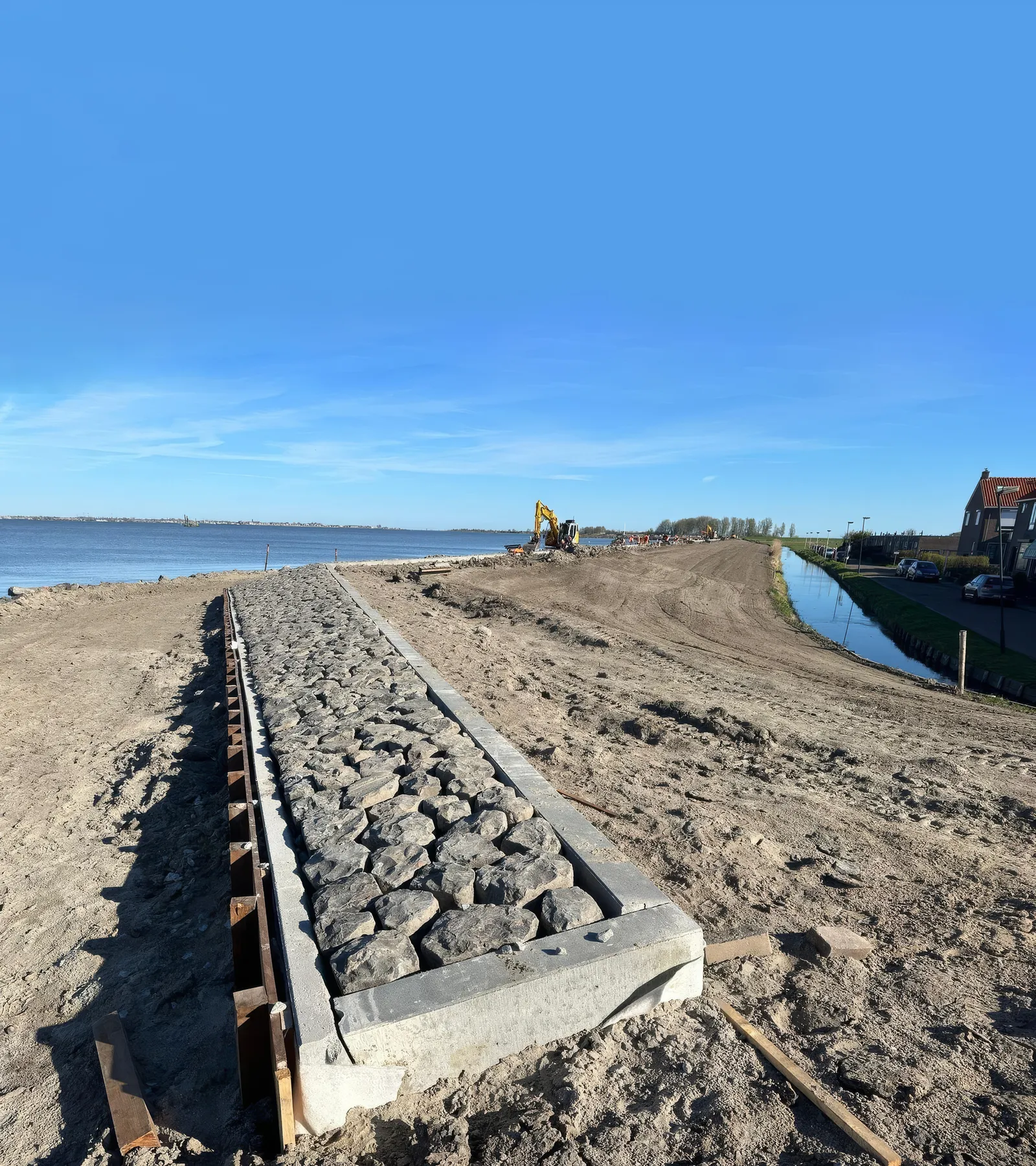
Teamwork
That craftsmanship is once again being put to use here on Marken. Following a preparatory phase and several trial sections built last year, Steenzetterij Ligthart began work on the revetment of the first section of the dike in early April. “A team of seven stone-setters works alongside colleagues who prepare the slope and install the underlying layers. On average, around twelve people are working on the dike at any one time,” says Ligthart. “The pace is slower than with modern concrete products, but that is inherent in the craft. We are building a sustainable dike, one stone at a time.”
Ligthart says the finished revetment will look as it did in the past, while meeting today’s requirements: strong, sustainable and respectful of nature and the landscape. Biodiversity has also been taken into account. In some places, so-called snake refuges are being created: small cavities beneath the stones where, for example, grass snakes can shelter. The dike will thus regain not only its distinctive basalt revetment, but also a piece of living heritage.
Een zakelijke vraag aan Steenzetterij Ligthart B.V.? Get in touch
Wie aan Dijkversterking Marken werkte
Keep following this
Get an email when a new story is published. No account needed.
- ProjectMarken dike reinforcement
- ThemeLower emissions and more reuse
- SubjectWater infrastructure
- CompanySteenzetterij Ligthart B.V.







