









Groundbreaking recycling concept for a challenging construction pit
Text Roel van Gils Beeld Bonneveld Aannemingsbedrijf
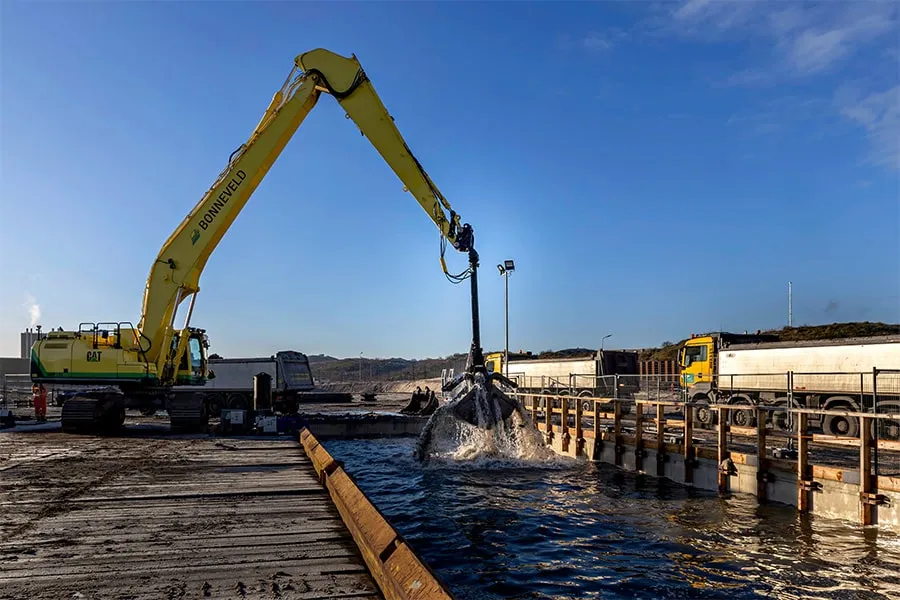
In the north of the Netherlands, Franki Grondtechnieken and Bonneveld Aannemingsbedrijf are jointly constructing a challenging underwater construction pit measuring 52 by 49 metres and no less than 20 metres deep. A total of 380 steel foundation piles are being drilled into it from a pontoon. What makes this civil engineering project particularly special is the ingenious way in which the resulting grout slurry is collected, processed and separated back into its original raw materials for reuse. This method also avoids the need for extensive diving work, which in turn improves safety.
The construction pit is formed by diaphragm walls no less than 1.5 metres thick and 35 metres deep. “Stability is provided by 168 15-strand anchors arranged in three rows, with lengths ranging from 50 to 65 metres,” says Jan Leen van der Vlies, Operations Director at Franki Grondtechnieken. “After installing the anchors, Bonneveld excavated and dredged the pit from a pontoon, underwater, to a depth of 20 metres below ground level. The modular pontoon was then converted to support our 150-tonne Fundex 3500 piling rig. Including some additional attachments, the total weight on the pontoon comes to 180 tonnes. This requires a carefully planned ballasting schedule. We have carried out stability calculations for every possible rig position. We had already done the same for Bonneveld’s excavators.”
Bed of nails
A total of 380 foundation piles are being installed in the construction pit. “The piles are arranged in 20 rows across and 19 rows deep, with 2 metres between them. An underwater concrete slab is then poured at a depth of 20 metres, with the piles projecting about 3.5 metres above it. Once the pit is pumped dry, what remains will look like a bed of nails. It will form the foundation for the superstructure,” explains Jan Leen. Franki uses grout slurry when drilling the piles. “There are several reasons for this. First, it increases the water pressure in the ground beneath the drill bit, improving ground displacement. The slurry also provides the necessary cooling during drilling and helps seal the drilled wall. It carries the loosened material up to the surface, and finally, its composition allows us to monitor the drilling process.”
Preventing grout spoil
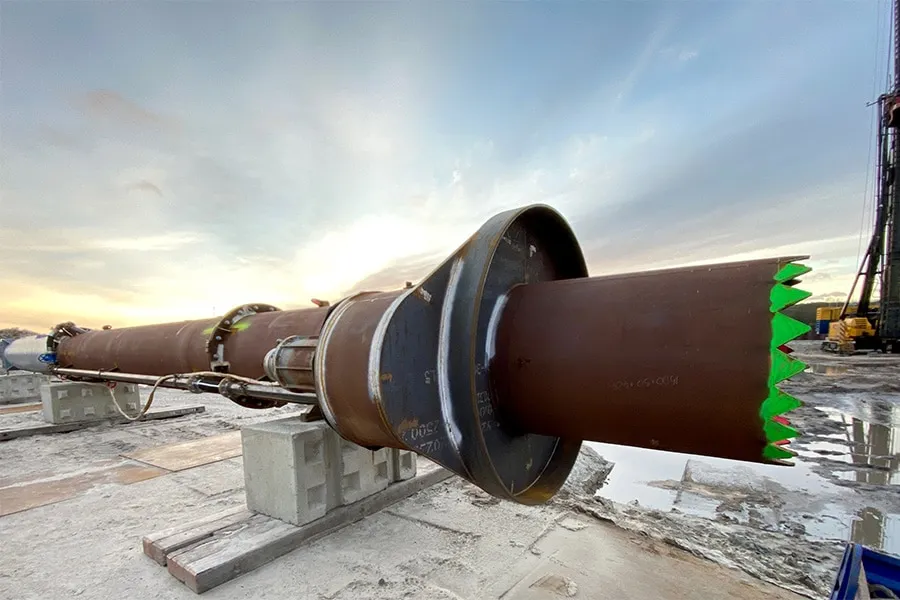
When a bored foundation pile is installed, around 7 to 10 m3 of grout spoil, a mixture of cement, sand and water, generally remains at the bottom of the hole. “That would be disastrous for the bond between the underwater concrete and the piles in this pit,” says Harry van der Heiden, Managing Director of Bonneveld Aannemingsbedrijf. “The piles need to be completely clean to prevent leaks or worse.” He calculates that installing the 380 piles would leave around 3,000 m3 of grout spoil in the pit. “Whether the foundation piles are installed from ground level or from a pontoon, the construction pit must be completely free of grout before the underwater concrete slab can be poured. That is why we devised a solution and further developed it together with Franki. First, an oversized 22-metre casing is placed on the bottom of the pit, then pushed and worked 1.5 metres into the ground to seal it. At the bottom is a pump chamber with a heavy-duty pump, which pumps around 80-100 m3 of grout slurry while a foundation pile is drilled to depth through the casing. This prevents any grout spoil from being left behind, because all the residue is pumped away before the casing is lifted out and moved above the next pile position.”
Recycling technology
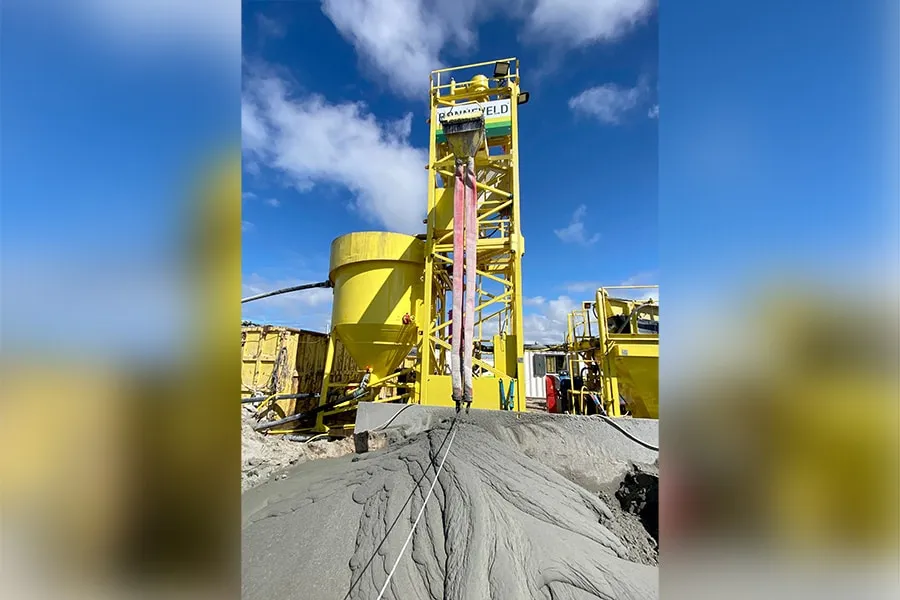
Bonneveld has added a further step to the grout system. Harry explains: “Using a unique method, we can separate the high flow rate of 80-100 m3/hour of grout slurry generated by each pile back into its original raw materials. That means 6 m3 of cleaned sand, which can remain on site, and 73-93 m3 of water, which is returned to the pit. The only material left over is 1 m3 of concentrated grout mixture. We are currently investigating whether its quality is high enough for it to be reused as a lubricant in the process. The early signs are very promising.”
The oversized casing also contains the so-called Pile Cleaning Device (PCD), which consists of a ring fitted with injection nozzles. “As the PCD is lifted out, it uses high-pressure jets to clean the protruding length of the foundation pile, in case it is not already clean,” explains Jan Leen. “Once the foundation pile has reached its final depth, we keep the grout system running for a few more minutes to make sure all the grout spoil has been pumped away before removing the PCD. This keeps diving work to an absolute minimum, as it is one of the most high-risk activities.”
The method used to construct this pit saves a great deal of material, time and emissions, says Harry. “First, the piles are drilled using an extension, which means we have 20 metres less pile to drill. The savings add up when you multiply that by 380 piles. It also avoids having to remove 7,200 metres of grout columns during excavation, both in dry and underwater conditions. It also means far fewer vehicle movements to and from the site, with the grout recycling plant making a substantial contribution. The grout slurry is separated into its three original raw materials, most of which can remain on site. This gives us control over the entire process.”
A business enquiry for Bonneveld BV? Get in touch
Companies in this story
Keep following this
Get an email when a new story is published. No account needed.
- ThemeUnderground construction
- SubjectUnderground infrastructure
- CompanyBonneveld BV







