









Geo-data specialist leads ground investigations and geotechnical consultancy for WarmtelinQ construction in South Holland
Text Roel van Gils Images Fugro, WarmtelinQ
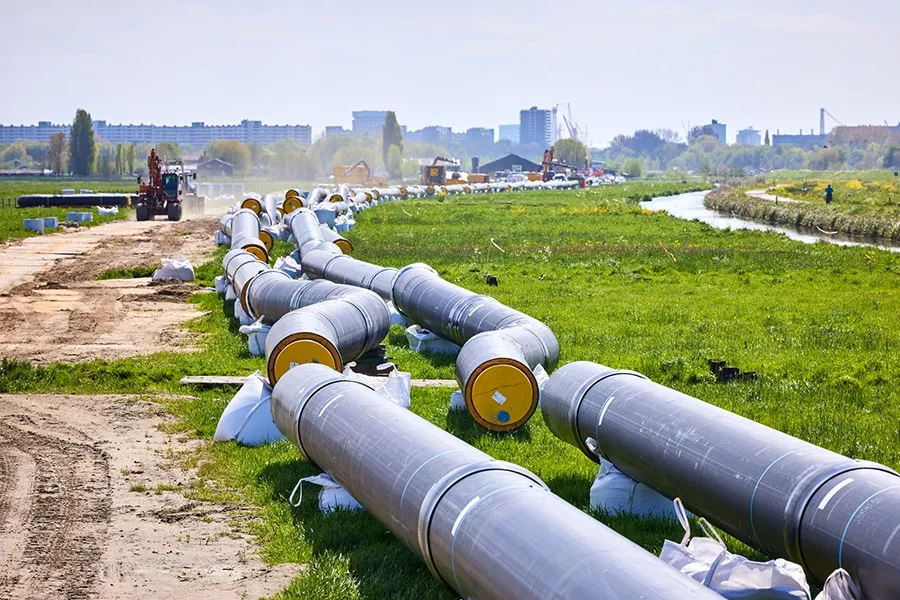
Ground conditions knowledge is crucial to constructing the residual heat pipeline
The WarmtelinQ project is under way in the province of South Holland. The underground pipeline will enable residual heat from the Port of Rotterdam to be used to heat homes and businesses sustainably. Fugro has been involved in the project as a geo-data specialist since the planning stage in 2017 and has since deployed almost all of its services. This includes disciplines you might not immediately associate with pipeline construction, such as foundation investigations.
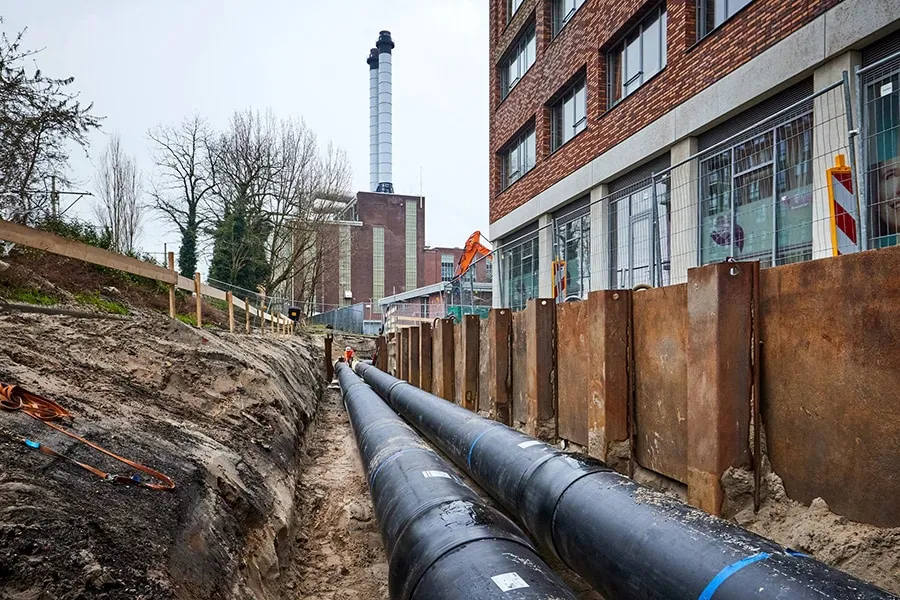
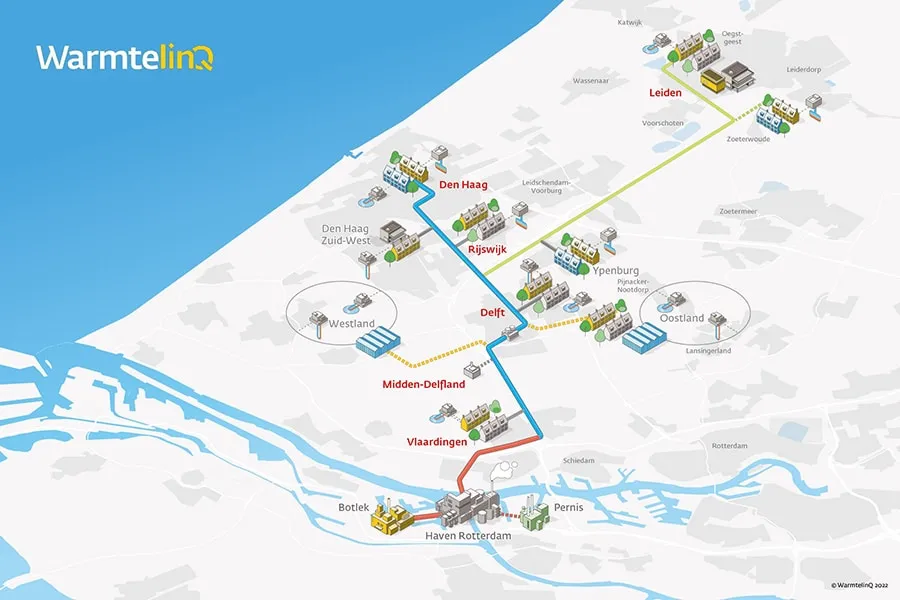
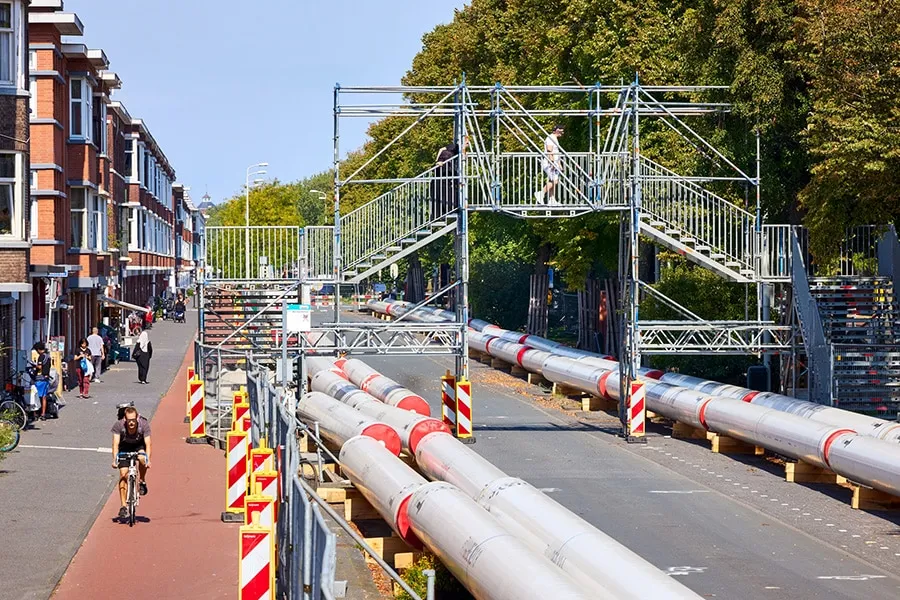
The WarmtelinQ project began in 2017 as the ‘central pipeline’, initially led by Eneco and transferred to Gasunie in 2020 at the request of the Ministry of Economic Affairs and Climate Policy. The underground pipeline consists of a supply and return line and runs from the Port of Rotterdam via Vlaardingen to The Hague, with a later extension from Rijswijk to Leiden. T-junctions are being installed at various points along the route, allowing local heat distribution networks to be connected in future. The pipeline runs through urban areas in The Hague as well as through the polder alongside the A4, and is being installed using open-cut trenching and directional drilling. Directional drilling includes closed-face boring and horizontal directional drilling (HDD). The former involves horizontal boring without opening up the surface, usually over a limited distance (25-250 m). HDD involves drilling a bore over a long distance, into which the pipeline is subsequently pulled. HDD bores can extend over considerable distances, up to 1,500 m, making them ideal for crossing major waterways, roads, rivers, nature reserves and urban areas.
First electric CPT crawler in the Netherlands
As part of the energy transition, Fugro is investing in making its fleet more sustainable. Its goal is to be carbon neutral by 2035. Fugro has an electric mini drilling crawler and has recently also commissioned an electric mini CPT crawler. A large, zero-emission CPT unit is also under construction. It is due to become operational in mid-2024 and will be able to carry out more deep CPT tests in less time. This puts Fugro at the forefront in the Netherlands.
Ground investigations and ground conditions
Fugro has been involved in the project from the outset. “We initially carried out desk studies and gathered existing information on the ground profile, soil parameters and groundwater levels,” says Jeroen Heikes, Senior Project Manager at Fugro. “On that basis, we provided preliminary dewatering advice and recommended what additional ground data needed to be collected to develop a robust design. As well as the geohydrological aspects, we also considered the geotechnical aspects, so all the necessary ground investigations could be carried out in a single phase.” When Gasunie became involved in 2020, the collaboration with Fugro continued to ensure continuity and avoid delays. Herman Brink, Senior Consultant Hydrology at Fugro, explains further: “Following the preliminary advice, we carried out the necessary ground investigations, installed monitoring wells, and conducted laboratory and environmental investigations. This enabled us to produce a geotechnical longitudinal profile for the entire route. We then began providing geohydrological and geotechnical advice.”
Dewatering advice
Most of the pipeline is being installed in an open-cut trench with trench sheeting. “Dewatering wells are installed around it to lower the groundwater level,” Herman explains. “The challenge is to extract just enough water to keep the trench dry, but not so much that groundwater levels in the surrounding area are lowered excessively. This could cause settlement, dry out nature areas and damage archaeological monuments. The impact on the stability of the sunken section of the A4 was also investigated. The abstracted groundwater then has to be discharged. This is another challenge, because the quality of the abstracted groundwater varies, and it cannot simply be discharged into surface water everywhere.”
Wall friction
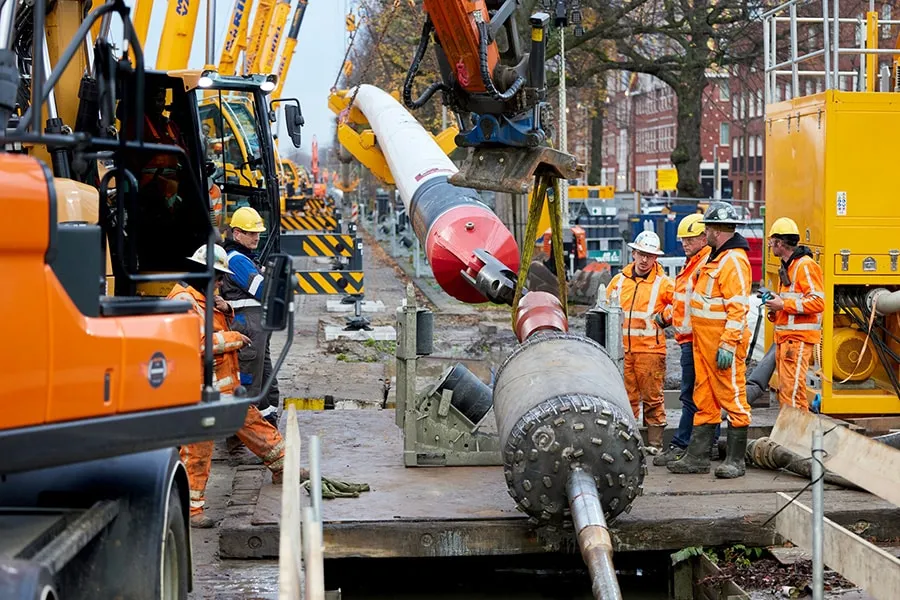
Open-cut trenching is not feasible at the major crossings, so different techniques are used depending on the location. HDD has been chosen for longer distances, while closed-face boring is used for shorter ones. For closed-face boring, a 6 to 8-metre-deep construction pit is excavated on either side of the road, and a pipe is then jacked horizontally beneath the crossing. “Underwater concrete had been specified throughout to ensure the vertical stability of the bottom of the construction pit in lower-lying areas,” says Herman. “By including the wall friction of the remaining water-retaining layers along the sheet piles in the calculations of the vertical stability of the pit bottom, we can demonstrate greater stability. This means less underwater concrete is needed, saving both money and CO2.”
Soil moisture sensors
In urban areas, the underground pipeline is also installed as far as possible using open-cut trenching with dewatering. “The surrounding area is closely monitored,” Jeroen assures us. “Based on our experience and investigations for other projects in The Hague, we were able to make a robust assessment of the foundation types of buildings within the area of influence. These range from concrete piles and timber piles to shallow foundations on natural ground. Data was missing for some locations. Our Foundation Investigation department therefore carried out additional foundation inspections, literally exposing the foundations. This information was incorporated into the monitoring plan. Input from our Foundation Investigation department led us to recommend using soil moisture sensors as well as monitoring wells (the standard measurement method, ed.). A drop in groundwater level does not necessarily lead to damage to foundation timber. Experience shows that soil moisture can reduce the risk of damage caused by timber drying out. By combining these data, WarmtelinQ can manage risks more precisely and give the contractor greater leeway to carry out the work.”
The complexity of the surroundings makes the project particularly interesting for Fugro. “The project touches on a huge range of areas, which means we draw on almost all our departments and disciplines. Everything is geared towards minimising the impact on the surrounding area,” says Herman. Fugro therefore remains closely involved during construction. “If the contractor makes a change, we assess its effect on the dewatering plan, whether it complies with the water permit and whether the risk profile remains unchanged.”
Fugro enters into new 10-year strategic partnership with Gasunie
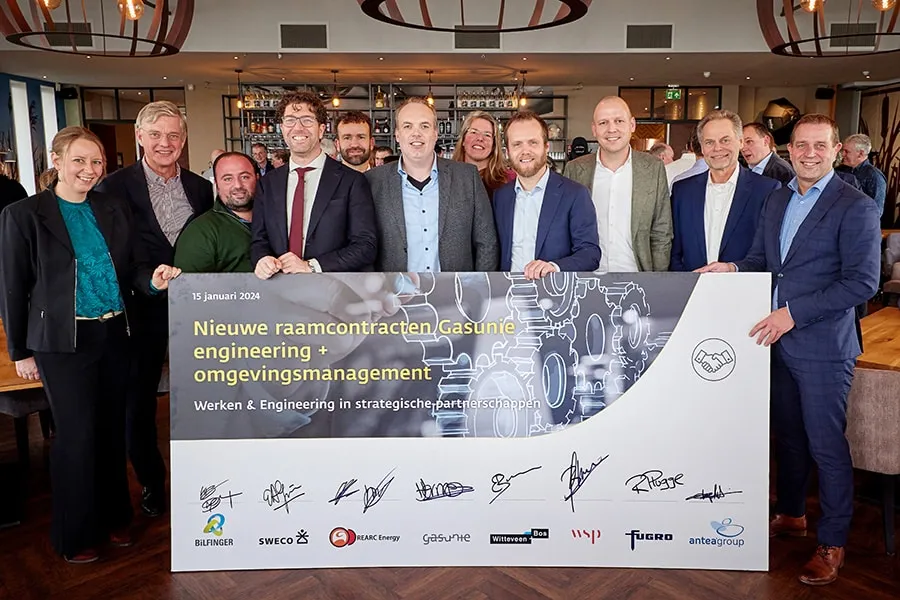
Separately from this project, we will work with Sweco on behalf of Gasunie to manage stakeholder relations for the transport and storage of sustainable energy across its existing and new networks. Over this extended period, Fugro will carry out ground investigations, environmental studies, and geohydrological investigations and design work, among other services. The energy transition is driving a shift within Gasunie from natural gas to hydrogen, CO2, green gas and heat. Growing demand for these energy carriers means adapting the existing network and building and managing networks for them. Fugro is pleased that Gasunie has chosen a long-term partnership with Sweco-Fugro for this work, helping to accelerate energy security and sustainability as part of the energy transition.
A business enquiry for Fugro? Get in touch
Who worked on WarmtelinQ
Keep following this
Get an email when a new story is published. No account needed.
- ProjectWarmtelinQ
- ThemeUnderground construction
- SubjectUnderground infrastructure
- CompanyFugro







