









Future-proof replacement and renovation underground
Text COB/Harry Bijl, Marije NieuwenhuizenImage COB, e.a.
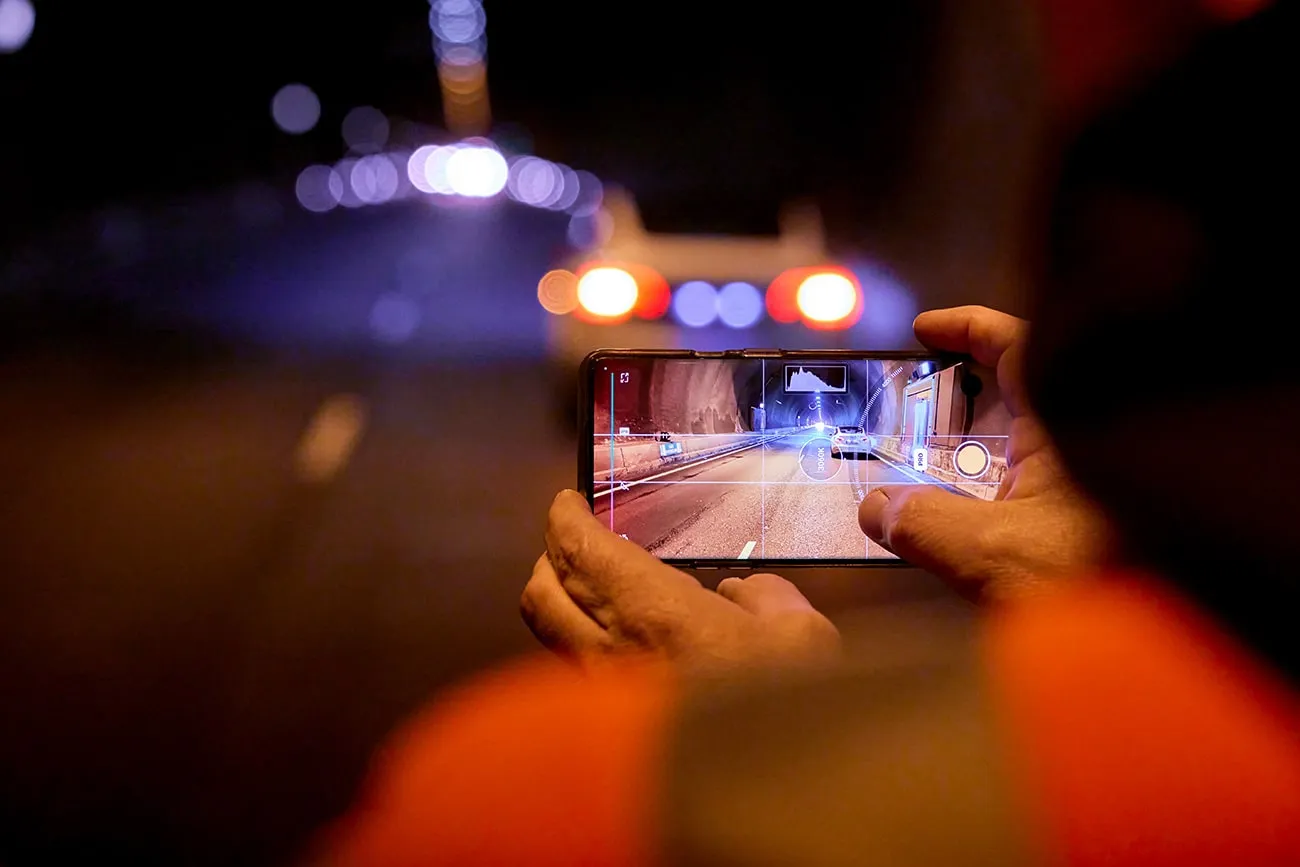
All the major societal challenges related to housing, sustainability, climate adaptation and liveability have a substantial underground component. The underground is already crowded, and even more infrastructure needs to be added. Meanwhile, much of what is already in the ground needs to be renovated or replaced. This presents a major challenge for both tunnels and cables and pipelines. Brenda Berkhout, Civil Engineering coordinator within the COB tunnel programme, and Jarko van Bloois, coordinator of the Knowledge Arena for Cables and Pipelines, discuss the challenges, impacts and solutions involved in renovating and replacing underground infrastructure.
Tunnel renovations
“In the 1960s and 1970s, the Netherlands saw a peak in the construction of infrastructure structures. We are now seeing that peak reflected in the renovation work required for bridges and locks, and therefore tunnels too,” explains Brenda Berkhout. “We expect more than twenty tunnels to need renovation over the next ten to fifteen years. The multi-year plans still include some new construction, but most of the available funding will be spent on renovation in the coming period.”
Brenda Berkhout believes that having so many projects taking place in relatively quick succession presents a great opportunity to take a smarter approach to tunnel renovations. “Now is the time. Under the Programme for Tunnel Renovations in South Holland (PTZ), which forms part of the national Replacement and Renovation Programme, Rijkswaterstaat has deliberately opted for a sequential approach, so that lessons from renovating one tunnel are immediately incorporated and applied to the next. ProRail is taking a similar approach, using the renovations of the Hemspoortunnel and Willemsspoortunnel to inform future projects. The COB network’s tunnel programme includes several projects to support learning from one project to the next. The aim is to turn the current renovation challenge into an opportunity to reduce the need for renovation in the future.”
Future-proof renovation
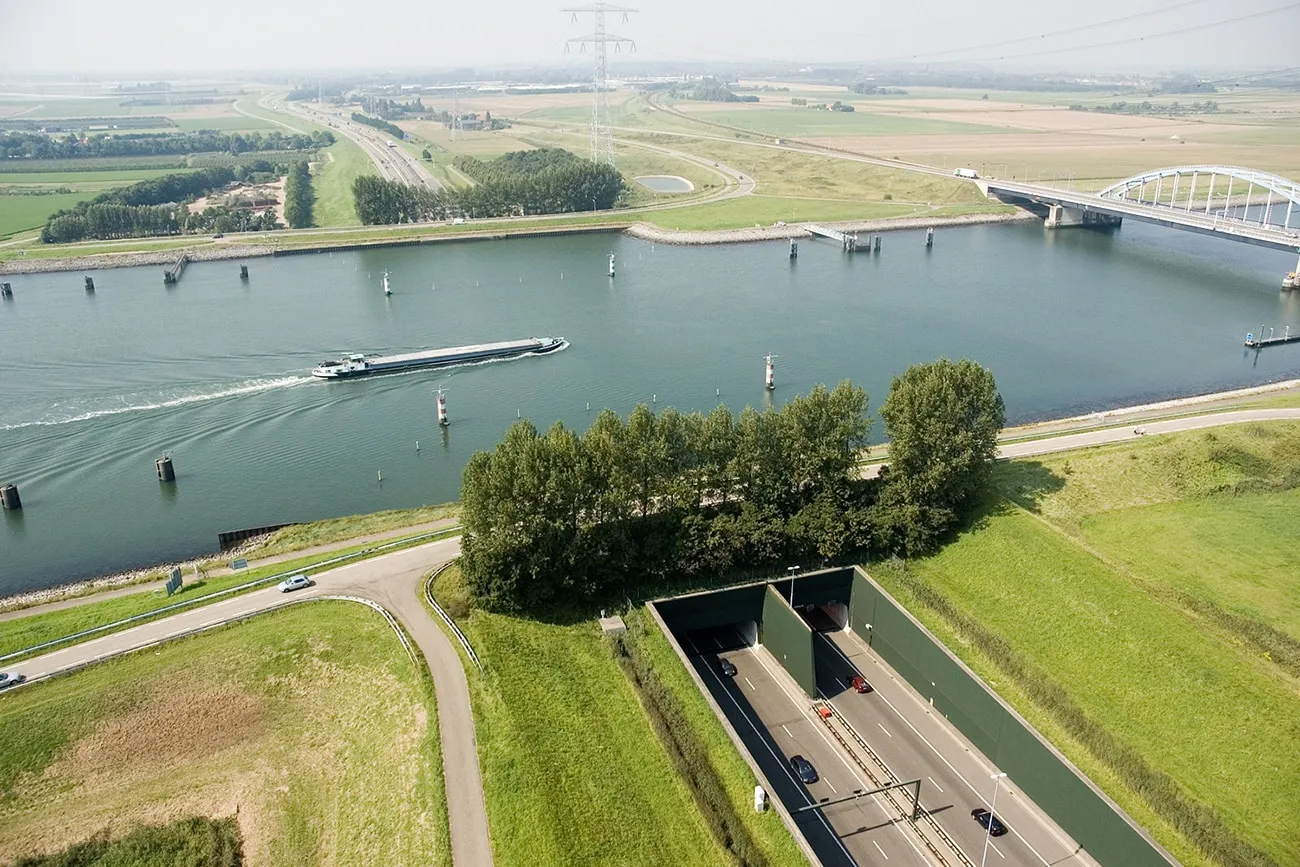
Considerable experience has been gained in recent years in replacing and/or renovating tunnel technical installations. These installations have a shorter service life than the civil structure. “For the civil engineering elements, it is becoming increasingly important to understand what is happening in terms of deformation and degradation,” explains Brenda Berkhout. “Maintenance of the civil components is essential if we are to achieve a service life of a hundred years or more. The Netherlands has many immersed tunnels, where the joints in particular are critical. We can see them ageing, and want to know what is needed to prevent damage occurring over the next fifty years. The same applies to concrete renovation.”
“We are on the right track,” is Brenda Berkhout’s interim conclusion. “The civil engineering strand of the tunnel programme includes research projects addressing various aspects of joint-related problems. Insights gained from earlier projects are already being applied in ongoing renovations. Rijkswaterstaat is also enabling us to observe the renovation of the Heinenoordtunnel, so that we can learn lessons for other projects in practice. We are also working with universities. Funding has been secured for PhD research into tunnel deformation and degradation. The programme runs through to 2030.”

Areas for improvement
A systematic approach to knowledge is therefore in place, and it is increasingly beginning to pay off. That said, Brenda Berkhout believes there is still room for improvement. “When it comes to monitoring, for example, we could learn from the approach taken in Asia. There are many immersed tunnels there too, and much more funding is allocated to monitoring joints, deformation and materials. Monitoring is often considered too costly in the Netherlands, but the results are extremely valuable. Tunnels continue to settle, even those that have been in place for decades, but we still do not really know why. We add ballast to tunnels to prevent them from floating, yet they continue to sink year after year. We want to know how long this process will continue and how much deformation the structure can withstand. Systematic monitoring helps us answer questions like these.”
Greater efficiency
The challenge of renovating tunnels is not limited to problems with the joints in civil structures. Brenda Berkhout says: “We also want to ensure that tunnels remain available as much as possible. The Netherlands simply cannot afford to have tunnels closed for extended periods for maintenance or renovation. Closing one tunnel bore in a single direction already causes major disruption in many places, let alone closing a tunnel completely for a long period. That is why we want to avoid the need for large-scale, lengthy renovations in the future, as well as unexpected maintenance.”
In addition, the COB network, which brings together clients, engineering firms, contractors and knowledge institutions, is looking for ways to improve efficiency. Brenda Berkhout says: “A good example is the Evolutiepad naar uniformiteit project, in which the COB network is exploring how to make tunnels more consistent in terms of technology and asset management information. This will allow renovations to proceed more quickly, smoothly and efficiently, and make future renovations easier to carry out with fewer tunnel closures.
With this kind of targeted, practical research, we are taking an increasingly integrated approach. This is also necessary because we are short of people. We really need to make more efficient use of the people we have.”
Cables and pipelines: combining replacement with expansion
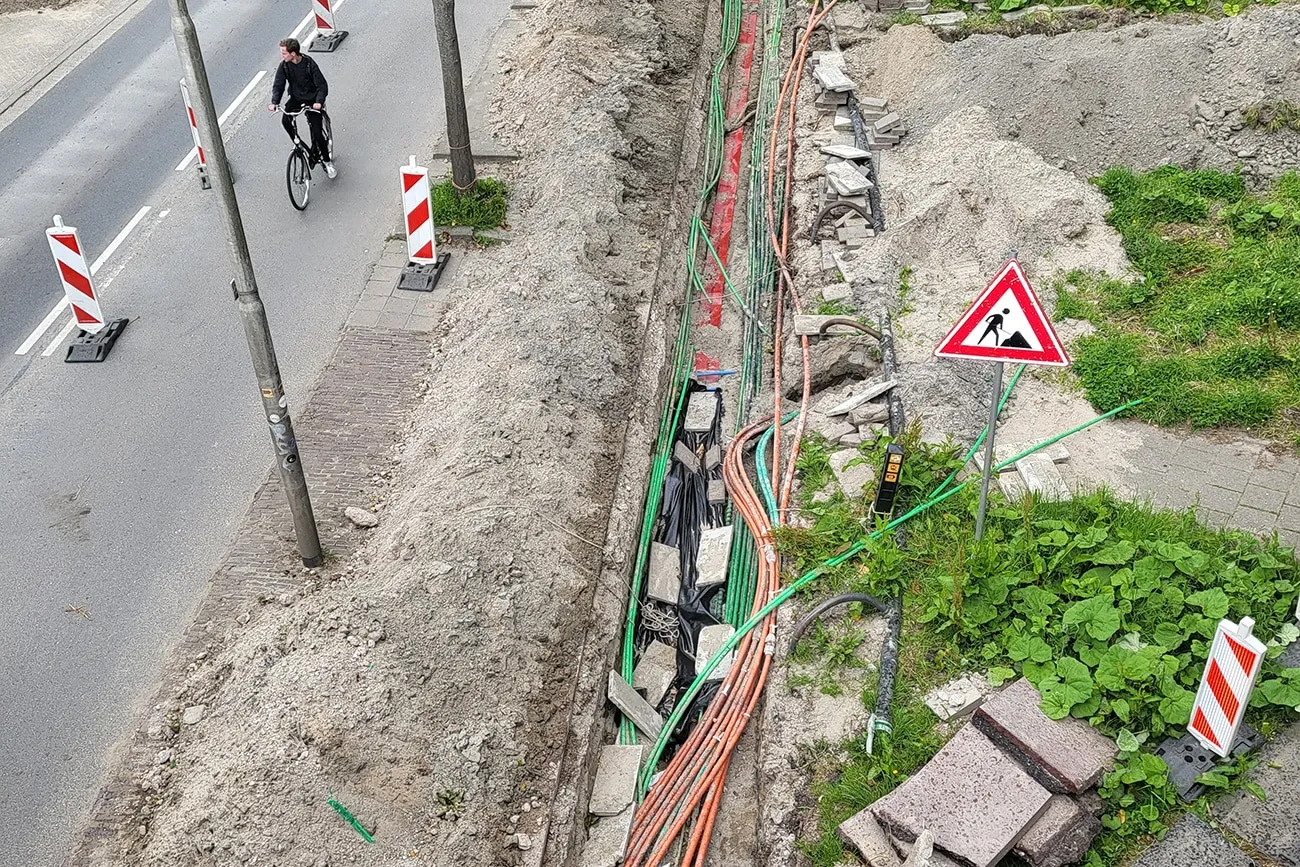
For cables and pipelines too, the peak in construction during the 1960s and 1970s is reflected in today’s replacement challenge. But there is more to it than that. Replacement work is taking place at the same time as cable and pipeline networks need to be expanded. The energy transition is driving upgrades to the electricity grid and the construction of heat networks, while hundreds of thousands of new homes also need to be built in the coming years. Furthermore, the replacement peak for cables and pipelines is less clearly defined than it is for tunnels, because the expected service lives of different utility networks, including sewers, electricity, water and gas, vary. This complicates efforts to avoid disruption and duplicated work by combining projects for different assets.
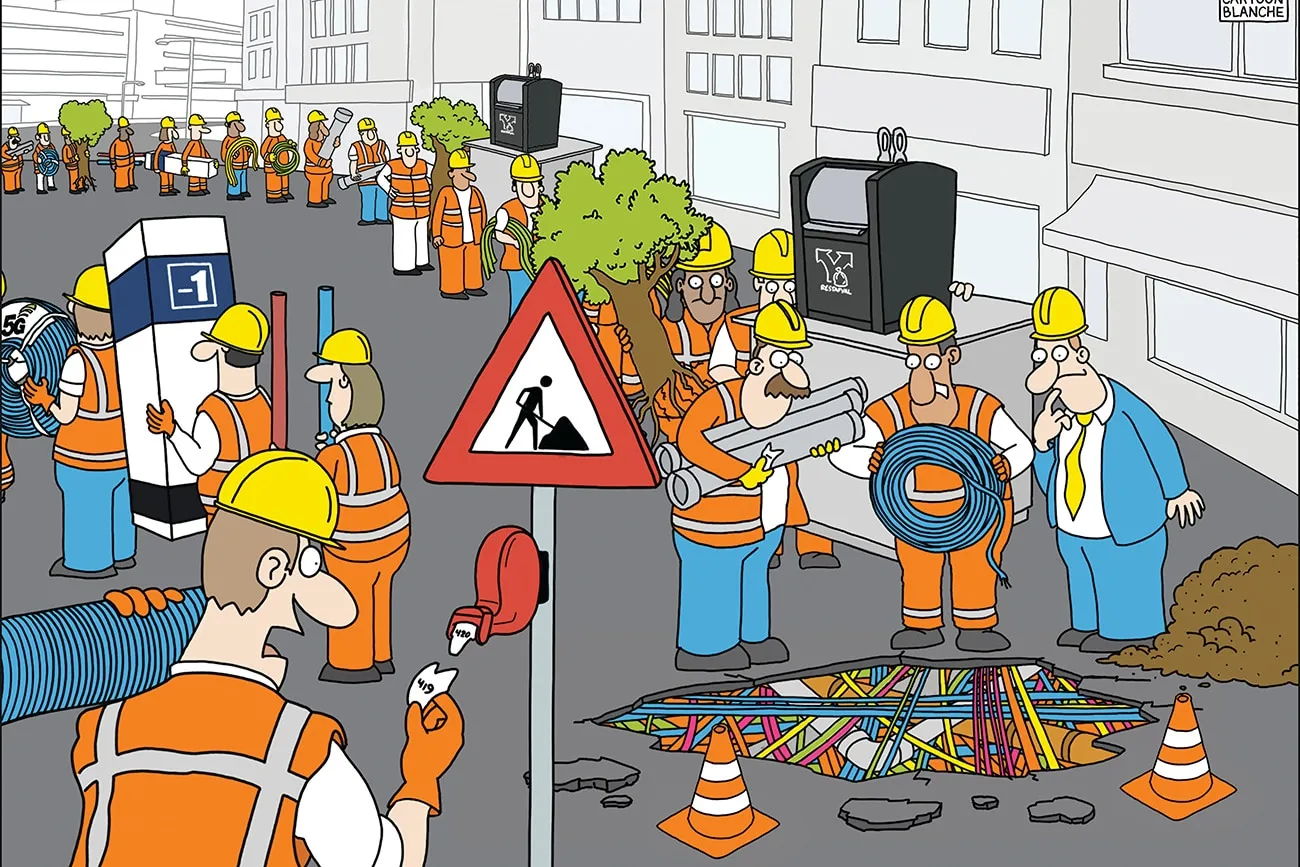
The cables and pipelines sector sees opportunities to combine replacement with new construction and turn a necessity into an advantage. Jarko van Bloois says this is a challenging task, emphasising that the underground is already so full that we need to think and work differently. “Governments and network operators used to work on the assumption that ‘anything must be possible’. That era is truly behind us. The challenge of replacement and expansion coincides not only with the energy transition. Measures to manage rainwater and the growing tendency to move functions such as waste collection and parking underground also have a major impact on cables and pipelines. And the drive to improve liveability is increasing demand for urban green space. This makes the overall challenge even more complex. On the one hand, demand for underground space is growing, while on the other, less space is available underground. The number of stakeholders is also increasing, making it even harder to reconcile the different interests.”
Taking a clear position
“We have passed the point where regulation alone can solve the problem. Congestion underground means that active coordination has become essential,” Jarko van Bloois continues. “Until now, solutions have only been sought in practice, as problems arise. That is not sustainable. We need strategic decisions and clear policy choices that prevent disputes in practice. When it is clear in advance what is and is not permitted, and what requirements and conditions apply, all stakeholders know where they stand.”
“The existing situation underground can seriously obstruct the progress of above-ground projects. On the other hand, smart use of the underground can help deliver solutions to these challenges. Decision-makers and policymakers need to understand this,” says Jarko van Bloois. “We can no longer afford to treat the underground as an afterthought. The interdependence of above-ground and underground infrastructure needs to be on the table from the outset of every project.”
Working together on solutions
The COB network, which includes representatives from governments, network operators and contractors, approaches the challenges from different angles. Jarko van Bloois says: “All the research projects are part of the Knowledge Arena for Cables and Pipelines, a knowledge programme run by the Mijn Aansluiting foundation and COB, often supported at project level by the Fonds Fysieke Leefomgeving. We look at issues such as coordination, factual knowledge, new ways of working and digital collaboration.”
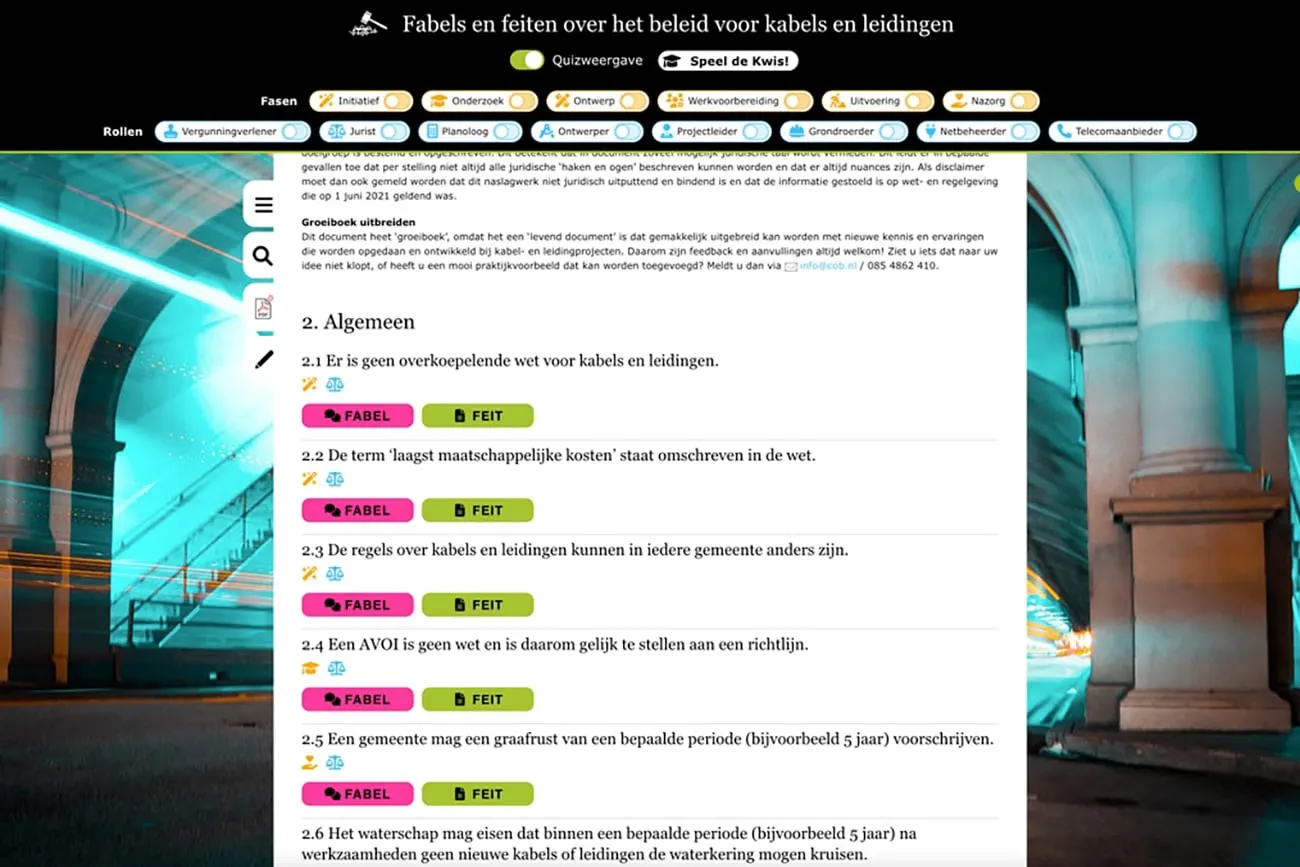
While the tunnel programme is currently focused on three main topics, civil engineering, digitalisation and sustainability (see box), the Knowledge Arena remains highly fragmented. “The analysis ‘Common ground voor ondergronds infra’, carried out in 2018 and 2019, provided a clear picture of the state of underground cable and pipeline infrastructure in the Netherlands and the challenges it faces,” says Jarko van Bloois. “It was already clear then that collaboration would become even more important, but also that it was still very difficult. That is why it was decided to start small, with practical, familiar challenges. This approach has led to several successful research projects in recent years. For example, a comprehensive online reference work, the groeiboek, has been created to explain the myths and facts about laws and regulations for cables and pipelines. Research has also looked at what really lies behind the ‘maze of regulations’ at local authorities, and the behaviour that leads to excavation damage. Knowledge Arena Days in 2021 and 2023 provided opportunities to share and celebrate the results. All this has helped build trust and understanding, and means we can now take the next step.”
Looking to the future
Jarko van Bloois is referring to the more programme-based approach currently being developed. “We are seeing greater attention being paid to the subsurface in spatial planning policy, including the ambition to make water and soil the guiding principles for spatial development. The number of consultation forums, research programmes, knowledge institutions and collaborative partnerships focused on the subsurface is growing. To avoid duplicated work, isolated ad hoc findings, confusion and conflicting conclusions, and instead bring efforts together and create coherence, it would be desirable to give the Kennisarena a more central role and programme research over the longer term.”
“That does not mean, however, that the Kennisarena will operate differently,” Jarko van Bloois stresses. “We will certainly retain our short-cycle approach to knowledge development, breaking research projects down into stages and delivering multiple outputs each year. The sector is very positive about this: it makes the huge challenges manageable and the research tangible and worthwhile. What we want is to align projects more closely with the ultimate goal, where do we want to be in 2030?, so that we have a coherent plan for the coming years. This provides direction and makes long-term funding possible, helping to ensure continuity.”
Sustainability
Sustainability is receiving increasing attention in both the tunnel and cable and pipeline sectors. Under the tunnel programme, the COB network is working towards three overarching goals for renovated and newly built tunnels by 2030: carbon-neutral operation, a maximum of 50% primary raw materials through a focus on reusability, and tunnels as a demonstrable solution for climate-resilient and water-resilient development. In 2022, the Kennisarena conducted research into sustainability in the cable and pipeline sector. Frameworks for developing effective sustainability measures were established in collaboration with government bodies, network operators, consultancy and engineering firms, suppliers and contractors. This work will be taken forward this year. More information is available at www.cob.nl/tunnelprogramma and www.cob.nl/kennisarena.
Question about this story? Ask your question
Keep following this
Get an email when a new story is published. No account needed.
- ThemeUnderground construction
- SubjectUnderground infrastructure







