









Emmakwartier: bringing specialist disciplines together
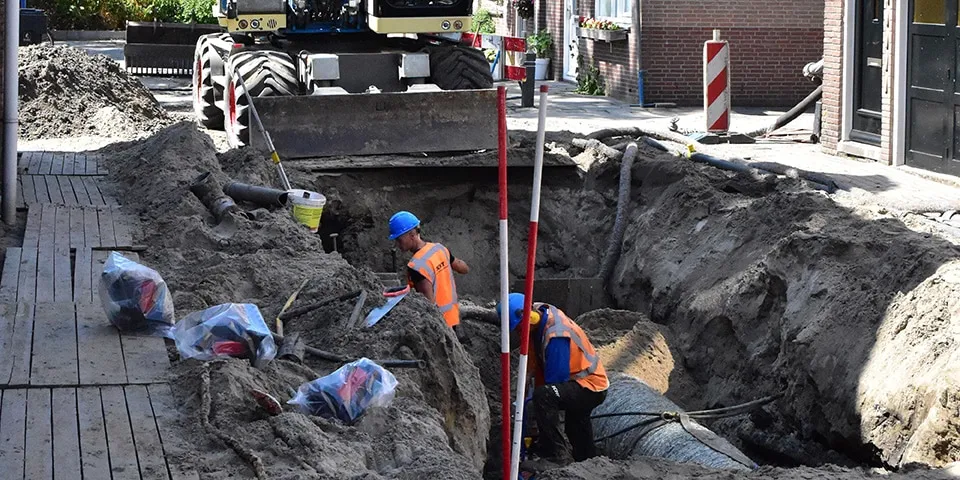
Work began in April 2018 on the climate-adaptive redevelopment of Emmakwartier, both above and below ground, and was completed in May 2019. The project included replacing the sewer and installing a drainage and conveyance sewer (DT sewer).
Wareco, a specialist operating across the Netherlands in urban water, groundwater, drought, environmental monitoring and soil surveys, was involved at every stage, from initiation through to delivery and management.
Sustainable, climate-resilient design
Like many old neighbourhoods in the low-lying Netherlands, Emmakwartier is a high-risk, technically challenging environment. Its pre-war buildings are mainly founded on shallow footings or timber piles, above shallow layers of soft clay and peat, while high groundwater levels cause damp problems in homes. At the same time, groundwater levels drop during dry (summer) periods, which can cause settlement and/or expose timber pile foundations. There is also little space above ground for green spaces, roads and water features.
This complex inner-city environment calls for a combination of specialist disciplines: building expertise, civil engineering, groundwater and water engineering, and drought expertise. Wareco brought together this unique combination of specialist knowledge and monitoring services to seize the opportunity presented by the redevelopment and create a sustainable, climate-resilient neighbourhood despite the challenging conditions, with due consideration for the built environment.
Wareco carried out the following work:
- soil, groundwater and geotechnical surveys to assess current and future conditions;
- design of practical, manageable measures for groundwater and rainwater;
- monitoring before, during and after the work to prevent damage to the built environment and reassure residents;
- liaising with local residents on minimising damage to the surrounding area and improving water management in the neighbourhood.
Survey and design
DT sewer
The preliminary groundwater survey assessed the drainage effect of the old sewer system and the risk of groundwater nuisance arising from replacement of the existing leaking sewers. The findings showed that groundwater measures would be needed as part of the redevelopment, taking climate change into account. Wareco therefore designed an integrated system (DT sewer):
- Diameters ranging from 300 mm to 600 mm, installed at depths of approximately 0.6 m to 0.9 m below the groundwater level;
- Direct discharge of rainwater and groundwater to surface water to prevent high groundwater levels;
- Sills in the overflow chambers ensure that the system retains rainwater for longer during periods of lower groundwater levels.
Early investigations quickly identified the risks, allowing the design to be developed without surprises. Together with Stadswerk072, residents were supported with measures to tackle damp problems. Involving residents early in the groundwater survey and design measures helped build support in the neighbourhood.
Environmentally sensitive construction
During construction, the high-risk environment was a key consideration. Lowering the groundwater level right next to pre-war buildings, in areas with soft soil layers, creates a risk of settlement and damage, as well as delays, reputational damage and other impacts. A dewatering plan was therefore prepared before work began, in accordance with protocol BRL12010. The plan set out the practical dewatering method. Given the high-risk environment, proactive monitoring was part of the dewatering operation, with the method adjusted as necessary in consultation with the contractor, site supervisor and monitoring teams. Groundwater level measurements were the primary guide.
Monitoring included:
- continuous, real-time monitoring systems, moving with the works and deployed in approximately 30 monitoring wells directly alongside the façades in the dewatered sand layer;
- switching dewatering on and off daily;
- elevation surveys (300 in total) to establish baseline conditions. Surveys after completion of the work show whether any unexpected settlement has occurred.
This monitoring plays an important role in ensuring the work proceeds smoothly and in maintaining residents’ confidence.
Assessing the DT sewer’s performance
After the work, Wareco will continue measuring groundwater levels across the area for at least 1 year to assess how the DT sewer is performing. This will make it possible to evaluate whether installing the DT sewer after replacing the sewers has made the neighbourhood more climate-resilient, or whether the system needs to be adjusted.
Construction risks assessed early in the process
Working with Stadswerk072, opportunities to improve the underground infrastructure were identified at an early stage of the redevelopment. This resulted in an integrated system that prevents excessively high groundwater levels and rainwater nuisance, while retaining rainwater intelligently so that it can replenish groundwater when levels are low. The design and construction process was organised so that construction risks were assessed early and monitored during the work. This resulted in a smooth, predictable construction process that reassured the local community.
Wareco’s specialists operating across the Netherlands in groundwater, urban water, buildings, design, construction and monitoring work closely together as a team throughout the process. This unique combination enables sustainable construction and climate-resilient design.
Question about this story? Ask your question
Keep following this
Get an email when a new story is published. No account needed.
- ThemeFlood protection and climate-resilient water management
- SubjectUnderground infrastructure







