









Building underground in a historic setting | De Entree
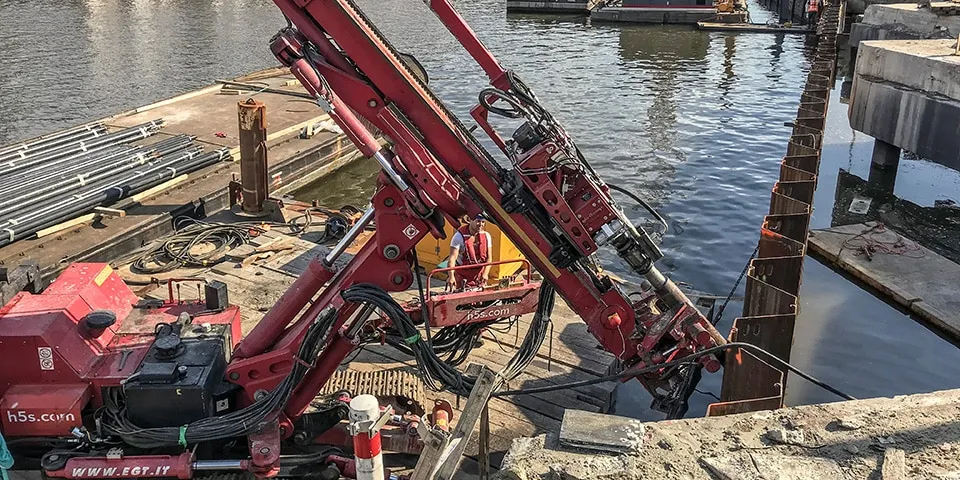
The renewal of the city-centre side of Amsterdam Centraal, the De Entree project, presents a host of challenges. A busy, dynamic setting, a built-up environment with extensive above-ground and underground infrastructure, and a historic subsoil. This led main contractor Max Bögl to bring in GEO2 Engineering’s expertise at an early stage and involve us as a project partner. The geotechnical consultancy’s remit on this project is extensive and, as senior adviser Dennis Wondergem puts it, has considerable depth, both literally and figuratively.
Historic subsoil
GEO2 Engineering has been involved in the De Entree project since the tendering stage in 2016. “The setting for the project is far from ordinary: historic buildings, underground infrastructure such as the North/South metro line, and the subsoil itself,” says Wondergem. “We have considerable expertise in projects of this kind and, thanks to our background, understand better than anyone what contractors need. That is why all our advice takes a practical approach. During the preparatory phase, we worked with Max Bögl & Partners to devise several smart solutions for both the design and construction methods, with as little disruption to the surrounding area as possible. This gave us a financial advantage during the tender.” GEO2 Engineering has remained closely involved in De Entree since the contract was awarded. “We went on to develop the geotechnical design in greater detail, after thoroughly mapping the historic soil conditions,” says Wondergem.
Cycle parking facility below the waterline
The cycle parking facility is being built in a cofferdam with anchored sheet piles and, on the north side, a sheet-pile box, Wondergem continues. “Historic channels of the IJ and the Amstel run through the cofferdam. This means there is considerable variation in the deeper sand layers, which affects the design of the pile foundations and sheet-pile structures. The cofferdam, foundation and anchoring systems have been engineered to prevent the floor from uplifting during the dry construction phase and the facility from settling excessively during operation. Once again, the biggest challenge lies in the interfaces with the surrounding area. These include vibrations caused by constructing the cofferdam, deformation caused by installing and deflecting the sheet piles, and water levels inside and outside the cofferdam.”
Cross-section of the future cycle parking facility (source: wUrck).
Building alongside historic caissons
The new road structure at Westertoegang, which has now been lowered and brought into use, also had interfaces with the surrounding area. “A concrete box structure was used, founded on the ground. We developed its design together with the structural engineer because of the significant interaction between the concrete structure and the subsoil. This included assessing the effect of the caissons below, sunk into place in 1905 and supporting the railway viaduct west of the central station, on the concrete box structure, and vice versa. We also investigated the potential impact of the necessary dewatering. The groundwater level near adjacent properties could not be lowered, to avoid any risk of damage to the historic buildings in the area, which are founded on timber piles.”
Quay walls and temporary jetties
The project also involves the design and construction of two quay walls, east of Kamperbrug and opposite the Noord-Zuid Hollandsch Koffiehuis. Assessing any impact on the adjacent existing quay structures and road and tram infrastructure, and monitoring this, played an important role. Finally, GEO2 Engineering advised on the impact of installing open-ended steel tubular piles for the temporary jetties used by the boat operators, including their effect on the caissons of the North/South metro line, the existing East Line and the existing quay structures in the Station Area.
Question about this story? Ask your question
Keep following this
Get an email when a new story is published. No account needed.
- ThemeFlood protection and climate-resilient water management
- SubjectUnderground infrastructure







