









Addressing underground challenges ‘as an integrated whole’
Text Roel van Gils Beeld COB
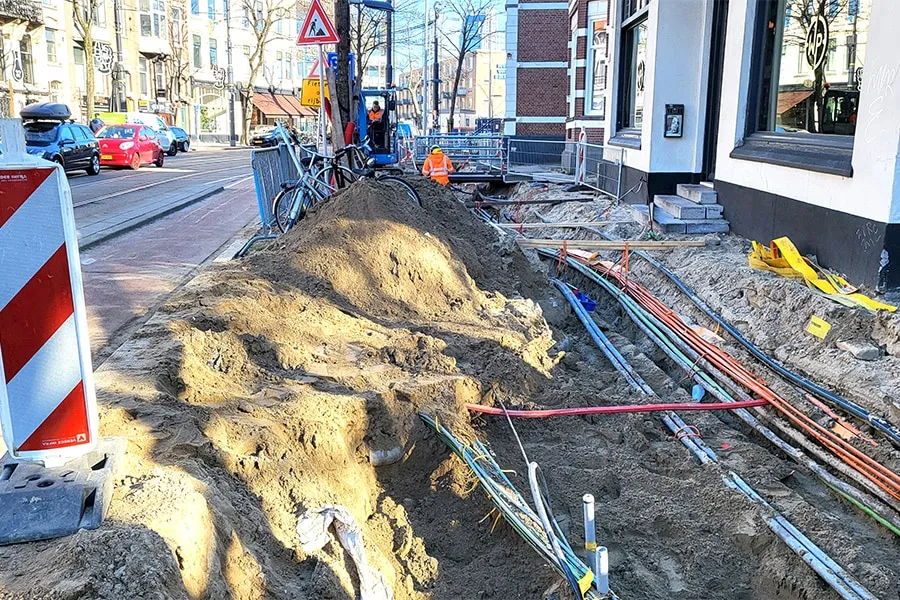
Future-proof utilities and a manageable subsurface
“Siloed working in the cables and pipelines sector, complex legislation and regulations, increasing shortages of space, resources and capacity, and a lack of data and data sharing mean that traditional ways of working no longer guarantee the best results. The energy transition alone is driving a growing realisation that collaboration is essential. No one can do it alone.” So says Edith Boonsma, COB programme manager for the Kennisarena kabels en leidingen. The Kennisarena brings parties together to address future challenges as an integrated whole.
The Kennisarena kabels en leidingen is an initiative by Stichting Mijn Aansluiting and COB. “COB is a membership organisation that develops knowledge in collaboration with a network of more than 120 organisations and makes this knowledge publicly accessible,” says Edith. “Until recently, COB had one major research programme, the tunnel programme. At one point, the Kabels en leidingen platform asked whether we could take stock of what was happening in the cables and pipelines sector, the current state of affairs, the status of legislation and regulations, and so on. This led to the publication in 2019 of the report ‘Common ground voor ondergrondse infra’, which analysed the development challenge facing underground cable and pipeline infrastructure.”

Vision and objectives
On the basis of the report ‘Çommon ground voor ondergrondse infra’, a programme of work was developed with stakeholders, comprising research projects that contribute to future-proof utilities and a manageable subsurface: the Kennisarena kabels en leidingen. “We started with a very practical approach, focusing on topics that several parties were willing to commit to, working with one another rather than against one another. And we’re getting better at it all the time. We’ve now delivered many outputs, agreed on a shared vision and drawn up the outline of a programme to guide the effective delivery of projects relating to cables and pipelines through to 2030. That vision, too, was developed together with our wider network.” The long-term vision identifies three overarching objectives for the Kennisarena. They range from efficient programming, addressing the issue of timing, to optimal spatial planning underground, addressing the issue of space, and manageable, robust delivery.
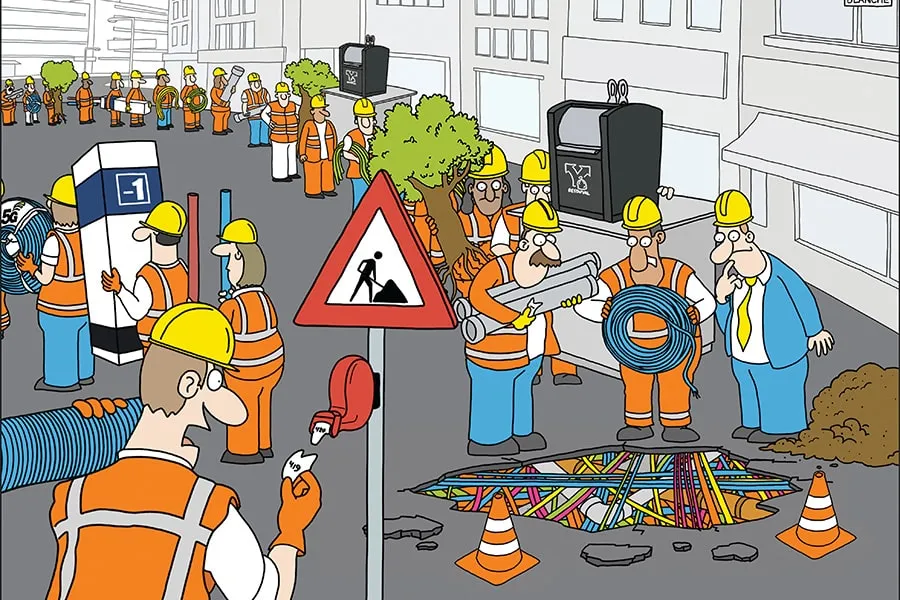
A light-hearted approach to complex issues
Edith knows that interests in the cables and pipelines sector are often at odds. “Network operators have a duty to supply, which is their primary reason for being commissioned. They have to supply water, gas or electricity to households, and lay the cables and pipelines for this ‘somewhere’ underground. Municipalities have different interests. They are keen to avoid having the street dug up too often, because of the disruption to local residents. So the interests are not the same. Contractors, in turn, have commercial priorities and want to be paid properly for the work they do. In the research projects we initiate through the Kennisarena, we work through all these different interests to make the projects attractive to everyone. We make a conscious effort to get participants to look beyond the project scope and their differences. We use all sorts of tools to keep the approach light-hearted, because the subject is complex. These include serious games and quizzes.”

An evolving publication on myths and facts
The results of research projects by the Kennisarena are published in various formats, including an evolving publication. “Think of it as a digital research report that is updated in response to new experiences and insights,” Edith explains. “Among other things, it presents the findings of research into myths and facts about legislation and regulations. In our sector, a lot of decisions are made on the basis of assumptions. This research helps dispel the myths and sets out the facts, so that when parties work together, they do so on the basis of what is true. To make it a little more light-hearted, we’ve created a quiz with various statements for readers to identify as myths or facts. And, of course, scores are kept. It’s a way to become more familiar with the subject. In any case, we can see that the evolving publication is being consulted a great deal. It really is used as a reference work across the whole sector. Everything we publish is free and publicly available.”
Excavation damage as a serious game
Excavation damage is also a hot topic in the sector. “It’s been an issue for as long as anyone can remember,” Edith rightly points out. “Despite tighter legislation and regulations and stricter oversight, the amount of damage caused has not decreased. WIBON, CROW 500, the Kabels en Leidingen Overleg (KLO), everyone focuses mainly on legislation and regulations. At COB, and more specifically within the Kennisarena kabels en leidingen, we suggested looking at excavation damage from a different perspective. More and stricter regulations do not deliver the desired results. Together with behavioural scientists, we created a serious game that shows everything that leads up to excavation damage. It makes clear the consequences of decisions made by different parties at different stages. In this way, we aim to encourage people to change their behaviour, not to act as isolated links but as a genuine chain, with everyone feeling and taking joint responsibility. The game has been such a success that CROW uses it in training and courses on underground infrastructure.”
We really need one another underground, says Edith. “Collaboration is essential. It also means adapting, which is something parties in the cables and pipelines sector have not traditionally been used to. The difficulty is that until recently, it was still possible to squeeze a pipeline in somewhere underground, but those days are over. Especially in busy urban areas. Things are becoming extremely complicated. There is simply too much to deal with. We are not only facing the energy transition: many sewers and pipelines are ageing and need to be replaced, a 5G network has to be rolled out, and we need to move away from gas. In short, it is an incredibly complex operation. Through the Kennisarena, we bring parties together and research how we can find common ground, work together, adapt and learn from one another, in order to achieve future-proof utilities and a manageable subsurface.”
Question about this story? Ask your question
Keep following this
Get an email when a new story is published. No account needed.
- ThemeUnderground construction
- SubjectUnderground infrastructure







