









TenneT is building a new 380 kV substation near Tilburg
Text Suzanne van Gaale Image TenneT
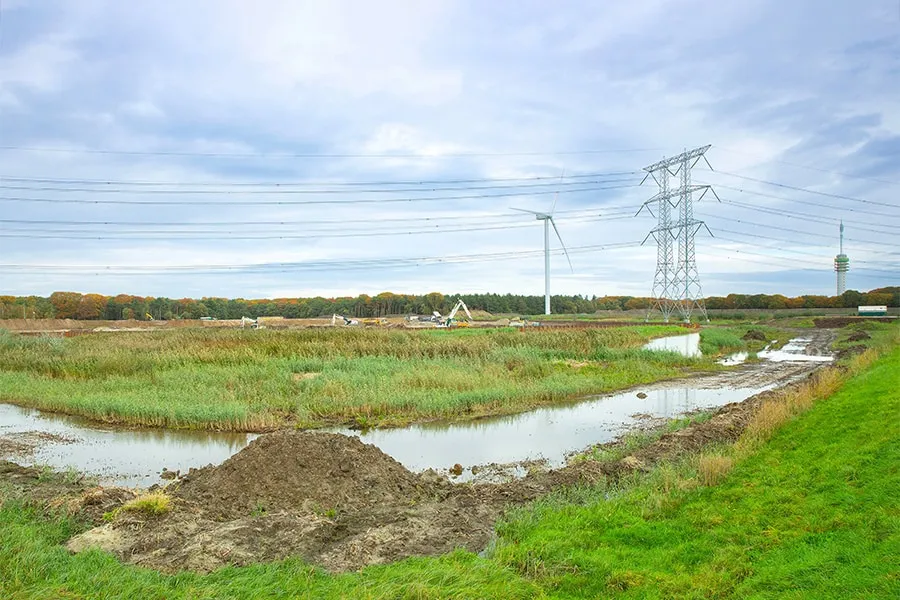
TenneT is building a new 380 kV substation north of the water storage area managed by Waterschap De Dommel near Tilburg. It is working with Samenwerking Croonwolter&Dros-Mobilis, Antea Group and Strukton. The substation is an important link in the regional and national energy transition. There is a great deal involved in this project. In particular, the location, the differing interests of the parties involved and the surrounding natural environment call for the utmost care. Project manager Roel Jannink and communications adviser Harriët van der Weele, both at TenneT, explain what this entails.
“We are facing the biggest overhaul of our energy infrastructure ever,” says Harriët. “The electricity grid in our country is full. Quite simply, we are all using more and more electricity as we seek to move away from coal and gas more quickly. This means that expanding capacity is essential. North Brabant was one of the first regions in the Netherlands to face what is known as grid congestion, or a full electricity grid. It is much like a traffic jam on a motorway. When too many cars try to use the road at the same time, a traffic jam soon develops. Our current grid was originally built for one-way traffic, from power stations to end users. Today, however, a great deal of electricity is also fed back into the grid, for example by wind and solar farms. In effect, the old one-way road needs to be made suitable for two-way traffic. Another factor is that wind and solar power are less predictable, so we have to contend with many more peaks and troughs. We want to generate and use more renewable electricity, but the limitations of the current grid are holding us back. That is why we at TenneT are working hard to make our ‘electricity motorway’ sufficiently robust to cope with electricity supply and demand over the coming decades. The major challenge is to upgrade the infrastructure while keeping the lights on.”
25,000 kilometres of high-voltage connections
To extend Harriët’s motorway analogy, TenneT, as the transmission system operator, is responsible for the motorways: the national high-voltage grid operating at 380, 220, 150 and 110 kilovolts. This comprises around 25,000 kilometres of high-voltage connections in the Netherlands, as well as some in Germany. TenneT transports electricity from its sources, including nuclear, coal and gas-fired power stations, solar panels and wind farms, along these motorways to the provincial and village roads of the regional grid operators: the medium- and low-voltage networks. Transformers at substations convert high voltage to a lower voltage, which the regional grid operator then delivers to homes and businesses. Harriët says: “Put simply, we make sure electricity is available, always and everywhere, with a security of supply of more than 99.99%.”
Tilburg, a piece of the energy puzzle
That covers TenneT’s role and the need for new substations in the Netherlands. But what part does the new 380,000-volt (380 kV) station near Tilburg play in all this? Roel says: “Tilburg is a piece of the energy puzzle for North Brabant and the Netherlands. First, it is needed to prevent current and future bottlenecks in the electricity supply in North Brabant. Second, it will be the endpoint of a new 380 kV connection between Borssele and the national high-voltage grid. The Zuid-West 380kV connection at Borssele will transport electricity from generation sites in Zeeland, Belgium and offshore to this new substation. The substation north of Tilburg will therefore provide space to connect the new link to the national 380 kV ring. That is not all: Tilburg substation will also be connected to the 150 kV electricity network by a transformer. This will be done via underground cables. This will free up capacity on the underlying 150 kV electricity network and help prevent urgent problems with the energy supply.”
What came before
The construction of the new substation is preceded by a long and thorough process. The clients are the Ministry of Economic Affairs and the Ministry of the Interior and Kingdom Relations. “Many regional and local parties and organisations are also involved, including the Province of North Brabant, the Municipality of Tilburg, Waterschap De Dommel, Natuurmonumenten and Huis ter Heide, as well as businesses, landowners and local residents,” says Roel. “It is a huge, complex project involving many stakeholders. Choosing a location is certainly not a matter of guesswork, but a process of careful research, consultation and coordination. On average, this takes around eight years. In this case, the process began in 2017, and we were able to start preparing for construction last year. The location north of the water storage area near Tilburg was ultimately selected because it is close to the existing high-voltage grid, making it the most logical choice.”
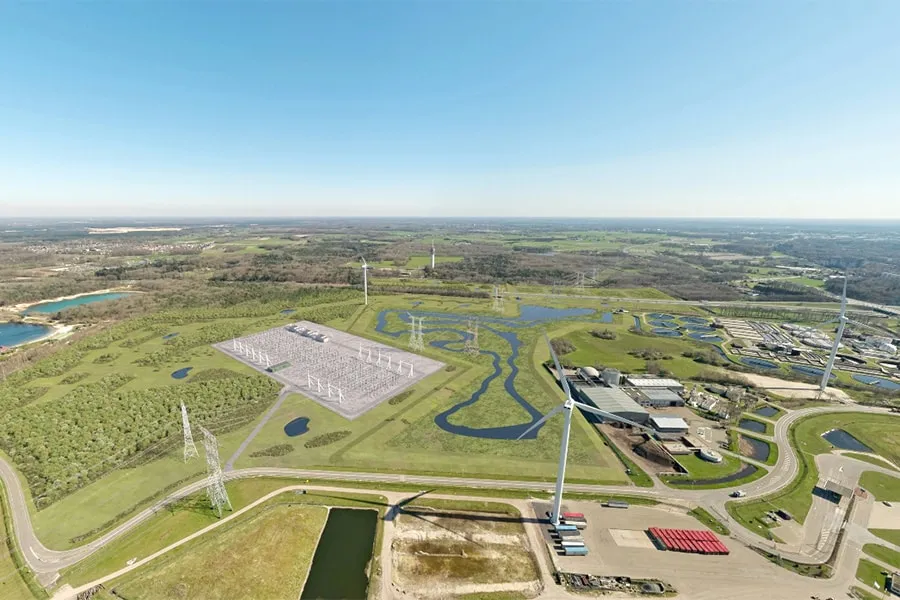
35 football pitches
To give an idea of the scale of the project, the entire construction site covers around 35 hectares. Approximately 6.5 hectares (13 football pitches) of this is allocated to the substation itself, or what Roel calls “the giant distribution board” where electricity is distributed to the various users. “On these 6.5 hectares, we are building 3 transformers and 1 reserve bay for a fourth transformer. There will also be new lattice towers to connect the substation to the existing 380 kV connection. In addition, underground 150 kV cables will run from the new substation to the existing Tilburg-Noord 150 kV substation. This will allow us to connect the 380 kV grid to the 150 kV grid.” Construction of the substation is being undertaken by Samenwerking Croonwolter&Dros-Mobilis. Strukton Wegen & Beton has prepared the entire 35-hectare site for construction and modified and partially relocated the existing water storage area. “We also engaged engineers from Antea Group for the entire preparatory phase, including the design for relocating the water storage area, soil surveys, analyses and planning. The collaboration between the parties is going very well. That is important, because it helps us deliver the most efficient project outcome, which benefits everyone involved.”
Water storage area relocated
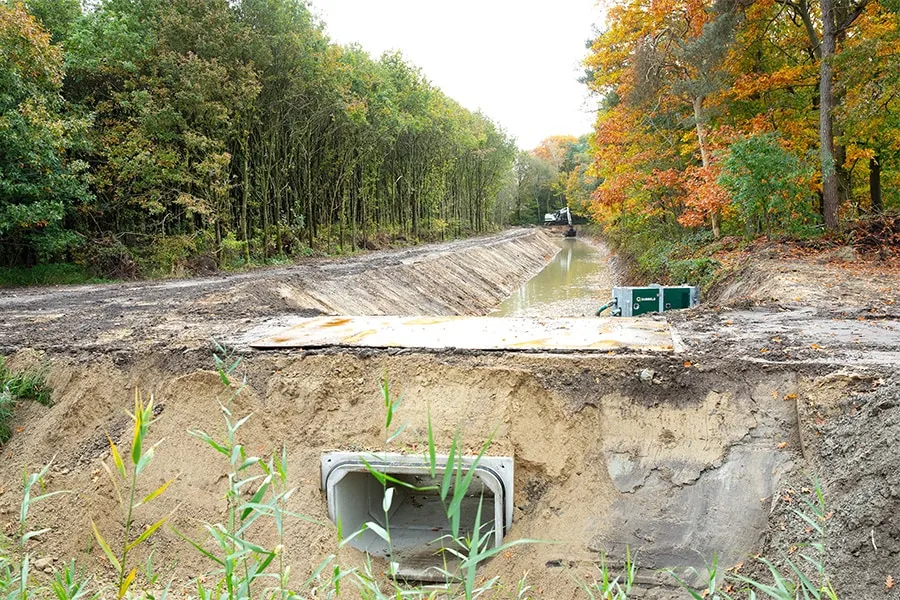
Although the location by the water storage area was a logical choice given its proximity to the existing high-voltage grid, that does not necessarily make it the easiest option. In fact, part of the substation will occupy the site of the water storage area serving Waterschap de Dommel’s water treatment plant. A plan therefore had to be drawn up to relocate the water storage area before construction began. Roel says: “Relocating a water storage area calls for specialist expertise and has a considerable impact. In close consultation with the water authority, the Municipality of Tilburg and Natuurmomenten, among others, Antea Group developed a design that takes existing structures and landscape features into account. In 2025, part of the water storage area will be relocated to the west and east sides of the N261 in accordance with this plan.”
Enhancing the landscape
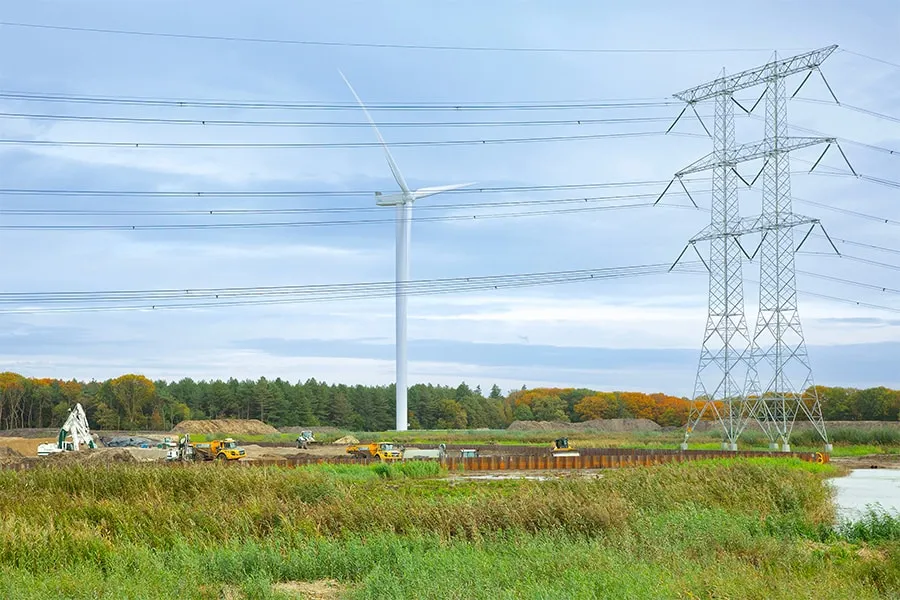
“Our substations affect the landscape, so we always compensate for tree felling, and where possible we go a step further,” says Harriët. “The same is true in Tilburg. This is a particularly interesting project from a nature perspective. Together with the Municipality of Tilburg, Natuurmomenten and the Province of North Brabant, among others, we are working on a wildlife and people corridor. This is a ‘recropassage’, combining an ecological crossing with a cycle tunnel. It links Huis ter Heide and de Brand. The crossing is intended for species including the tree frog, roe deer and great crested newt. A great deal has also been done for the badgers and bats living there. To minimise disturbance to these animals, an artificial sett has been built north of the substation. We have created a migration route for the bats. Some trees had to be felled, so we needed to find a way to help the bats. The trees that will be replanted have been placed temporarily in big bags so that they can be moved easily. Some trees had to be felled to make way for construction. We took this opportunity, together with Natuurmomenten, to open up the landscape, which will benefit certain protected species. As for the construction work itself, we are using low-vibration piling methods instead of drilling. During construction, lighting will be directed towards the site rather than the forest. We are also using screening materials and construction sheeting to prevent potential disturbance to wildlife. In short, together with the nature and environmental organisations involved, we are carefully considering every detail of how we can enhance nature.”
Schedule
Over the past year, a great deal of work has gone into preparing the site for construction, and work is now under way to relocate the water storage area. Construction of Tilburg substation itself is currently in progress. If all goes according to plan, the new 380 kV substation will be commissioned in autumn 2026. To see how the project is progressing, visit the virtual project atlas Zuid West 380 kV Oost on the TenneT website. The atlas provides an aerial overview of the current and planned situations.
A business enquiry for Croonwolter&dros? Get in touch
Wie aan 380 kV hoogspanningsstation Tilburg werkte
- Collaboration Croonwolter&dros: Mobilis
 Croonwolter&drosMentioned in Preparation for construction of Tilburg 380 kV substation now getting under way
- Collaboration Croonwolter&dros: Mobilis
 MobilisMentioned in Preparation for construction of Tilburg 380 kV substation now getting under way
- engineering and consultancy firmAntea GroupMentioned in Preparation for construction of Tilburg 380 kV substation now getting under way
- clientTenneTMentioned in Antea Group provided consultancy services for Tilburg high-voltage substation
- earthworks and remediation partnerGubbels Infra & MilieuMentioned in Strukton and Gubbels lay the foundations for Tilburg high-voltage substation

Keep following this
Get an email when a new story is published. No account needed.
- Project380 kV high-voltage substation Tilburg
- SubjectNews
- CompanyCroonwolter&dros
- CompanyMobilis
- CompanyStrukton Civiel







