









Strukton and Gubbels lay the foundations for Tilburg high-voltage substation
Text Susan Peek Beeld Koen van Rens, Antea Group, Strukton, Gubbels
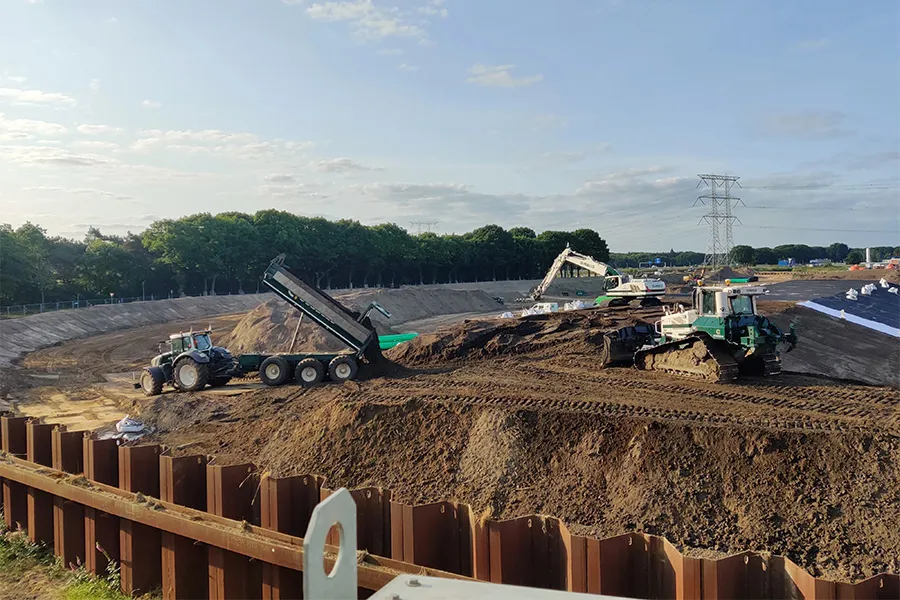
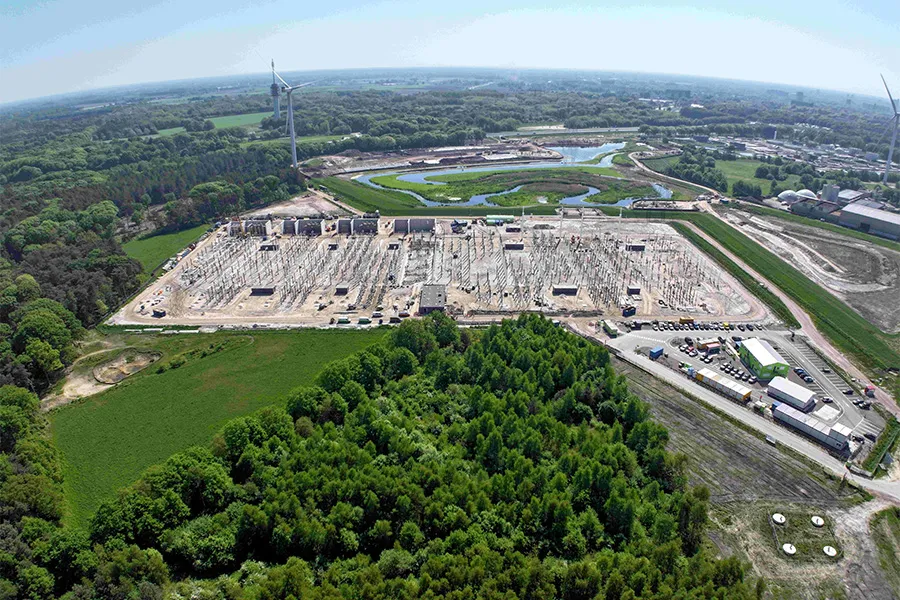
The new 380 kV high-voltage substation near Tilburg is being built in an unusual location: partly on a former vacant plot and partly in the effluent area of the wastewater treatment plant. Preparing the site for construction required land to be relocated, dykes to be modified and contaminated soil to be handled safely. Strukton Wegen & Beton and Gubbels Infra & Milieu worked together on this complex project. Their joint task: to lay the foundations for the substation, both literally and figuratively. Christian Rebbens (Gubbels), Twan van Erp and Sjaak Gerritsen (Strukton) explain.
Working together from the tender stage
The partnership between Strukton and Gubbels began during the tender stage. “We know each other from previous projects,” says Christian Rebbens, managing director of Gubbels. “When Strukton asked us to join the tender, we decided to take it on together.” Bidding for and delivering the work as a joint venture proved to be the right choice.
As part of the joint venture, Gubbels joined Strukton in the project steering group. “This kept the lines of communication short and allowed us to make decisions quickly,” says Rebbens. The division of responsibilities was clear: Strukton took on the civil engineering work, including concrete structures, weirs, culverts and mast foundations, while Gubbels acted as the specialist earthmoving and remediation partner.
Strukton technical manager Twan van Erp was also involved from the outset. “We contributed closely to the planning and construction strategy during the tender stage. From then on, it was a three-way partnership between Strukton, Gubbels and the client. We continually looked at how we could make this complex project feasible and safe.”
Site preparation and remediation
The worksite, covering around 35 hectares, had to be fully prepared for construction. This involved large-scale earthworks, remediation and the construction of new water infrastructure. A total of 191,000 m3 of soil was excavated and processed under remediation conditions, and 91,000 m3 of clean soil was brought in to make the site suitable for construction. In addition, 36,900 m3 of dredged material was removed from watercourses and taken away.
“The unusual thing here was that we were dealing with a legacy from the past,” says Rebbens. “The soil and watercourses were contaminated in many places. The existing embankments were also built using IBC construction, so they had to be rearranged into new IBC structures. In total, we relocated and rearranged 25,500 m2 of IBC dykes. This allowed us to keep most of the contaminated soil within the site, while ensuring it was managed safely and under control.”
The effluent area posed the biggest challenge
The biggest challenge was working alongside the wastewater treatment plant, which had to remain operational throughout the works. “Effluent continued to be discharged into the area during construction,” explains Van Erp. “This meant we had to install temporary sheet-pile structures, and later dredge and fill in the effluent pond area. That section alone required pontoons with cranes and the removal of contaminated dredged material. It was a huge operation, particularly as we had to keep the water level in mind at all times.”
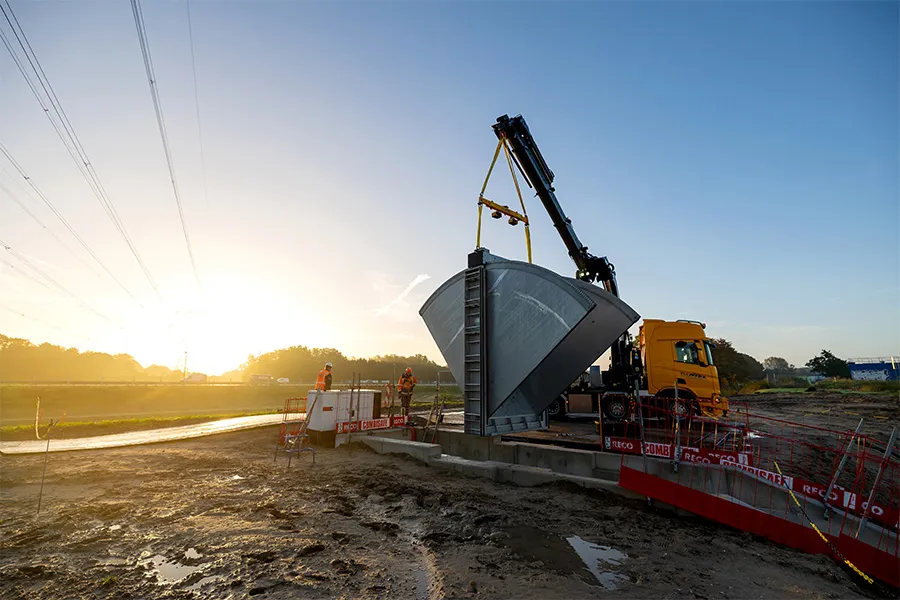
Around 2.5 hectares of the effluent area was lost to the construction of the substation. To compensate, two new water storage areas were created on the other side of the N261, complete with steel sheet piling, overflow areas and new weirs. “We built the three large concrete box culvert weirs with adjustable gates,” says Van Erp. “The work had to be precise to the millimetre, because the water management system has to function perfectly.”
Civil engineering precision and bespoke solutions
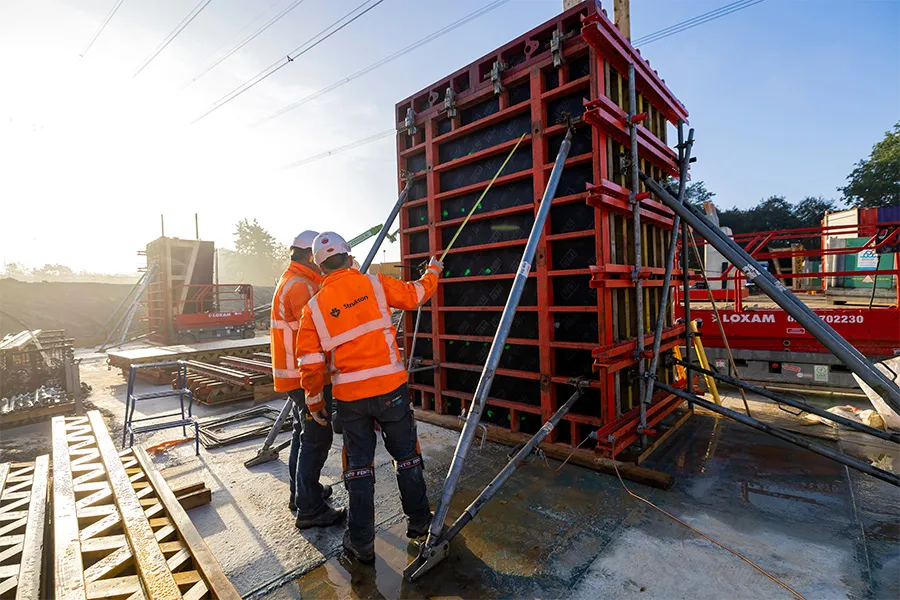
Alongside the earthworks and water management, civil engineering precision was also a key focus. Strukton built four new mast foundations and strengthened four existing ones. “The masts will carry the new 380 kV line, so the positioning has to be accurate to the millimetre,” Van Erp stresses. “We used screw injection piles for three foundations and built concrete pile caps above them. Each foundation was bespoke, because the existing masts all had different shapes and piles. This called for flexibility and on-site engineering.”
The same approach was applied more widely. “We were working with old structures about which little was known,” says Rebbens. “That meant investigating and making decisions afresh each time. For the final mast foundation, we even proposed an alternative foundation method to eliminate schedule risks. This proactive approach was well received and shows that our risk management is sound.”
Three new culverts were also installed and two existing ones extended. A total of 1,800 m2 of asphalt was laid for the fast cycle route, including two new cycle ramps. “The route ran straight through our worksite,” says Rebbens. “We created a temporary diversion so cyclists could pass safely.”
Logistics, weather and risk management
The work required flexibility and forward planning. “We had weeks of rain at the end of 2023 and the beginning of 2024,” says Rebbens. “Despite that, we had to meet the deadlines. You know what matters to the client: getting the substation operational on time. That makes preparing the site and erecting the masts crucial. So you ask yourself: how do we keep the mast contractor and SC&M moving? The water board and Tilburg Municipality were carrying out a lot of work in parallel, and everything had to fit together. We succeeded, and we’re proud of that.”
According to Gerritsen, everyone gave their best to solve the puzzle. “Together with TenneT and Antea, we sometimes changed the phasing: what do you bring forward, and what do you push back so that everyone can keep working?”
Van Erp stresses that anticipating challenges was essential. “However well you prepare, on projects like this you’ll always be surprised by unforeseen circumstances: nature, ground conditions, technology. The question is whether you can respond quickly and safely. We managed to do that together.”
Collaboration is the key to success
Despite the scale and complexity, Strukton and Gubbels look back on the project with satisfaction. “There were so many interfaces on this project, involving TenneT, SC&M, Antea and later Hanab/Selt, that collaboration was truly the key to success,” says Gerritsen. He highlights the breadth of the work: “We did everything at one location: earthworks, remediation, weirs and mast foundations. It was extremely challenging technically and logistically, but together you make decisions in the best interests of the project. The finished result is the best proof that this way of working delivers.”
Rebbens adds: “TenneT facilitated that collaboration and regularly organised safety boosts and coordination meetings. This kept everyone alert and ensured that safety remained the priority. Ultimately, the strength lies in trust: knowing that the other party is doing its job well, so you can keep moving.”
The joint venture itself also worked extremely well, according to Van Erp: “We deliberately ‘let go’ of what had been tendered in 2023. By bringing in additional people and changing the sequence of work, we safeguarded quality and programme.”
The results speak for themselves: all the work was completed within TenneT’s deadline, to a high standard and with very few outstanding items. The high-voltage substation will soon stand firmly on its foundations. SC&M has now begun construction of the substation itself, another important link in the chain where everything comes together.
A business enquiry for Strukton Civiel? Get in touch
Wie aan 380 kV hoogspanningsstation Tilburg werkte
- Collaboration Croonwolter&dros: Mobilis
 Croonwolter&drosMentioned in Preparation for construction of Tilburg 380 kV substation now getting under way
- Collaboration Croonwolter&dros: Mobilis
 MobilisMentioned in Preparation for construction of Tilburg 380 kV substation now getting under way
- engineering and consultancy firmAntea GroupMentioned in Preparation for construction of Tilburg 380 kV substation now getting under way
- clientTenneTMentioned in Antea Group provided consultancy services for Tilburg high-voltage substation
- earthworks and remediation partnerGubbels Infra & MilieuIn this story
Keep following this
Get an email when a new story is published. No account needed.
- Project380 kV high-voltage substation Tilburg
- ThemeMaterials and techniques for infrastructure
- SubjectNews
- CompanyGubbels Infra & Milieu
- CompanyStrukton Civiel







