









HDPE and PE concrete protection for wastewater treatment plants
Text Roel van GilsImage DL Plastics
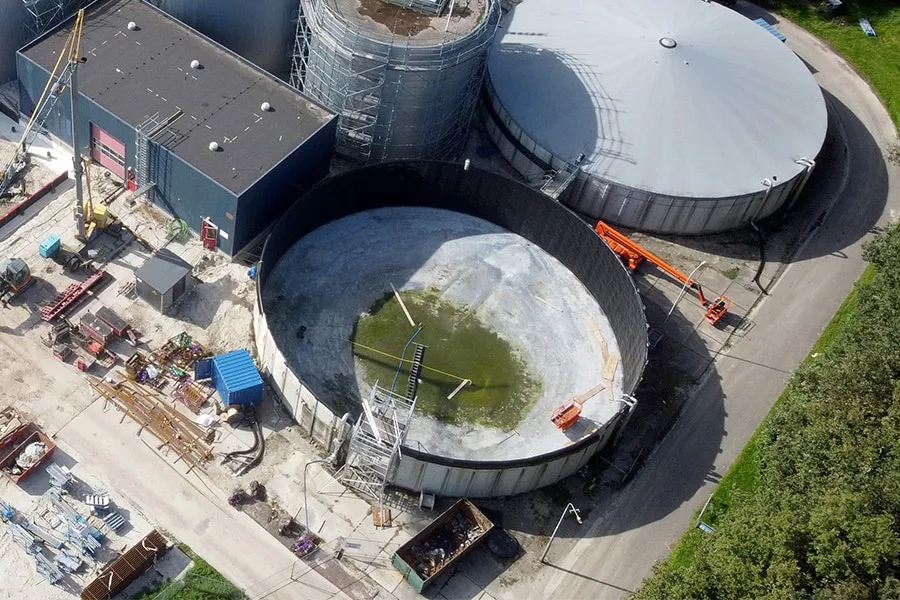
The biological treatment process at a wastewater treatment plant releases H2S gases. The same is true of the process at the RWZI in Echten. H2S gases can attack concrete so rapidly that it rots away within a few years. To prevent this, DL Plastics is installing a special lining in the five concrete tanks at the RWZI in Echten.
DL Plastics knows wastewater treatment plants inside out. “We’ve been to every treatment plant in the Netherlands at some point, to varying degrees,” says Ronald de Lange, who has been involved in the family business all his life. For more than 50 years, DL Plastics has been a major player in the global market for the processing and installation of flexible membranes across a range of sectors. “We’re at home at RWZI and AWZI plants, as well as industrial treatment plants, and we have a solution for every exceptional situation.”
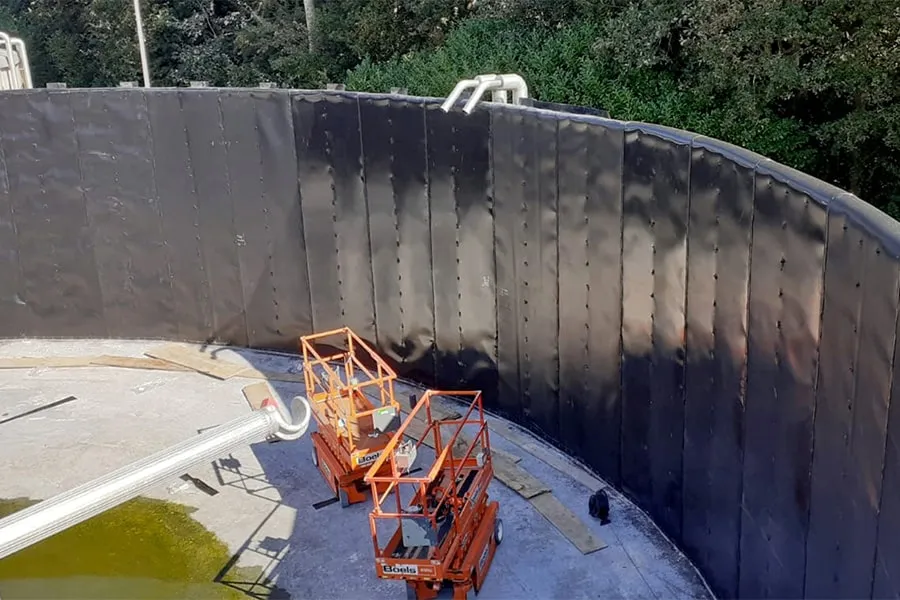
A wide range of options
DL Plastics is also a familiar partner to Van Hattum en Blankevoort. “They always know where to find us for projects like these,” says Ronald. “We reviewed the request internally and proposed a solution. At Echten, different types of concrete protection in HDPE and PP were selected. The latter can withstand higher temperatures. We also distinguish between our DL T-lining for new builds and the DL Renovatie Lining for existing tanks, which is mechanically fixed rather than cast in. All these options are being used here.” The existing tanks at the RWZI in Echten are to be fitted with a roof. “In the past, the gases could escape freely here, but now that everything is enclosed, it is crucial to protect the concrete properly above the waterline. We therefore connect to the existing materials and can weld them together seamlessly.”
Pressure on the schedule
DL Plastics installs the DL Renovatie Lining itself, while the DL T-lining is made to measure and fitted to the formwork by Van Hattum en Blankevoort. “Naturally, we weld all the joints on site and test them,” says Robert Rouhof of DL Plastics. “We also finish all corners and penetrations, ensuring every gap and seam is sealed.” One tank has now been completed, with the other four scheduled for next year. “The biggest challenge is the weather. Plastic welding requires temperatures above 5 degrees Celsius and dry conditions. Our work also always takes place immediately after the concrete work and before the finishing work begins. So the schedule is always tight, but that’s something we can handle. And because we work across several sectors, we can quickly step in and bring in extra people if needed.”
In total, DL Plastics is installing around 2,000 m2 of concrete protection at the RWZI in Echten. “As well as the five tanks, we’re also protecting a number of small grit traps and a concrete screen.”
Een zakelijke vraag aan DL Plastics? Get in touch
Companies in this story
Keep following this
Get an email when a new story is published. No account needed.
- ThemeExtending the life of roads and civil engineering structures
- SubjectNews
- CompanyDL Plastics







