Working together to extend the service life of structures
Text Tjerk van Duinen Image Rijkswaterstaat / BOP
Rijkswaterstaat engages with the market
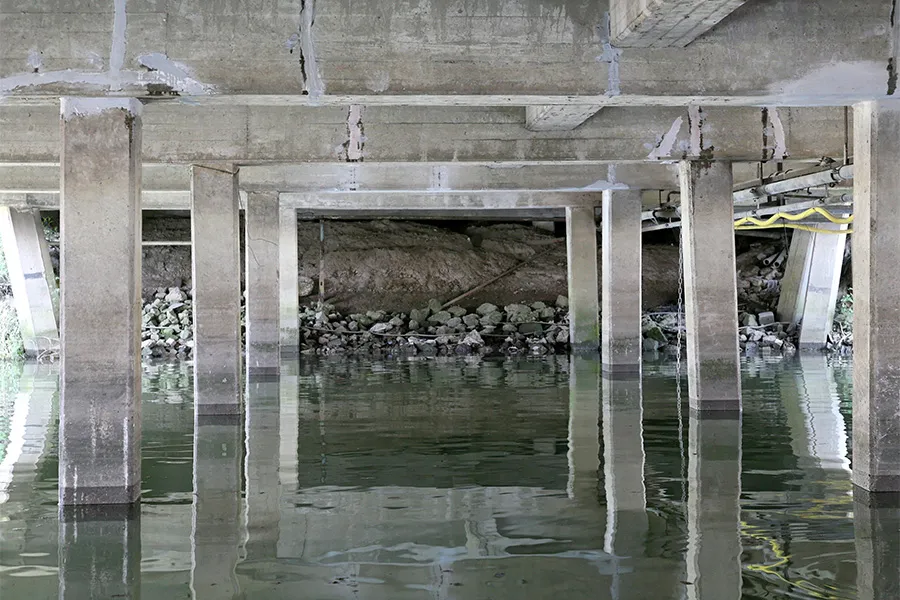
Asset management is high on Rijkswaterstaat’s agenda. In this context, maintenance and the extension of the service life of concrete structures are also receiving increasing attention from the national infrastructure manager. After all, this is one of the most sustainable ways of managing infrastructure. Maintenance can therefore make a major contribution to sustainability ambitions for the coming decades.
To sum up the challenge in a few figures, Penny Pipilikaki, Senior Technical Adviser in Concrete Technology at Rijkswaterstaat, paints a picture by construction period. “There are still 300 to 400 structures dating from before 1960. During the major construction wave between 1961 and 1980, 2,115 bridges and viaducts were built, two a week, followed by 1,033 in the subsequent twenty years. Since 2000, the figure has been 1,129. Older structures were designed for loads that were thought at the time never to be reached, but many are already operating at their maximum capacity. There is more traffic, lorries are getting heavier, and electrification is also adding weight. This will only increase. To continue to guarantee structural safety, we can limit the loads, strengthen the structure or replace it with a stronger one. The number of necessary replacements will begin to rise from 2030 and peak between 2040 and 2060. This is already a major challenge to manage, with limited resources and without putting excessive strain on the accessibility of the Netherlands as a transport hub. Add the viaducts, underpasses and bridges owned by provinces and municipalities, and the total comes to 90,000 structures.”
The importance of maintenance
Replacement alone is not an option. The scale of the challenge is too great and resources are too limited. The government also has sustainability ambitions. In 2020, the ‘Strategy for Climate-Neutral and Circular Rijksinfrastructure’ was formulated. To put this strategy into practice, five transition pathways were drawn up, including the Transition Pathway for Structures, a roadmap for government bodies and market parties towards climate-neutral and circular infrastructure. Maya Sule, Programme Manager for the Transition Pathway for Structures: “Maintaining existing structures is an important part of this. Maintenance, or ‘Repair’, ranks high on the R-ladder of circular strategies. Some structures will have to be replaced, while others can be responsibly retained while still guaranteeing structural safety. With planned maintenance, we can arrange things so that structures remain in use for longer without placing an undue burden on future generations.”
Finding a balance
Extending service life, replacing or retaining structures: Rijkswaterstaat has to weigh up many factors and still has much to learn. Penny says: “We need to find an accurate way to determine what should be demolished and what can be retained. We already know that some structures cannot be kept in service; for those where the answer is less clear, there is a range of solutions available. A great deal of research has already been carried out into making new concrete more sustainable. Given their impact on sustainability, service-life extension measures also deserve our full attention. That is why ‘Service Life Extension’ measures are also part of the Transition Pathway for Structures. Our main aim is to take communication and knowledge-sharing with the market to the next level. We would like to hear from the market about innovations and techniques that extend the service life of concrete structures in particular. We can then take these into account when striking a balance between replacement and retention.”
Sharing knowledge
Maya: “Companies in the concrete maintenance sector told us that we were mainly talking to contractors. We engage with the whole supply chain, particularly when it comes to sustainability. It is important for us to know where repairs are frequently carried out, how they could be avoided and how replacement construction could be improved. That is, of course, a difficult question to ask, since this is their work, but given the enormous challenge we face, there will still be plenty of work to go around. We do not draw enough on this kind of knowledge from across the supply chain. Design firms must also learn from it, so that, first, design errors that make routine maintenance difficult can be avoided and, second, solutions are already in view at the design stage in case the design unexpectedly needs to be strengthened after all. This makes the design adaptable. You avoid using too much material now and can respond to different circumstances later if necessary. That is how we work sustainably.” We are familiar with ways of keeping concrete in service for longer, such as cathodic protection. I am also involved with the KB Kenniscentrum, because it is a proven way of preventing reinforcement corrosion.”
Question about this story? Ask your question
Keep following this
Get an email when a new story is published. No account needed.
- ThemeMaterials and techniques for infrastructure
- SubjectConcrete