Impressive concrete structures for the new Royerssluis
Text Roel van Gils Image Rinkoniên Royerssluis
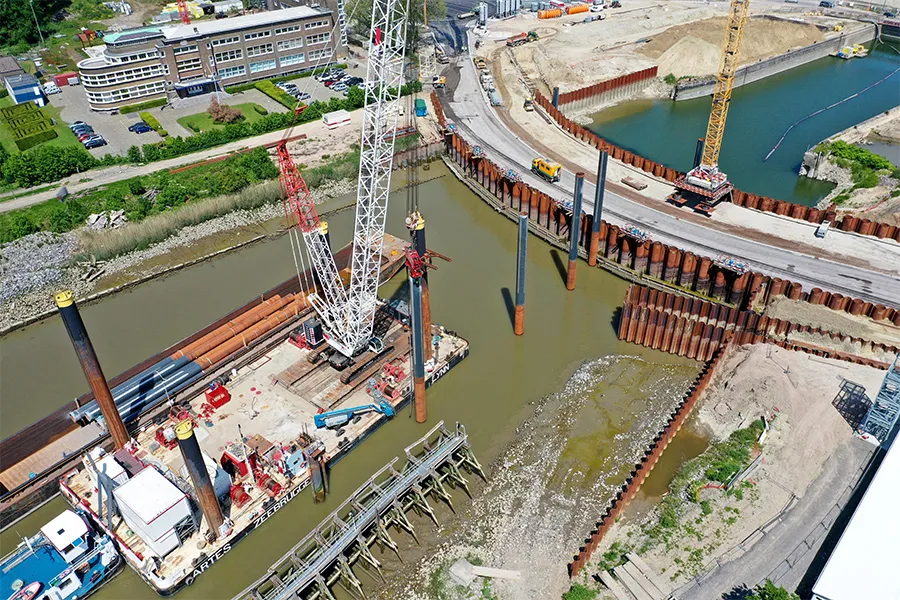
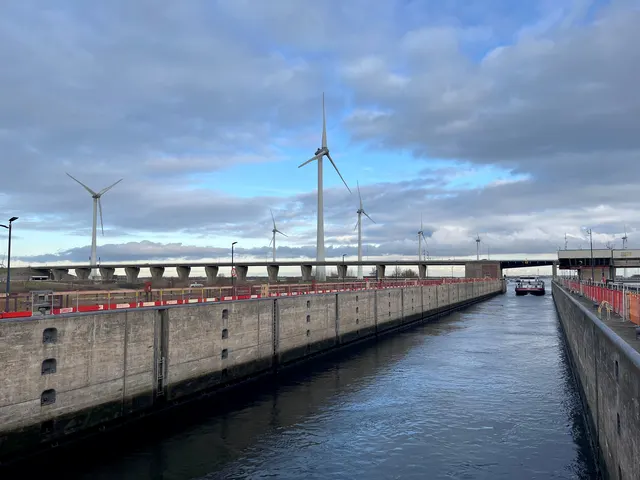
After more than a hundred years of faithful service, the Royerssluis in the Port of Antwerp was showing signs of wear. The existing lock was also not designed to accommodate the ever-larger vessels passing through the complex. The Flemish Government therefore decided to replace it with a new, larger lock. An enormously complex undertaking that will take no less than seven years in total, with the Oosterweelknoop construction pit also just a stone’s throw away. Over the next two years, the focus will be on building the impressive concrete structure of the new lock.
The Royerssluis is one of the most important locks in Antwerp. It is a key gateway for inland shipping, connecting the Scheldt with the Albert Canal. “The old lock was in need of an overhaul,” says Sofie Nullens, Royerssluis project manager at the Department of Mobility and Public Works. “It was outdated and suffered from significant leakage, resulting in very long lockage times. The lock gates and bridge functions were also not independent of one another. This meant that when the lock broke down, both shipping and road traffic were disrupted, and breakdowns were a regular occurrence. Finally, the lock was too small for the emerging four-barge push-tow configuration.”
Engine of the Flemish economy
There were plenty of reasons for a complete transformation. And what a transformation! The existing lock is being completely replaced with a new, longer and wider lock, allowing modern inland vessels to pass through safely and smoothly, and increasing freight volumes to the Albert Canal. “These works will help the engine of Flanders’ economy run more efficiently,” says Nullens. The new lock is not the only project in the surrounding area. “The Royerssluis has many technical interfaces with the channel-zone tunnel of the Oosterweel Link. The tunnel runs very close to the upper lock head, where the roads of the new Oosterweelknooppunt will connect. To minimise disruption and benefit from economies of scale, we jointly tendered the works and awarded the contract on the basis of price and quality to the Rinkoniên consortium. It comprises Belgian companies Artes Group, CIT Blaton and Stadsbader, and Dutch companies Mobilis and Boskalis.”
Detour
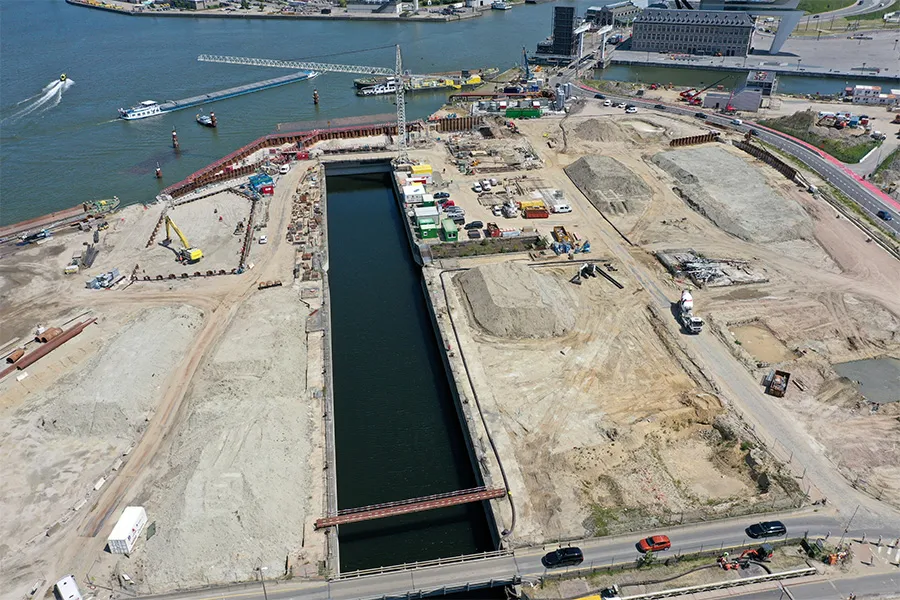
Work began in October 2021. The first vessels will be able to pass through the new Royerssluis in early 2029. The project was meticulously prepared. The works are also having a major impact on shipping traffic. “We had to relocate some of the lock’s functions, and of course the old lock has been completely demolished. Inland vessels are currently being diverted via the Boudewijn and Van Cauwelaert locks and the Berendrecht and Zandvliet lock complex. Both are large sea-lock complexes, so they are not ideal for inland shipping. Vessels also have to take a long detour. So it is vital to bring the Royerssluis back into service as soon as possible.” The preparatory and demolition works have now been completed. “We built a cofferdam around the old lock so that we could carry out the demolition in dry conditions and excavate the construction pit for the new lock,” says Ward Vertonghen, project director at the Rinkoniên Royerssluis joint venture.
150,000 m³ of concrete
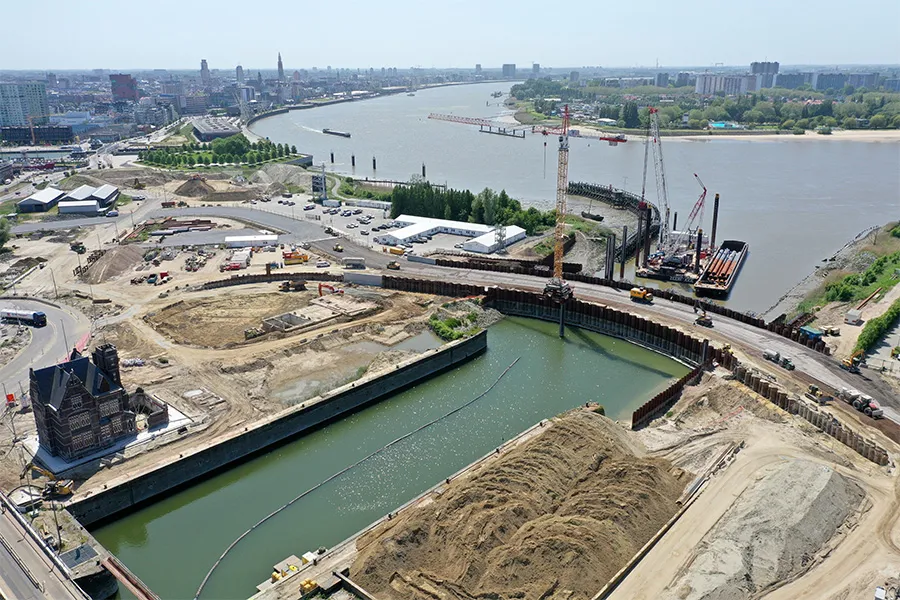
Excavating the construction pit involves moving enormous volumes of earth, more than 400,000 m³, enough to fill almost 6,000 large shipping containers. “Earthworks are in their final phase, and over the next two years we will focus mainly on the concrete works,” Vertonghen continues. The new lock will be 36 metres wide and 235 metres long. The volume of concrete to be pumped, more than 150,000 m³, is equivalent to filling over sixty Olympic swimming pools. More than 25,000 tonnes of reinforcement will also be required. “Alongside the concrete structure, we are also busy preparing the steelwork and all the mechanical components, which require the necessary cast-in provisions. The lock will have a steel rolling gate at each end, weighing 1,000 tonnes on the Scheldt side and 600 tonnes on the dock side. The gate on the Scheldt side is taller because of the higher water level, and is therefore heavier. There will also be two almost identical movable bascule bridges carrying road traffic over the lock.”
Wheelbarrow principle
According to the current schedule, the concrete structure will be largely complete by early 2027. “We can then backfill around the lock and flood it,” explains Vertonghen. “The gates and bridges will then be installed. They are being built in parallel by Victor Buyck. The gates use a wheelbarrow principle, with upper and lower roller carriages running on a rail and pulled into and out of the gate chamber by winches in the machinery building. The gate chamber itself can be completely drained for maintenance on the gates.”
Nullens adds: “The gates are 10 metres wide and can also be used by cyclists and cars to cross the lock in an emergency, should both bascule bridges be out of service. The bascule bridges are wider, of course, with two road lanes and a 4-metre-wide shared footpath and cycle path. Particular attention is therefore being paid to vulnerable road users.”
Lock keeper’s house
The former lock keeper’s house is also receiving special attention as part of the project. “It now stands on an isolated island in the middle of the large construction pit. The house has been a listed monument since 2001 and is being incorporated into the new design to preserve the link with the past,” says Nullens. “The new lock’s nautical control centre will be housed there.” Vertonghen adds: “The house has been placed on a stable diaphragm wall structure and shored up, so that it is unaffected by the lock’s structural works. Once the lock has been built and backfilled, we will restore the house, preserving as many historic features as possible, including the internal walls, stairs, floors and even the fireplace. In addition, we are building two machinery buildings for the lock gate equipment and a central technical building.”
Finally, the self-closing mobile flood barrier is also worth mentioning. “If the Scheldt gate is open and breaks down during a severe storm, Antwerp will not be protected from extreme high water via the lock,” says Nullens. “To guard against this, a self-closing mobile flood barrier will be built into the lock deck.” The new Royerssluis is scheduled for completion at the end of 2028, with the first inland vessels expected to pass through in early 2029.
Have a business enquiry for Mobilis? Get in touch
Companies in this story

Keep following this
Get an email when a new story is published. No account needed.
- ProjectRoyerssluis
- ThemeMaterials and techniques for infrastructure
- SubjectConcrete
- CompanyMobilis
- CompanyBoskalis Nederland