How grey concrete turns green
The Greeks and Romans were already working with cement mixes in ancient times, forming the basis of today’s concrete. Reinforced concrete was not invented until the 19th century. Concrete is therefore ‘as old as the road to Rome’. If we take sustainability to mean ‘service life’, concrete can be called sustainable avant la lettre. Today’s concrete has so many positive qualities that we can confidently call it a sustainable product, turning from grey to bright green.
“When we look at concrete as a building material, we can see that it offers optimum liquid impermeability, allows construction in any shape, requires little maintenance and is strong and robust. Add its fire-resistant properties and long service life, and there is no escaping the conclusion that concrete scores highly in terms of sustainability and versatility,” says Ron Peters, director of Betonhuis.
Concrete and CO2
Peters says: “Making the material and our sector more sustainable is one of Betonhuis’s key priorities.” Looking at the debate around CO2 from concrete production, the associated emissions come partly from limestone, which is needed to produce clinker, and partly from the production process itself. Three quarters of the mass of building materials used in residential and non-residential construction in the Netherlands consists of concrete. The Netherlands processes between 13 and 15 million cubic metres of concrete each year. Given these volumes, concrete does feature on the CO2 emissions ladder, but volume is an important factor here. Moreover, concrete has a favourable CO2 profile compared with other building materials. In the Netherlands, concrete accounts for just 1.6% percent of CO2 emissions, including the production of cement and reinforcing steel abroad. “This share is low, but it clearly needs to come down further and ultimately reach zero. In line with the European Green Deal, the European cement and concrete industry is therefore working towards CO2-neutral cement and concrete by 2050.”
Concrete and circularity
Concrete can be used in a circular way, its raw materials are widely available and it creates no waste. Structures and building components can be reused, extending their service life. Concrete can also be recycled into aggregate. Concrete is made up of cement, sand, gravel and admixtures. Concrete recovered from demolished buildings in the Netherlands can replace up to 20% of gravel with recycled concrete aggregate.
Concrete protects: ‘Our health lies underground’
Betonhuis Riolering has launched this campaign to highlight the protective role of sewerage. The campaign explores the choices involved in replacing sewer systems and showcases the qualities of concrete sewerage.
“Sewerage is invisible to many people, but indispensable. It ensures that wastewater and rainwater are carried away safely and hygienically. That is why Betonhuis Riolering has launched the awareness campaign ‘Our health lies underground’,” explains Annemiek Houtman, sector secretary at Betonhuis Riolering.
“Sewerage helps prevent people from coming into contact with polluted water containing bacteria and pathogens. Thanks to this sanitary infrastructure, average life expectancy increased significantly in the twentieth century. Sewer systems are subject to stringent quality requirements. Wastewater must be carried away safely, after all. Concrete sewerage provides this assurance, even now that the load on the sewer network is rising sharply as more and more is discharged into it.”
Sewerage also plays a role in climate adaptation. The risk of flooding, drought and heat is increasing, posing risks to our economy, public health and safety. Cloudbursts and prolonged rainfall cause flooding, while at other times drought causes damage. Houtman says: “Permeable concrete pipes enable water storage, conveyance, infiltration and drainage to be managed while respecting the environment through continuous groundwater management. Concrete also protects the environment and prevents polluted water from entering streams and rivers. The raw materials for concrete are available regionally or locally, or within a reasonable distance. At the end of its service life, concrete is recycled, for example as foundation material or as aggregate for making new concrete. This makes concrete sewerage an environmentally conscious choice.”
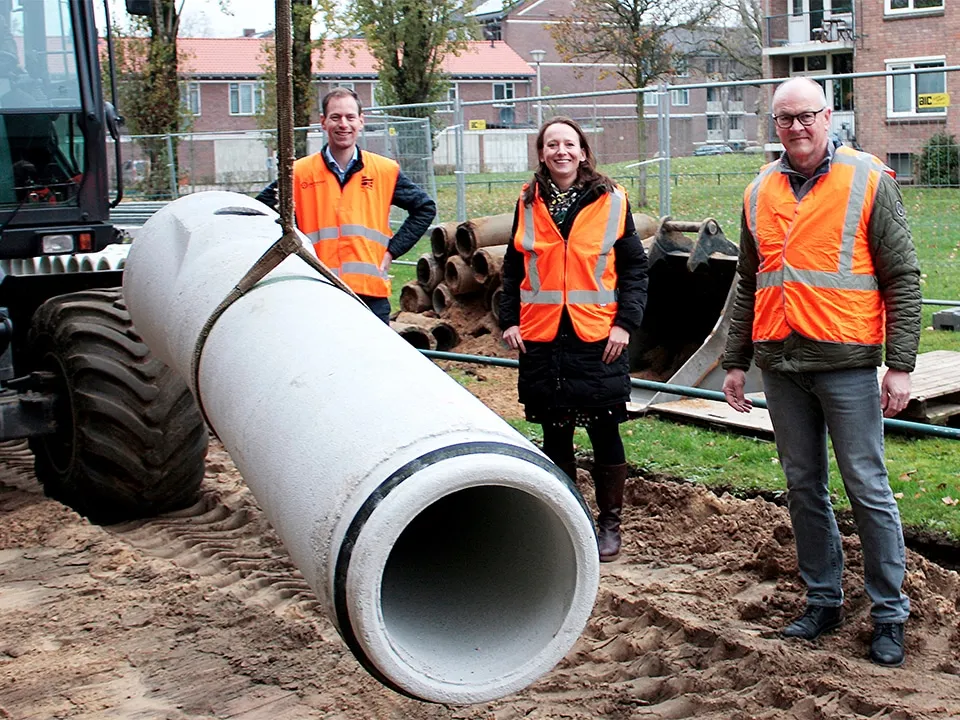
First CO2-friendly sewer pipes installed in Nijmegen
Nijmegen is the first city in the Netherlands to install sustainably produced sewer pipes. They were laid this week at Pijlstaarthof. The concrete pipes are made by De Hamer Beton in Nijmegen, which is also a member of Betonhuis, and contain a new binder with a far lower environmental impact than the widely used Portland cement. Eric de Groot, commercial director of BTE Nederland, which includes De Hamer, calls the use of the more sustainable sewer pipes ‘a new step’. De Groot says: “Our mission is to limit CO2 emissions from concrete production as much as possible. We are already doing this by working increasingly in a circular way and by using alternative binders for concrete.”
It is no surprise that the first sustainable HaproGeo pipes are being installed in Nijmegen. “When Nijmegen was Green Capital in 2018, we ran a pilot with the municipality using sewer pipes made up of 10 percent material recovered from old concrete. Making them even more sustainable is the logical next step,” says Matthijs Voschezang, regional manager at De Hamer. “We are based in Nijmegen. Of course you want to see a first like this in your own city.”
Concrete also protects at filling stations
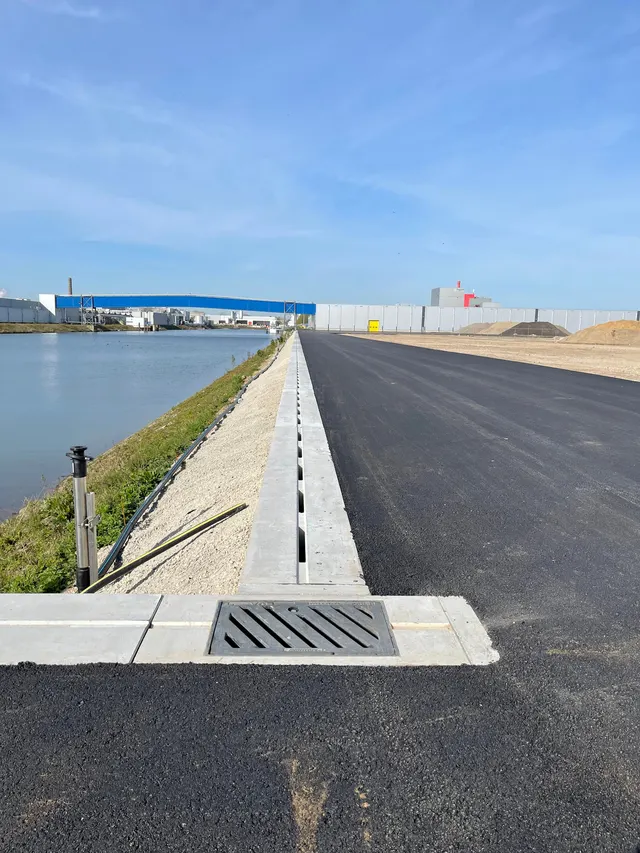
Floors at filling stations need to be liquid-tight, low-maintenance and durable. “I can’t think of a better material than concrete for meeting these requirements,” says Arjen Blaauw of Cimitec. “Concrete helps protect the soil from oil and fuel seeping into it.” As long as petrol and diesel are being sold, filling stations need liquid-tight floors to prevent fuel from entering the ground. Cimintec specialises in monolithic floors for filling stations. “Before the 1990s, filling stations mainly used individual elements, which were cast in place with liquid-tight concrete. Monolithic concrete floors are more common today. They are less prone to settlement. However, it is essential to get the base right: the ground beneath the floor must be level, and the floor must be laid properly.”
According to Blaauw, concrete is the only suitable material for floors at filling stations. “The only alternative is asphalt, but it is nowhere near as resistant to oil and fuel as concrete. The material is also highly durable: it requires little maintenance and lasts a long time. We design for a service life of fifteen years, as that is the period assumed for a filling station, but the concrete itself lasts much longer.”
Concrete protects
Concrete is everything and everywhere. It is part of our lives, wherever we are. We are surrounded by it without even realising. We rely on concrete because it is exceptionally strong, safe and reliable. We build with concrete because it makes anything possible.
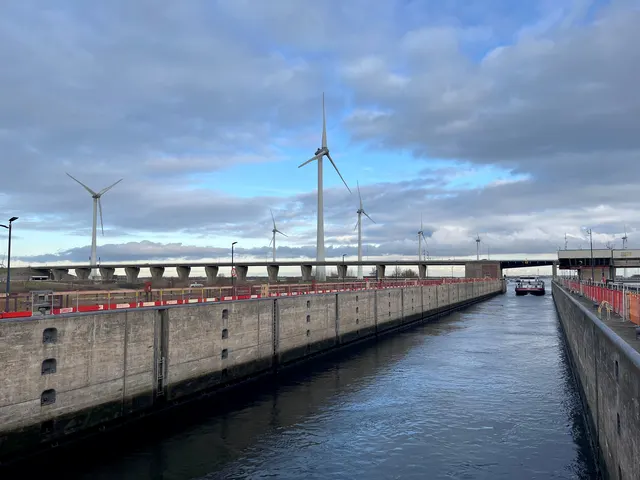
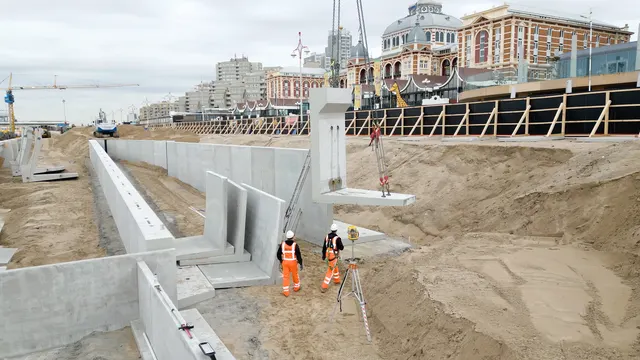
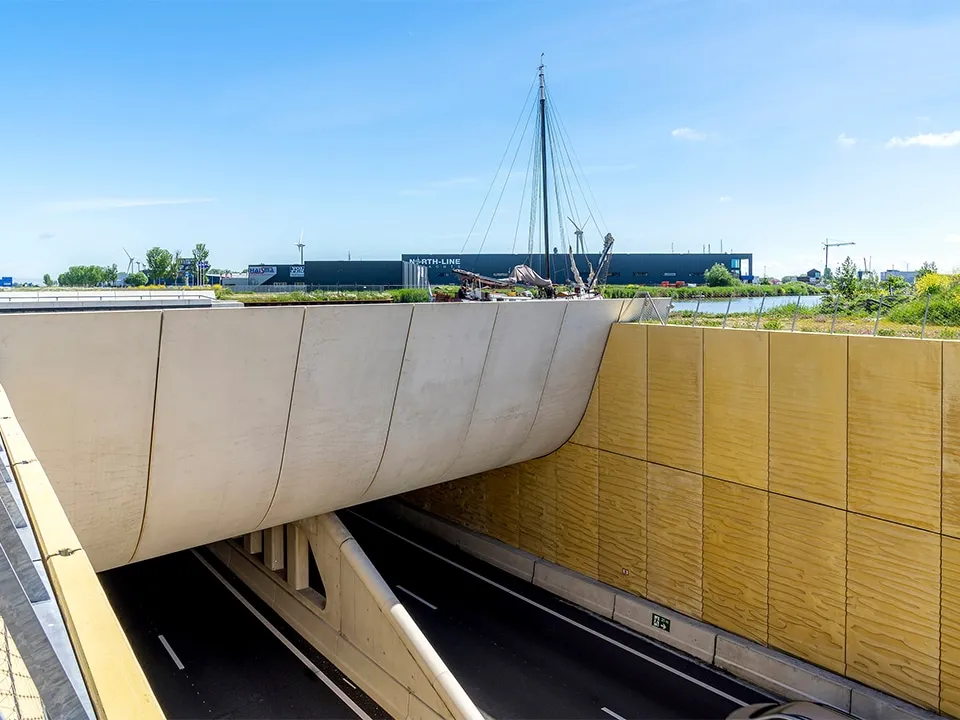
Concrete can be both monumental and modest. Flood defences protect our country, while tactile paving guides us through the bustle of the streets. Water treatment plants provide clean drinking water. Meanwhile, badgers, pine martens and red deer can cross safely over ecoducts. Our economy runs on infrastructure made up of roads, bridges and viaducts. At the same time, sewer systems protect our health, helping us live better and longer lives. Throughout the time concrete protects us, it remains as we know it: sustainable and energy-neutral, because concrete retains heat better than any other material. Wonderfully strong and proven over decades. Low-maintenance and reusable. It can always take on a new form. Concrete is everything and everywhere for a reason.
More information:
www.betonbeschermt.nl
Question about this story? Ask your question
Keep following this
Get an email when a new story is published. No account needed.
- ThemeMaterials and techniques for infrastructure
- SubjectConcrete