Concrete is versatile and always close at hand

“The market still equates sustainability with a long service life. That is how people like to think of concrete. But concrete is so versatile that it is much more than a product with a long service life.” So says Ron Peters, director of Betonhuis.
As an organisation, Betonhuis represents the interests of seven sector associations in the cement and concrete industry. Paving, Ready-mixed Concrete, Concrete Producers, Cement, Structural Precast, Sewers, and Bricks and Blocks are subsectors of this industry, all of which benefit from Betonhuis as a knowledge centre and advocate. In Peters’ view, concrete’s image could certainly do with a boost, given all its advantages. Betonhuis is committed to making that happen.
Good properties
“When we look at concrete as a building material, we can see that it offers excellent liquid-tightness, allows construction in any shape, requires little maintenance and enables strong, robust structures. Add its fire-resistant properties and long service life, and you can only conclude that concrete scores well in terms of sustainability and versatility,” says Peters.
What about the circularity and CO2 emissions of concrete?
In Peters’ view, the market still views concrete with a degree of scepticism when it comes to circularity and the CO2 released during production. “Concrete can be used in a circular way. The raw materials are widely available and no waste is created. Structures and building components can be reused and their service life extended. Alternatively, the concrete can be recycled into aggregate. Concrete consists of cement, sand, gravel and admixtures. The concrete recovered from demolished structures in the Netherlands could replace up to 20% of gravel with recycled concrete aggregate, but there is always more concrete needed than that 20%.”
Another concern is the amount of CO2 associated with concrete production. Peters says: “CO2 emissions result partly from the limestone needed to produce the clinker semi-finished product, and partly from the production process. But the real factor is that we are talking about enormous volumes of concrete being used every year. Compared with other building materials, concrete itself has a favourable CO2 profile. The Netherlands uses between 13 and 15 million cubic metres of concrete annually. With volumes like these, concrete does indeed feature on the CO2 emissions ladder, but this is purely a matter of volume.”
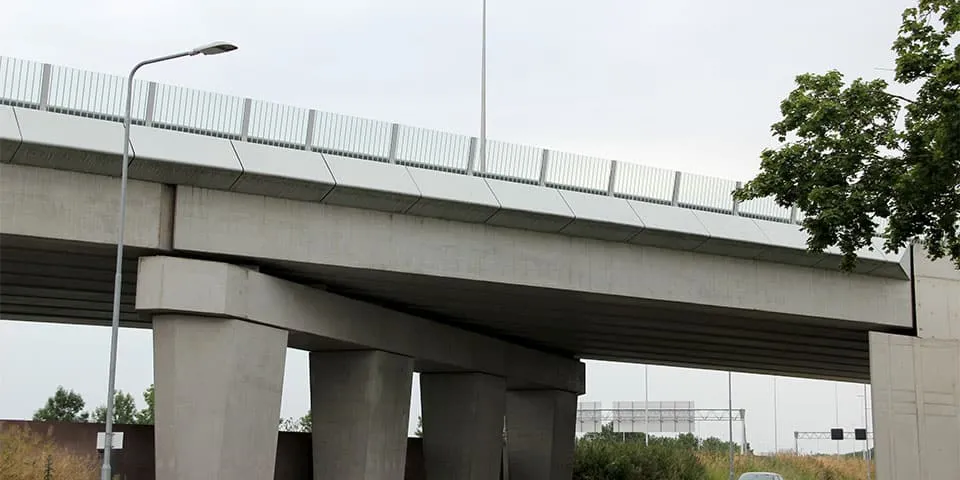
In Peters’ view, the market still views concrete with a degree of scepticism when it comes to circularity and the CO2 released during production.
Dutch concrete performs better
In the Netherlands, concrete mixes containing fly ash and blast-furnace slag are used. This results in a better CO2 footprint, if we take an honest and balanced view. “The global CO2 footprint of concrete production is 7%. At European level, it is between 3% and 5%, while in the Netherlands we achieve a figure of 1.6%. That figure includes emissions abroad resulting from the production of cement and reinforcing steel. This is remarkably low when you consider that three-quarters of the mass of Dutch building materials consists of concrete,” says Peters.
“We would like to see more concrete used in road construction”
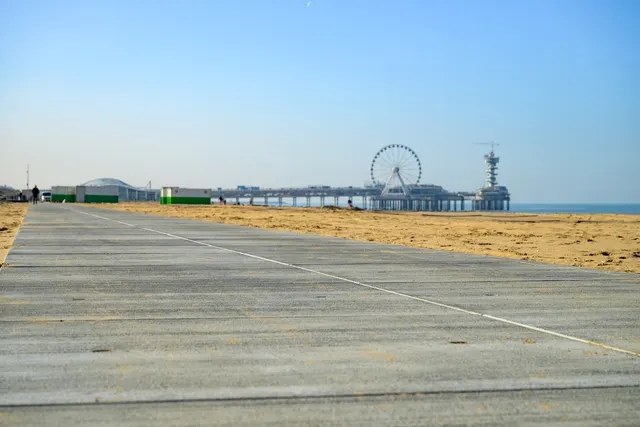
Betonhuis is also campaigning for greater use of concrete in road construction. “Concrete and road construction go hand in hand. Almost all new cycle paths are built in concrete, a lot of concrete is used for roundabouts, and the concrete barriers in use are well known. We would like to see more concrete used in road construction because it offers a sustainable solution. For example, a concrete road with a porous asphalt top layer requires less foundation material,” Peters explains.
Speaking of road construction, the construction industry is fortunately continuing to work, even during the coronavirus crisis. Peters says: “There is a clear link between the coronavirus crisis and the nitrogen and PFAS issues. With less road traffic during the coronavirus crisis, nitrogen emissions are lower. Less traffic and lower nitrogen emissions make it possible to bring infrastructure projects forward. Less disruption and less nitrogen mean road maintenance is easier to carry out, and there are more opportunities to build new roads sooner.”
Not everything that seems sustainable really is
“There is a lot of talk about using wood as a sustainable building material. In public debate, concrete is often portrayed as the dirtiest kid in the class, while wood is presented as the material of the future. In our view, this is entirely unjustified. Concrete’s greatest environmental advantage is that it undoubtedly has a very long service life and requires little maintenance. Because it is used so widely, its production results in high greenhouse gas emissions. The industry is working towards CO2-neutral cement and concrete by 2050, in line with the European Green Deal. Betonhuis advocates a fair comparison of materials. Every production process has environmental drawbacks. In the case of CLT timber, it often has to be transported over long distances, so transport and its associated ecological footprint must be taken into account. The material’s service life also plays a role in this comparison.”
Peters argues that the most suitable material should be used in every case, determined entirely by the function. When weighing up which building materials to use, it is advisable to consider all factors relating to sustainability, service life and circularity. Concrete performs very well on these points and is always close at hand. That alone could certainly be a strong argument for using it.”
Question about this story? Ask your question
Keep following this
Get an email when a new story is published. No account needed.
- ThemeMaterials and techniques for infrastructure
- SubjectConcrete