









5 tips for stakeholder managers!

Strategic stakeholder management (SOM) helps you build lasting relationships with your stakeholders, keep projects running smoothly, and prevent or resolve conflicts with the local community.
Why has the importance of strategic stakeholder management grown?
We put this question to expert Tom Leest, an independent consultant and trainer specialising in strategic stakeholder management and involved in major, complex infrastructure projects such as the A15 Maasvlakte-Vaanplein and A16 Rotterdam.
1. A complex society
Most spatial development projects involve a wide range of interests, and it is not easy to balance, trade off or bring those interests together. This requires thorough analysis and a strategy for accommodating those interests within the project.
TIP: ‘Carry out a thorough stakeholder and/or issue analysis. Map out the interests and, above all, take enough time to review them with the key people in your project organisation. What opportunities and challenges does the project face, and what is the best way to address them?’
2. Well-informed, vocal and organised citizens
Groups are able to organise themselves more quickly through social media and their networks. They can also access information more quickly online. As a result, you are much more likely to be dealing with the various parties on an equal footing in terms of knowledge.
Authority can no longer be taken for granted. Decisions made by government bodies or companies are criticised or challenged. A good local example in this context is the so-called right to challenge. This allows a group of organised residents to ‘challenge’ the local authority by delivering a public service in their own neighbourhood or town better, more efficiently or differently.
TIP: ‘Make sure you know who your stakeholders are and keep an active eye on them on social media. Take them seriously, keep them informed early, and give them an exclusive from time to time.’
3. Transparency benefits everyone
With so many social media platforms, it is difficult to keep information under wraps. Moreover, building lasting relationships with the local community depends on being as transparent as possible. It therefore makes sense to approach stakeholders openly and transparently. However, this requires a way of thinking that does not come naturally in many organisations. This also presents a major internal challenge for the stakeholder manager.
TIP: ‘Bring the local community inside. Show that you are transparent when sharing information with them. Help your project organisation colleagues understand the value of this, and consider a tool such as ‘joint fact finding’, where you, as stakeholder manager, gather the same information together with stakeholders and establish a shared understanding.
4. The power of alliances
Projects increasingly involve not just one initiator or funder, but partnerships between several parties. You are almost never the only one at the wheel of a project. Several parties share responsibility, making your project more complex.
Key considerations for the stakeholder manager include managing collaboration between these different parties and ensuring that agreements are honoured.
TIP: ‘Governance and/or partnership agreements are often made at an early stage. The challenge is to keep these agreements alive, even when new people join the parties involved. Create a shared record, celebrate successes together and keep a close eye on agreements made in the past.
5. The internal challenge
The added value of stakeholder management is increasingly recognised in the construction industry. There is a greater focus on preventing disruption. Good strategic stakeholder management is increasingly included in tender requirements or MEAT criteria.
In project teams, both in government and in construction companies, stakeholder teams and stakeholder managers still often struggle to establish their role and integrate the interests of the local community into the project team. The internal challenge is to bring the rest of your organisation or project team on board with ‘stakeholder thinking’.
TIP: ‘When meeting stakeholders, for example, take along a technical colleague responsible for the subject under discussion. It is useful to familiarise colleagues from different disciplines with the interests at stake in the local community, so they can take them into account in their work too.’
Find out more
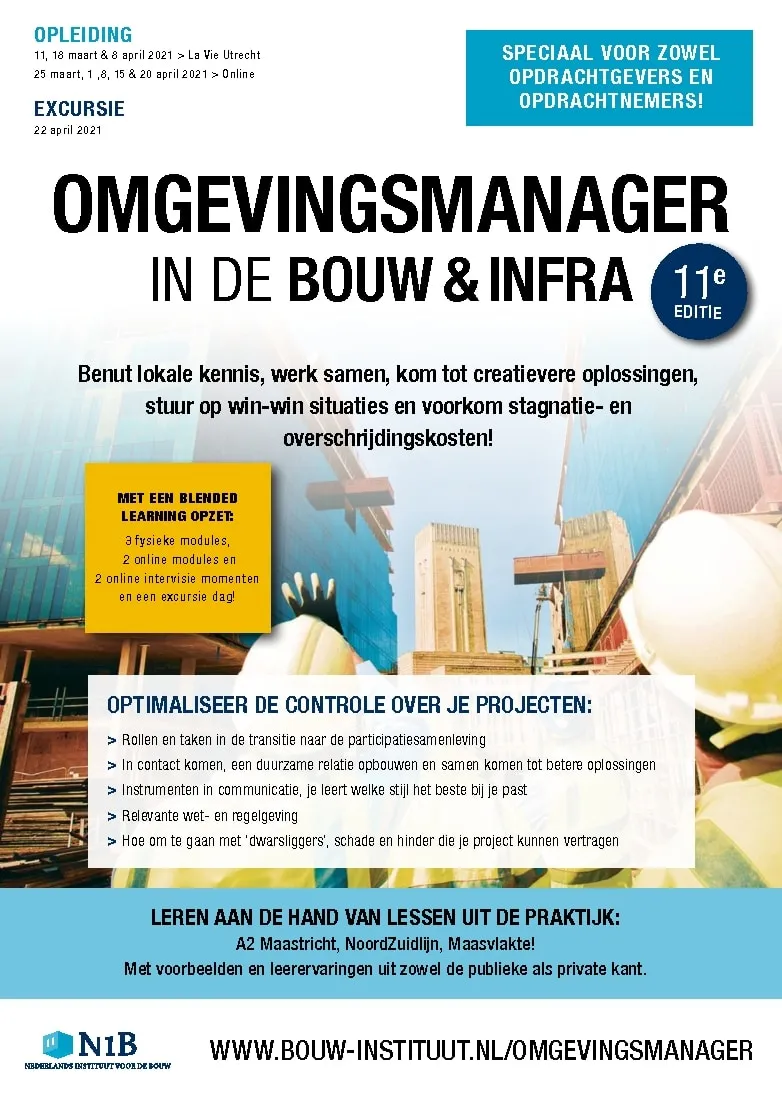
Tom Leest is one of the instructors on the 5-day course ‘Stakeholder Manager in Construction and Infrastructure’. Make use of local knowledge, work together, develop more creative solutions, aim for win-win outcomes and avoid delays and cost overruns!
Question about this story? Ask your question
Keep following this
Get an email when a new story is published. No account needed.
- ThemeViable projects and strong collaboration
- SubjectNews







