









Tunnel ventilation and smoke control
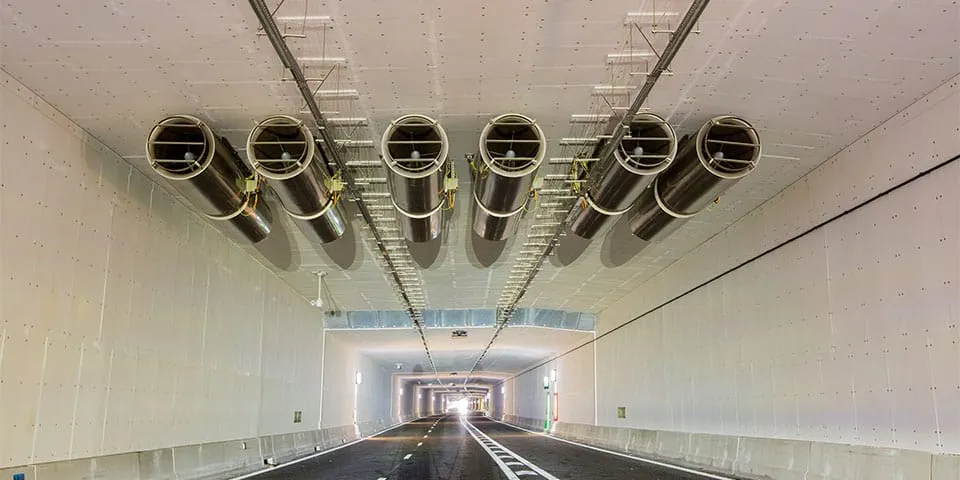
For more than seventy years, NOVENCO Building & Industry has manufactured tunnel fans for normal ventilation and smoke control in the event of fire in road and rail tunnels. The ventilation specialist has also been active in the Dutch market since the late 1970s, and has since equipped a large proportion of Dutch tunnels with so-called jet fans. The Netherlands is, however, a ‘special’ tunnel country, with tunnels that generally have a different profile. NOVENCO has found a solution for that too.
“Jet fans mounted on the ceiling of a tunnel are indispensable,” says Jos Wissink, Business Development Manager at NOVENCO. “On the one hand, they provide the necessary ventilation under normal conditions, including when traffic is at a standstill in the tunnel. Using the jet thrust principle, air is conveyed along the tunnel, which acts as a large duct. On the other hand, in an emergency such as a fire, the fans blow smoke downstream, allowing people to escape from the tunnel safely. The jet thrust principle keeps installation costs low and makes efficient use of the available space in the tunnel tube.”
Space-saving tunnel fans
The Netherlands has a relatively large number of underwater and cut-and-cover tunnels with a rectangular profile. “This is fundamentally different from the horseshoe-shaped profile of mountain tunnels in most European countries,” Wissink emphasises. “A rectangular profile also means there is less room for the tunnel systems. NOVENCO has developed a special range of space-saving rectangular tunnel fans for these types of tunnel, with a minimal installation height. This can save as much as 20 centimetres in height. “We are often involved in a tunnel project at an early stage to carry out the tunnel ventilation calculations, so that the impact of the system on the tunnel design becomes clear quickly. We also assess the probability of different factors occurring together. These include expected emissions under normal conditions and the size and location of a fire, as well as external influences such as wind direction and wind speed. Sometimes as many as 200,000 calculations are run using a range of variables to determine the right fan types and minimise the risk of failure in the ventilation concept.”
Question about this story? Ask your question
Keep following this
Get an email when a new story is published. No account needed.
- ThemeUnderground construction
- SubjectBridge construction







