









The power of monitoring to extend the service life of civil engineering structures
Text Roel van Gils Image Fugro
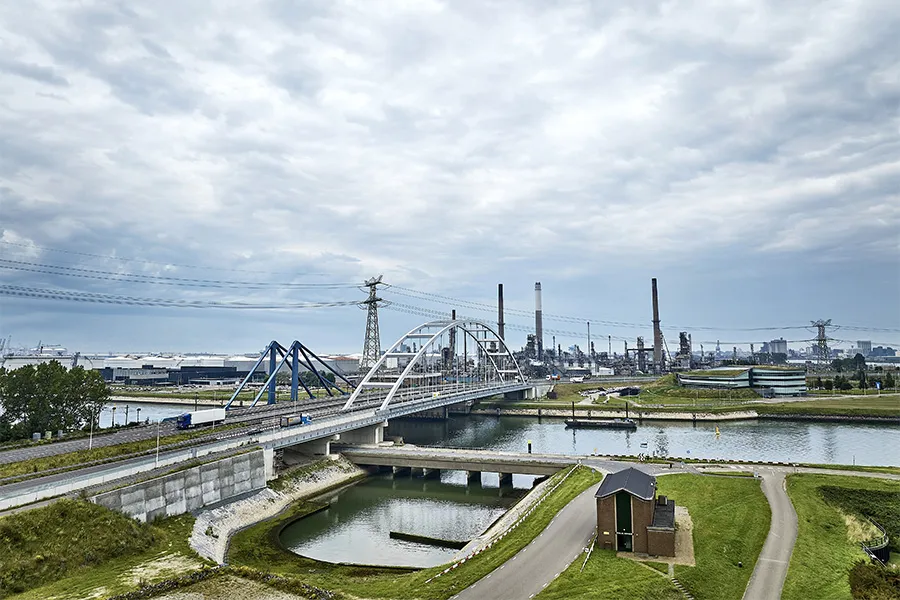
The Dutch infrastructure sector faces a huge challenge: maintaining and renewing ageing bridges, viaducts and underpasses. There is no budget to replace them all. Besides, it is hardly a sustainable option. Part of the solution to the large-scale Replacement and Renovation Programme (V&R-opgave) lies in the power of monitoring, as Fugro is demonstrating at the Suurhoff traffic bridge on the A15 and the railway bridge over the Gouwe canal near Alphen aan den Rijn, among other projects.
Much of the Netherlands’ civil infrastructure was built in the 1960s and 1970s. “These structures are now fifty to sixty years old and are reaching the end of their theoretical service life,” says Edo Noordermeer, a consultant at Fugro. “Replacing them all would be madness. Quite apart from the fact that there is not enough budget, in many cases it is not even necessary. Many structures are fundamentally still in good condition and can last for decades, but naturally you want to be sure of that, because some structures do need strengthening or, in the worst case, complete replacement.”
Suurhoff traffic bridge. (Image: ANP Hollandse Hoogte, Siebe Swart)
Technical roles are no longer attractive
“Ageing is only one of the issues affecting structures,” says Edo. “The second is the increase in traffic loads and volumes, which are now much higher than the levels structures were originally designed for. In the past, a 30-tonne load was considered substantial. Now, 100-tonne loads regularly cross structures. That can be a real concern for bridges. The third factor is that traditional practice relies heavily on periodic inspections by experts. This is a technical profession that is no longer popular. Many experts are retiring, and far fewer are joining the profession. There is an increasingly serious shortage of people with the right expertise. One solution to all these issues is automated measurement and monitoring. At Fugro, we are seeing growing demand for this.”
Continuous versus periodic monitoring
When a bridge reaches the end of its theoretical service life, a structural reassessment is carried out. Based on the available information about the condition of the structure and its current loading, its actual remaining service life is assessed. This inevitably involves assumptions, and conservative safety margins are applied to manage uncertainty. The service life can be fully realised by refining these assumptions through additional investigations or better models, or by monitoring a structure with sensors and setting threshold values within which it can remain safely in service. Fugro is doing the latter, for example, on the railway bridge over the Gouwe near Alphen aan den Rijn. “The great advantage of sensors is that they provide continuous monitoring,” says Edo. “Visual inspections are, by definition, periodic, often only once a year, and even in the most critical cases only weekly or monthly.
Sensors, by contrast, allow monitoring at a much higher frequency, from hours to minutes or even seconds, depending on the sensor technology used. This provides much more information about a structure’s behaviour and potential risks. By continuously monitoring bridges and viaducts, we can accurately determine which structures are still safe and fit for use, and which genuinely need replacing and/or renovating. This prevents valuable resources being spent unnecessarily on replacing structures that can remain in service for years under monitoring, while ensuring that safety is maintained.”
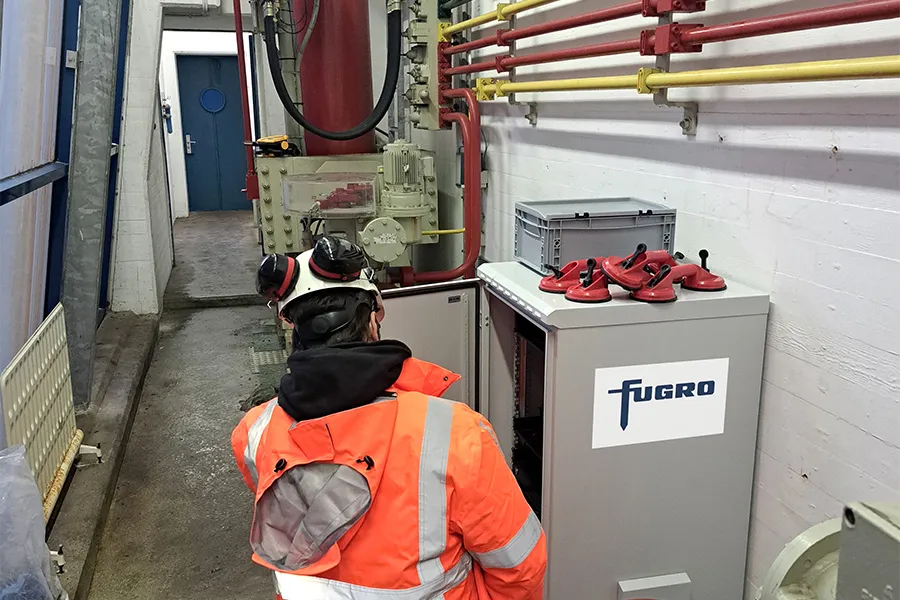
Installation of the monitoring system’s control equipment in the old section of the bascule bridge.
Strain measurements on the Suurhoff bridge
The Suurhoff bridge opened in 1974 and forms the gateway to the Maasvlakte. It is scheduled for replacement, but the existing bridge must remain safe to use until then. The structure was therefore renovated in 2021. The Suurhoff bridge was the first in the Netherlands to be strengthened using a new technique developed by Arup, in which steel plates are fixed to the road deck with epoxy adhesive and bolts. “Arup wanted this new, innovative method, which can be applied with relatively little effort, to be tested in practice. Naturally, the effectiveness of the new technique needs to be validated. How does the strengthening perform over a longer period?” says Hans Redder, project manager at Fugro. “Together with Arup, we drew up a plan and selected the type of measurement technology. At specific points beneath the road deck, we use fibre Bragg grating (FBG) fibre-optic sensors to measure strain and temperature. This allows us to determine how well the strengthening is performing, and whether it can withstand traffic loads and temperature variations over the longer term in real-world conditions throughout the seasons.”
State-of-the-art technology
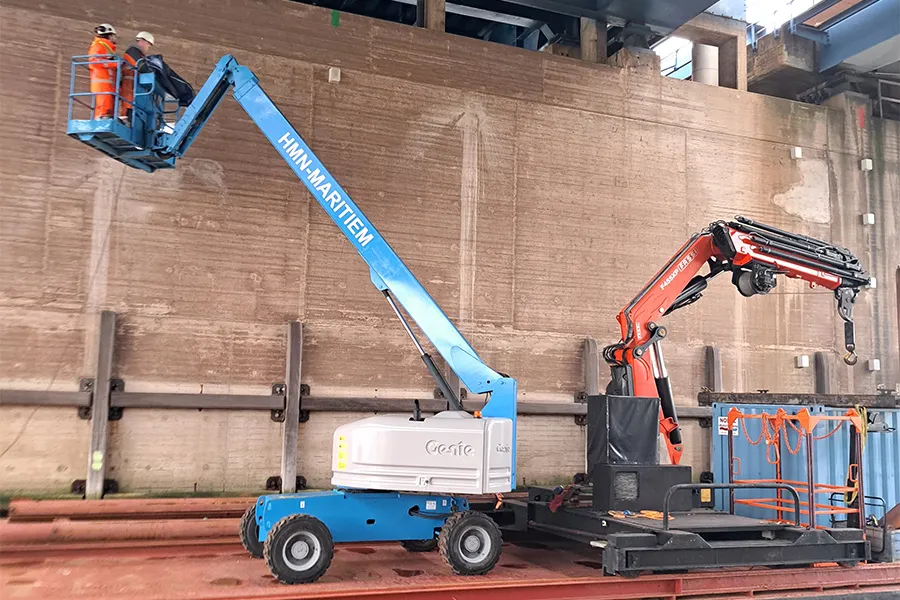
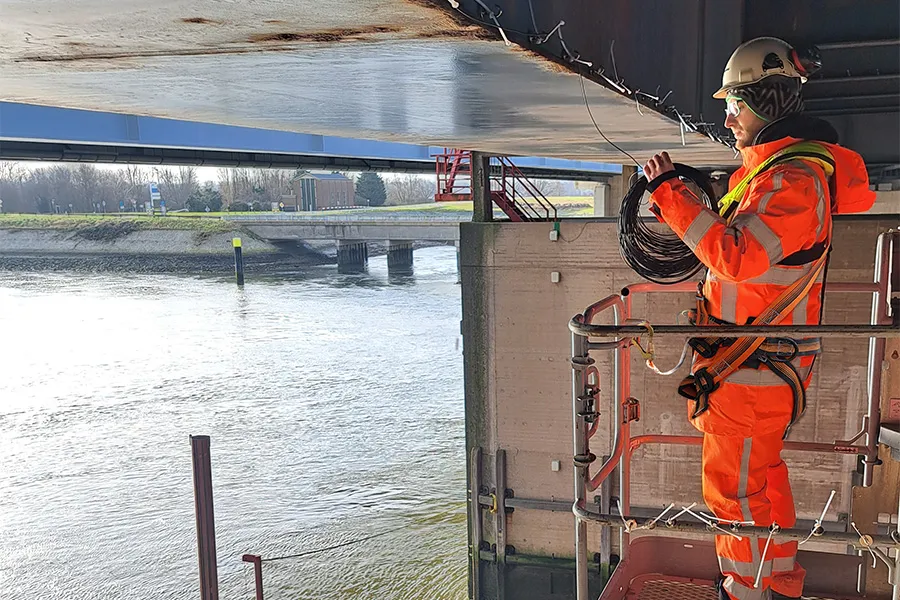
Fugro is monitoring the Suurhoff bridge for a period of three years. “The monitoring system was installed in February 2024 and consists of 26 strain sensors and three temperature sensors. They were all installed beneath the bridge deck within two weeks, working from a pontoon with a boom lift,” says Hans, describing the installation. “The advantage of fibre-optic technology is that the signal is not affected by interference or attenuation over long distances. Traditional technologies are affected by large temperature fluctuations. Beneath the bridge deck, temperatures can easily reach fifty degrees Celsius or more when the sun is shining directly on the road surface. Fibre-optic technology gives you confidence that the system will operate reliably for three years without intervention. That is worth a lot, especially given how difficult it is to access the underside of the bridge deck.” Although the sensors are beneath the bridge deck, the control equipment has been installed in a dry location in the old section of the bascule bridge. All the data is displayed on Fugro’s VirGeo® cloud platform. “Every quarter, we also take high-frequency measurements of up to 100 Hertz over a two-week period. It is great to be working with state-of-the-art technology on such a historic bridge.” “This monitoring allows us to assess the strengthening that has been applied and validate whether the new method is the best option for steel bridges affected by fatigue,” says engineer Bram Buts, technical manager at Rijkswaterstaat. “This could make the new strengthening method a standard in our field.”
Railway bridge near Alphen aan den Rijn
“The railway bridge near Alphen aan den Rijn is a swing bridge with one pier in the Gouwe canal,” says Frank van der Kroon, project manager at Fugro. “The bridge swings open to allow shipping through, then swings back so that trains can pass. In the latter position, the rails must be precisely aligned with the abutments. The system has very little tolerance for deviations, to prevent the bridge from developing a fault and causing disruption to train services. The foundations of this railway bridge have been subject to settlement in the past. To monitor the risk of further settlement, the positions of both abutments and the central pier are continuously monitored using a robotic total station (RTS). In each measurement cycle, the RTS measures four prisms on each of the three structural elements twice. A measurement cycle takes fifteen minutes. This means we determine their current positions four times every hour, allowing us to detect deviations quickly and accurately.”
TotaLite®
As civil engineering structures age and the climate changes, damage and risks caused by unwanted deformations are expected to increase in the coming years. The RTS system excels in precision and reliability, but cannot be deployed on a large scale because of its cost and practical limitations. RTS systems are large, require a fixed power supply and are vulnerable to theft. As a result, Fugro has lost several RTS units in recent years. There is still a need for reliable, automated deformation measurements. To meet that need, Fugro has been looking for an innovative solution: TotaLite®. This new measurement technology uses a camera to monitor deformations with great precision. Its advantage is that it offers a cheaper and easier-to-deploy method for long-term automated monitoring of civil engineering structures. At the railway bridge in Alphen aan den Rijn, TotaLite® is being tested alongside the RTS. The innovation has already been validated for use in tunnels and buildings, but further development is needed to achieve the required sub-millimetre accuracy in all weather conditions, in complex projects where deformation poses a risk, such as this railway bridge. Edo says: “These developments involve long-term innovation programmes. The step from taking measurements in a laboratory to working outdoors in the field is a very big one. That is why it is important to test the technology in practice and deploy it on several projects at the same time. Findings from this pilot will help us continue improving the technology and make it suitable for widespread use.”
Pioneer
Technological advances in structural monitoring are moving fast. “Just five years ago, sensors were less suitable for the type of monitoring we are now carrying out on the Suurhoff bridge and the railway bridge over the Gouwe,” says Edo. “There have also been major advances in data processing. We continually look at the sensors and technologies being developed by others and how best to apply them. Fibre optics is a good example, and is relatively new for use on structures of this kind. Fugro is definitely a pioneer in this area. Many strain measurements are still made using conventional electrical equipment. We also continue to develop our own sensors and systems: systems that are much cheaper and easier to install, and consume little power. This means we need to spend less time physically working on structures over roads or railways, for safety reasons.”
Thanks to Fugro’s smart monitoring technologies, asset managers can extend the service life of their structures, responsibly deferring costly replacements. Together, we are working towards a safe and liveable world, ensuring our infrastructure remains reliable in the future.
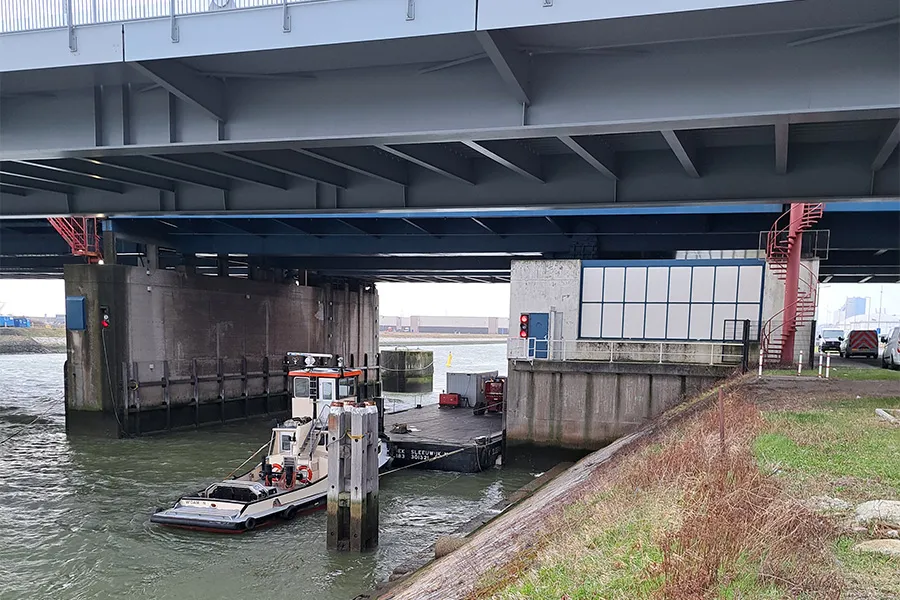
railway bridge at Alphen aan den Rijn
On 11 October, an inland vessel collided with the railway bridge at Alphen aan den Rijn. The vessel became stuck beneath the bridge, and rail services were disrupted for hours. The monitoring system also provides valuable information in an incident such as this. The RTS system was not hit in the collision, so measurements continued throughout the incident. Based on the measurements, ProRail was able to establish, before the bridge was closed again, that the foundation of the central pier had sustained no damage. This information helped the bridge to be reopened to rail traffic sooner. “The monitoring data gave us immediate clarity about the impact on the foundation. Without that information, it would have been harder to make a decision and the closure of the railway bridge could have lasted longer,” said Reinier Kleissen, structural assets systems specialist at ProRail.
A business enquiry for Fugro? Get in touch
Companies in this story

Keep following this
Get an email when a new story is published. No account needed.
- ThemeExtending the life of roads and civil engineering structures
- SubjectBridge construction
- CompanyFugro







