









The distinctive design of the new Prins Clausbrug in Dordrecht
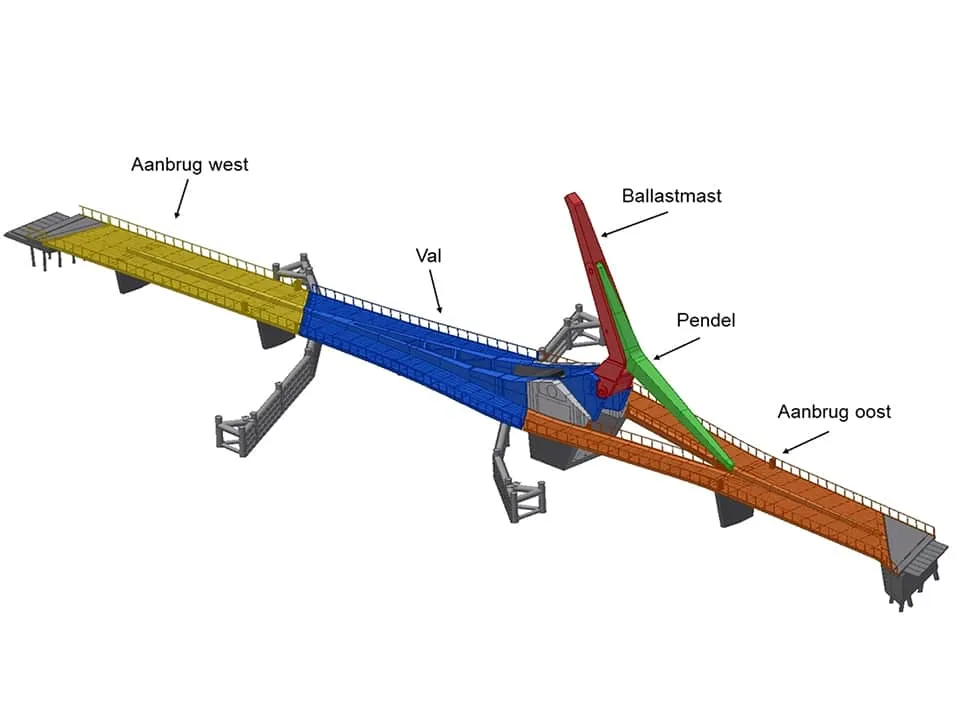
The new Prins Clausbrug, currently under construction in Dordrecht, is anything but standard. The movable bridge for cyclists and pedestrians will be 140 metres long and consist of two steel approach spans and a movable leaf almost 50 metres long, measured from the axis of rotation.
The architectural design is highly ambitious. The bridge has a distinctive form and features a unique movement concept. Gemeente Dordrecht awarded the structural design and construction of Prins Clausbrug to the Dura Vermeer and Hillebrand construction joint venture. Iv-Infra developed the reference design into a fully integrated final design and construction design on behalf of the joint venture.
An architectural landmark
Prins Clausbrug will connect Dordrecht city centre with the new Stadswerven district and become an architectural landmark for Dordrecht. The unique movement concept and ambitious design of the reference design, drawn up by architect René van Zuuk, posed the main challenge in developing the architectural design. To turn it into a technically feasible design that would be maintainable and operate reliably, all components had to be carefully coordinated to meet the demanding design requirements.
Distinctive design
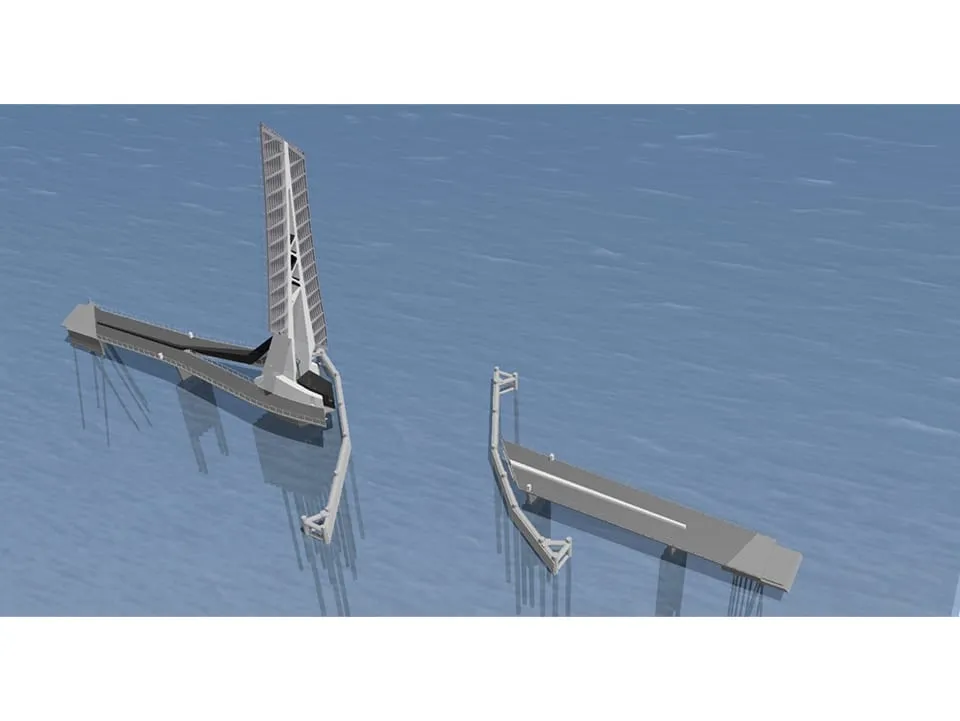
The bridge is hydraulically operated, with the leaf balanced around its axis of rotation by a unique system comprising an upright, hinged counterweight mast held in position by a pendulum rod. As the bridge opens and closes, it makes a distinctive movement: the imposing counterweight mast first bends forwards, then returns.
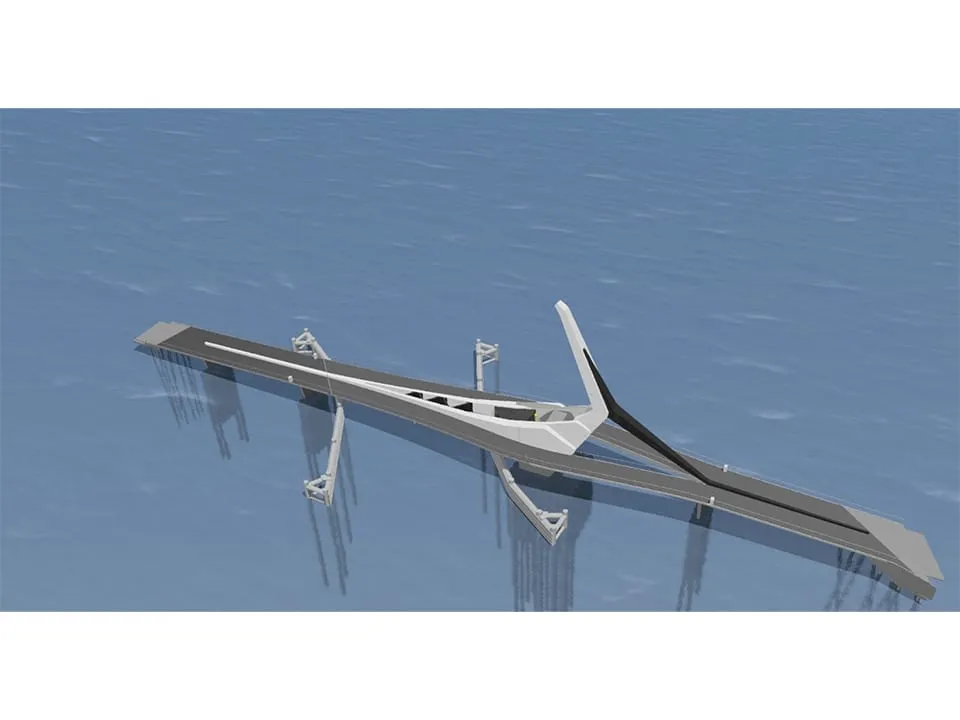
The steel approach spans have a flowing, slender design. The east approach span curves around the basement pier in two sections, joining to form a single deck at the end of the bridge. Cyclists and pedestrians crossing the bridge are routed around the counterweight mast and pendulum rod on either side, with a view of the bridge’s impressive mechanism. As the basement does not need to accommodate a ballast chamber, it has been designed as a circular, flared plinth rising elegantly from the water.
How imbalance changes as the bridge moves
The balance of the leaf closely resembles that of a leaf with a hinged counterweight chamber. There is one important difference: the counterweight mast is also supported horizontally at its pivot. The balance of the leaf is therefore strongly affected by the vertical and horizontal reactions at the counterweight mast pivot, which in turn depend on the position of the pendulum system. This makes the balance of Prins Clausbrug more difficult to determine than that of ‘traditional’ bascule and lifting bridges.
As the bridge opens, the closing moment around the axis of rotation hardly decreases up to an opening angle of around 45 degrees, and instead increases slightly. Beyond 45 degrees, the closing moment decreases smoothly. This pattern is characteristic of the bridge mechanism and has a major bearing on the forces acting on the bridge’s hydraulic cylinders. The counterweight mast’s movement also complicates the calculation of wind loads on the bridge. These effects were therefore determined using an ANSYS Workbench model and incorporated into the hydraulic drive calculations.
Innovative solutions for the movable leaf
The bridge crosses the waterway at an angle, giving the leaf skewed joints and making it considerably longer than the 23 m-wide navigation channel. Controlling the vertical and horizontal deformation of the leaf at the skewed joints, in interaction with the approach spans, posed a major challenge and led to innovative solutions.
The skewed joint at the rear heel of the leaf is so far in front of the main pivot that the differential vertical deformations would be too great when the joint is open. To keep deformations within acceptable limits, an additional support was installed beneath the deck plate at the skewed joint. Separating the leaf’s deck plate from the main girder creates a flexible, tensioned joint.
The leaf’s two front bearings rest on the steel structure of the west approach span, which cantilevers beyond the pier. At the front heel, therefore, the bridge is supported not by a rigid base but by a flexible cantilever, with different but interdependent vertical spring stiffnesses due to the skewed joint. To ensure that the support forces generated by the leaf’s imbalance are distributed evenly, one of the two supports has been set slightly higher, using camber, when unloaded.
Bridge drive
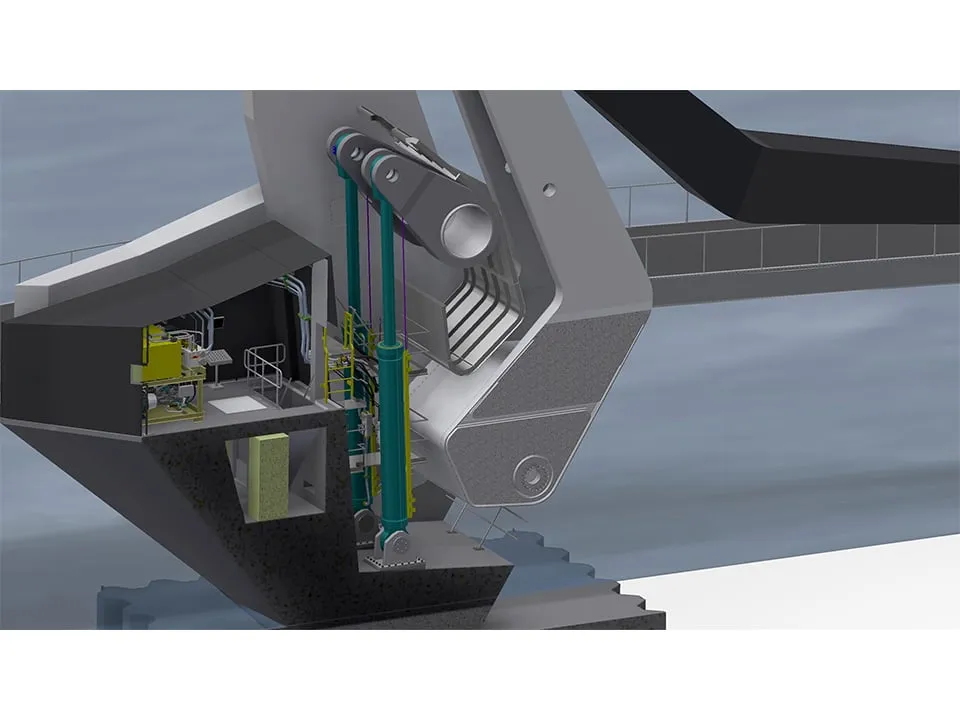
The bridge is operated by an electrohydraulic drive comprising two hydraulic cylinders and an electrohydraulic power pack. The cylinders are connected to the leaf and the basement floor by two pivots fitted with fibre-reinforced polymer spherical plain bearings. To accommodate these, each cylinder has a cylinder-end eye and a rod-end eye containing the bearings. The rod-end eye is connected by a pivot pin to two cheek plates attached to the connecting tube between the leaf’s main girders. The cylinder-end eye is hinged to two cheek plates on the welded cylinder support, which is anchored to the basement floor with prestressed anchors. To distribute the forces as evenly as possible between the cylinders during normal bridge operation, they are hydraulically linked at both the cylinder and rod ends. This makes them move as if they were a single cylinder.
Construction well under way
Following an intensive design process, construction of Prins Clausbrug is now well under way. The bridge design makes this a complex and challenging project, but the construction joint venture is aiming to complete it by mid-2021.
Question about this story? Ask your question
Who worked on Prins Clausbrug
- integraal definitief ontwerp en uitvoeringsontwerpIv-InfraIn this story
- engineering consultancyIV-groepMentioned in Prins Clausbrug: an architectural showpiece with smart engineering
- architectRené van Zuuk architectenMentioned in Prins Clausbrug: an architectural showpiece with smart engineering
- electrical installationLangezaal & InnigerMentioned in Prins Clausbrug: an architectural showpiece with smart engineering
- contractorHillebrandMentioned in Prins Clausbrug: an architectural landmark powered by smart engineering

Keep following this
Get an email when a new story is published. No account needed.
- ProjectPrins Clausbrug
- SubjectBridge construction
- CompanyIv-Infra







