









Smoke control system in Spaarndammertunnel
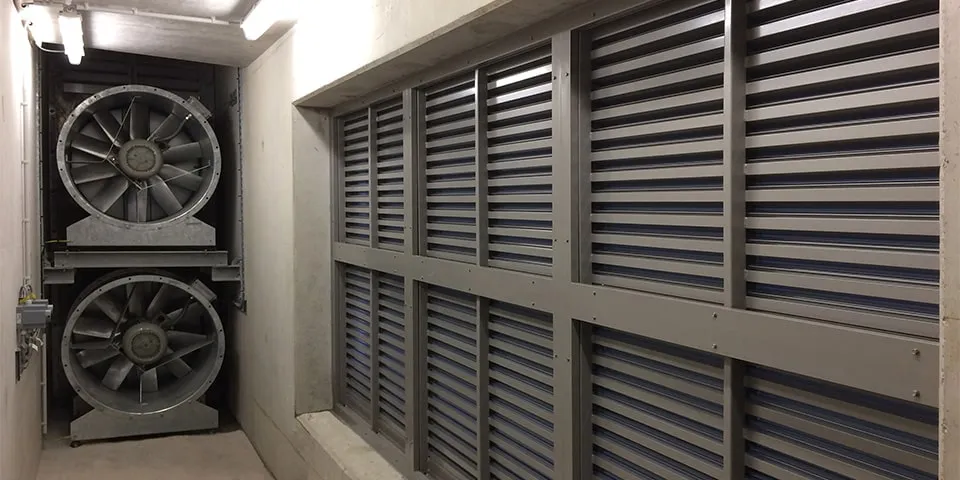
Spaarndammertunnel in Amsterdam is prepared for emergencies such as fire. Among other measures, the tunnel is equipped with a pressurisation system and longitudinal ventilation. To protect the tunnel and its escape routes from smoke and heat in an emergency, Colt International BV in Katwijk (NB) engineered, supplied and installed the pressurisation system in the central tunnel duct and the jet fans in the tunnel tubes. These systems help ensure that Spaarndammertunnel is prepared for emergencies such as fire.
Stan Veldpaus, project adviser for smoke control systems at Colt: “If you are in a tunnel that is on fire, you need to be able to reach safety quickly. That is why every tunnel has an escape passage. Pressurising it keeps smoke and fire out. At Spaarndammertunnel, where the escape passage lies between the two tunnel tubes, we supplied the pressurisation system.”
Safety on all fronts
If necessary, the pressure in this tunnel can be increased to the maximum flow rate. As smoke blown out of the tunnel by the ventilation system could be drawn in through the pressurisation system’s supply fans, both sides are equipped with 2 pressurisation fans for redundancy. Only the fans at the entrance to the tunnel affected by the fire are switched on. It is also important to ensure that the escape passage door, which opens inwards, can be opened safely. The air pressure is therefore measured continuously by sensors. In addition to the pressurisation system, Colt supplied and installed the jet fans in the tunnels, as well as the sensors and the decentralised control cabinet for the pressurisation system in the escape passage.
Jet fans at the tunnel entrance.
Longitudinal ventilation prevents backlayering
The fire can be tackled, among other ways, by directing a strong airflow in one direction (longitudinal ventilation). This prevents backlayering, which can occur because of the tunnel’s low ceiling. Smoke and heat rise, reach the tunnel ceiling and can then spread in both directions. However, by pushing air in the direction of traffic from one side, smoke and heat are blown towards the exit, keeping the leading end clear of smoke and allowing firefighting to be carried out with the wind at the firefighters’ backs. Veldpaus: “Longitudinal ventilation has also been used here. To equip both sections of the tunnel, we supplied 8 jet fans for each tunnel tube and mounted them in the ceiling, 4 at the entrance and 4 further into the tunnel. These jet fans can withstand hot air at 250 degrees Celsius for at least 1 hour.” They are also designed to extract exhaust gases. To reduce noise, Colt fitted silencers on both sides of the fan motors.
Clearance envelope
“The clearance envelope was an important factor in determining the dimensions of the fans,” says Veldpaus. “The larger their diameter, the greater their power. You are always constrained by the tunnel’s cross-section. As space is limited, we installed steel fans with a diameter of 1.12 m, 8 jet fans in total, each with a thrust of 1125 N and a length of 3.5 m. The supply fans in the escape passage each have a diameter of 900 mm and a length of 750 mm.”
International company active in fire safety and smoke control for infrastructure projects
Colt specialises in developing climate control systems that ensure air quality, daylight and safety. The international company is active in fire safety and smoke control for infrastructure projects, among other fields, providing services from design through to annual maintenance and certification. Colt works for businesses such as construction consortia, as well as end users such as Rijkswaterstaat.
Question about this story? Ask your question
Keep following this
Get an email when a new story is published. No account needed.
- ThemeUnderground construction
- SubjectBridge construction







