









Passive fire protection prevents concrete failure
Passive fire protection plays an important role in tunnels. Promat is part of Etex Building Performance BV, which belongs to the Etex Group. Promat has played a major role in passive fire protection for tunnels for more than 60 years. Frank van der Wal, Tunnel Manager for the Netherlands and Scandinavia, tells us all about passive fire safety.
Since 1963
“Our company has been supplying fire-resistant boards and mortar systems for passive fire protection in tunnels since 1963,” Van der Wal begins. “To be precise, the first tunnel we treated in this way was the Holmesdale Tunnel in the United Kingdom. Since then, the technology has continued to develop, and we have become the market leader in this specialist field.”
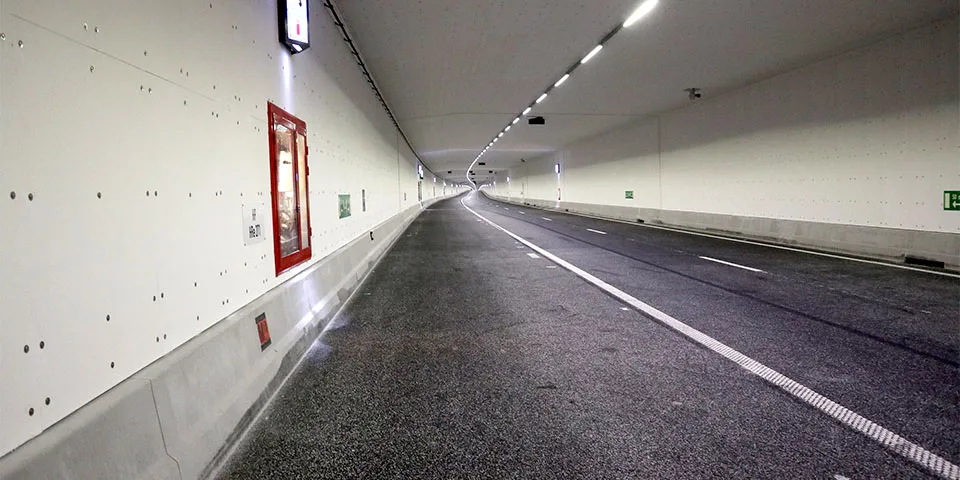
Passive fire protection in the Gaasperdammertunnel, thanks to Promat.
What does passive fire protection do?
Van der Wal explains: “We line the concrete in a tunnel with fire-resistant boards. This prevents the concrete from failing as a result of the heat generated by a tunnel fire, thereby safeguarding the structural integrity of the concrete. Without protection, heat causes steam to form inside the concrete. The vapour pressure can cause the concrete to spall. The concrete also comes under pressure as it expands when heated. It literally bursts apart, raining down concrete, and the integrity of the structure is compromised. The fragments flying off also pose a danger to road users trying to escape and to the emergency services. A major advantage is that our materials are maintenance-free and always work, with no expiry date. If an incident occurs in a tunnel, the fire-resistant boards can easily be replaced afterwards.”
Integrated systems allow more time for evacuation
Van der Wal continues: “Ghent University included our products in CFD models as part of a study into smoke stratification. The results showed that effective smoke and heat extraction, combined with our passive fire protection materials, significantly increased the time available for evacuation, because the hot smoke gases cooled more slowly against the lined ceiling. This is, of course, highly desirable in an emergency.”
Promat markets three types of board under the name PROMATECT®. “The oldest is the -H RWS/HCM, followed by type T, with the latest version being T-FX. These are cement-bonded boards that can either be installed afterwards using anchors or placed in the concrete formwork before casting. The boards last as long as the tunnel itself.” What about the mortar option? “The fire-resistant mortar can be sprayed onto the tunnel concrete afterwards. This is how we made, among others, the Westerscheldetunnel safer,” Van der Wal concludes.
Question about this story? Ask your question
Keep following this
Get an email when a new story is published. No account needed.
- ThemeUnderground construction
- SubjectBridge construction







