









Out of sight, but not out of mind
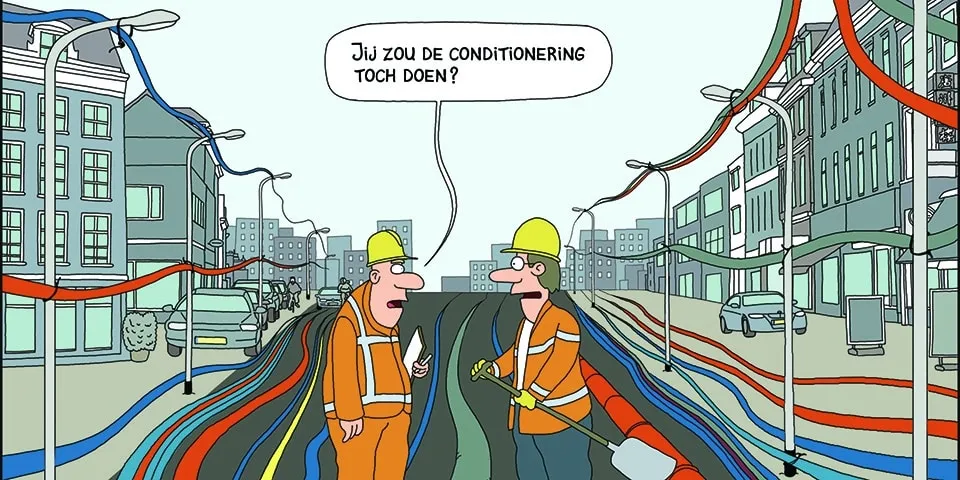
In this edition of Grond Weg Waterbouw magazine, which focuses on underground construction, COB has a key role to play. COB is the Dutch knowledge centre for underground construction and the use of underground space. It brings together engineers, contractors, clients, competent authorities and research institutes to exchange and develop knowledge on subjects including tunnels, cables and pipelines, and underground spatial planning. My name is Stanley Hunte, and I coordinate the Cables and Pipelines platform, which has around 75 members.
Platform members often tell me that, in practice, projects do not take sufficient account of unexpected objects underground. An article in a magazine like this is therefore an ideal opportunity to highlight the presence and importance of underground, and therefore invisible, objects. Raising awareness of underground objects, and of the subsurface more generally, is one of COB’s objectives. We believe the subsurface is an integral part of public space and is essential to every structure built, including in the civil engineering sector. My focus is on cables and pipelines, but the issue is much broader.
No energy transition without underground cables and pipelines
A lack of knowledge and visibility of underground objects such as culverts, waste bins, and especially cables and pipelines can lead to unnecessary delays and costs on projects. This infrastructure is also essential to the economy and our everyday needs: without gas pipelines, for example, there would be no industry; without power cables, no renewable energy from wind farms; and without water mains, no drinking water supply. In short, no energy transition without underground cables and pipelines! But I’ll come back to that later. At COB, the network sets the agenda. Platform members encounter issues from their own individual perspectives and raise them at platform meetings, where we discuss them together. If there is sufficient interest within the platform, a project is launched, such as “Struggling with cables and pipelines on major infrastructure projects” in 2017. Platform members noted that people involved in infrastructure projects have much to learn from one another about managing cables and pipelines. A review was therefore conducted to identify common themes and useful insights.
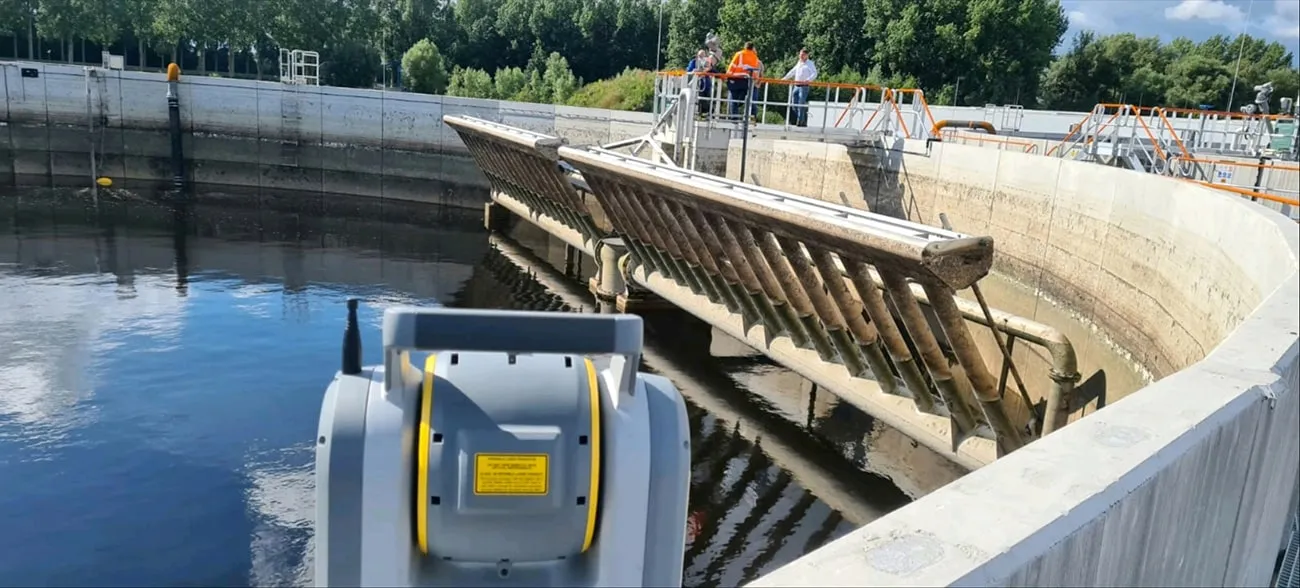
During construction of the railway tunnel in Delft, there was little or no space for temporary and permanent cable and pipeline routes. (Image: Flickr/Sander van der Wel)
Learning from practice and from each other
Six projects were examined, with people involved in one project documenting how another project was managed. This approach enables people to learn from practice and from each other. Students also conducted research and presented their findings to fellow students.
In all the projects studied, relocating cables and pipelines was part of preparing the project area, but responsibility for this preparatory work lay with different parties. Although this work normally accounts for only a small percentage of total project costs, the study shows that failing to map the subsurface properly can cause major problems and costly knock-on effects. The report sets out recommendations for the various project phases and roles. Sharing relevant information and data in good time can significantly improve efficiency and reduce risks.
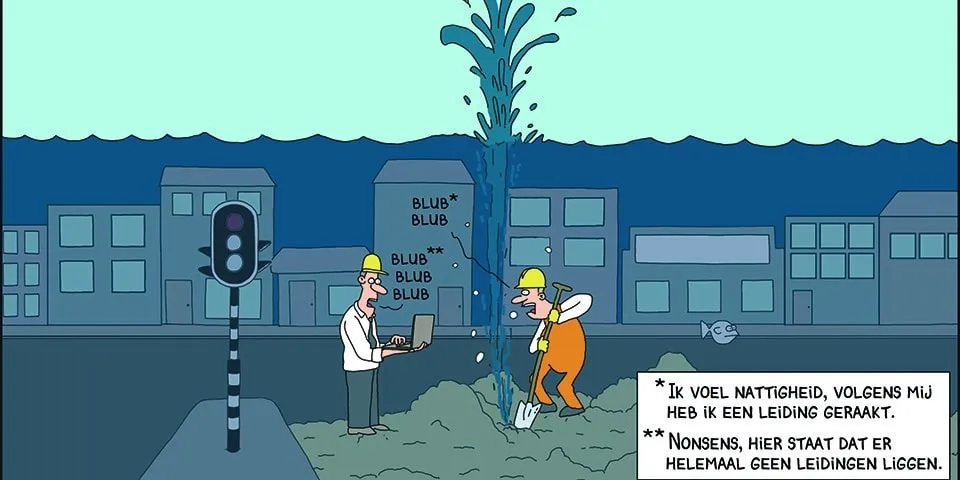
Unexpected pipelines are often found within project areas; recorded information about cables and pipelines is frequently incomplete or entirely inaccurate. (Image: COB/Cartoon Blanche)
Common ground for underground infrastructure
Improving efficiency is a good lead-in to another COB project: “Common ground for underground infrastructure”. As noted above, cables and pipelines play an important role in the energy transition. But other societal challenges also affect the subsurface, including the renovation and replacement programme (many cables and pipelines are nearing the end of their service life), climate change adaptation (upgrading sewerage systems and building water storage facilities), the 5G rollout (additional fibre-optic networks) and urbanisation (building faster and providing more connections). Here too, efficiency needs to improve, because tackling all these challenges separately will not be feasible or effective. The Common ground for underground infrastructure project aims to develop an overall strategy for the installation, management and maintenance of underground cables and pipelines. The first step has already been taken: a knowledge analysis was presented on 12 April 2019. See www.cob.nl/commonground.
Reports such as “Struggling with cables and pipelines” and “Common ground for underground infrastructure” are available to download free of charge. A wealth of information is freely accessible through COB’s knowledge base. The COB team is also always on hand to help people get started. So underground objects such as cables and pipelines may be out of sight, but they are NOT out of mind!
Een zakelijke vraag aan Nederlands Instituut voor de Bouw? Get in touch
Companies in this story

Keep following this
Get an email when a new story is published. No account needed.
- ThemeUnderground construction
- SubjectBridge construction
- CompanyNederlands Instituut voor de Bouw







