









Groundbreaking research into the dynamics of movable bridges
Text Roel van Gils Photography Antea Group
New calculation method for predicting dynamic loads validated
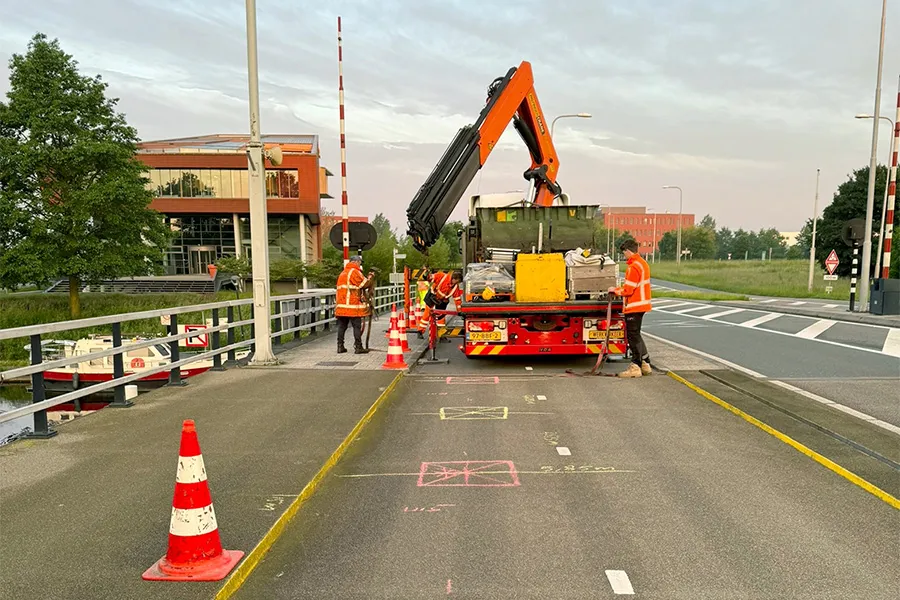
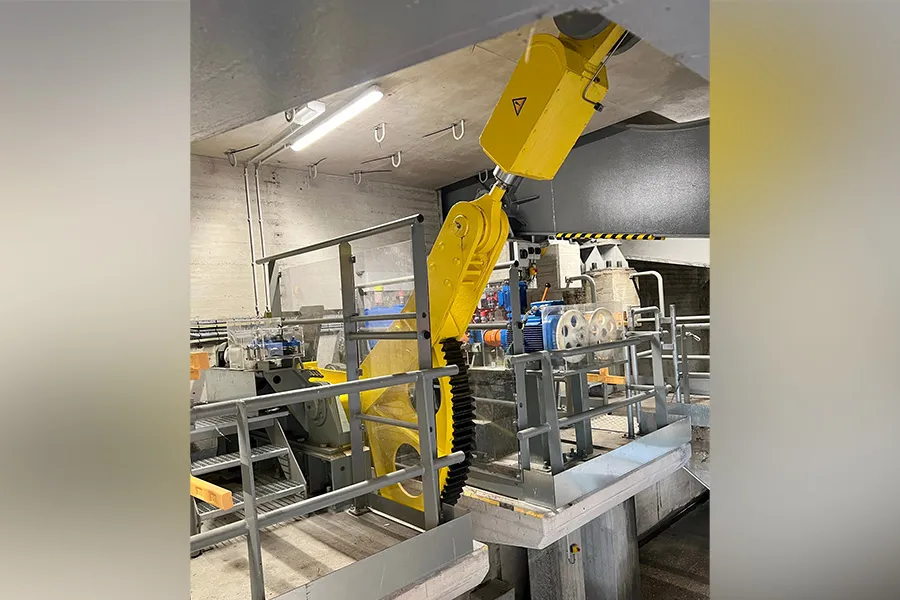
When existing movable bridges are reassessed, the operating mechanism is often quickly identified as a candidate for replacement. Current design codes are based on simplified calculation models with theoretical assumptions that do not represent every aspect of the actual situation. In a PhD study at TU Delft, Kodo Sektani, bridge structures adviser at Antea Group, developed a new calculation method that better predicts the forces acting on the drive throughout the entire operating cycle. Following extensive verification research based on laboratory measurements, the method has now also been successfully validated in practice on the Crolesbrug in Bodegraven, a bascule bridge with a Panama wheel mechanism. This is an important step towards wider practical application!
Bridge operating mechanisms generally account for a large share of the costs of replacement and renovation. Where it is technically viable to keep them in service, this can deliver substantial savings for society and a much more sustainable outcome. Yet these mechanical components are still too often written off prematurely, even though no degradation is evident in practice. Current codes divide the operating cycle into separate scenarios and use simplified assumptions. According to Sektani, this approach does not always reflect the actual dynamics of the operating mechanism, meaning that in some cases it predicts exceedances that are not representative of real-world conditions.
More targeted assessment
The new calculation method offers a more realistic alternative. It accurately predicts the forces in drive trains under a range of conditions, from normal operation to emergency stops. This provides a more reliable basis for both strength and fatigue assessments. The model itself does not distinguish between these, but enables users, for example, to relate peak loads to ultimate limit states and load cycles to damage factors for fatigue calculations. “We can now assess much more precisely whether replacement is really necessary,” says Sektani, who carried out the research on behalf of Antea Group as part of his PhD at TU Delft.
Verification and validation
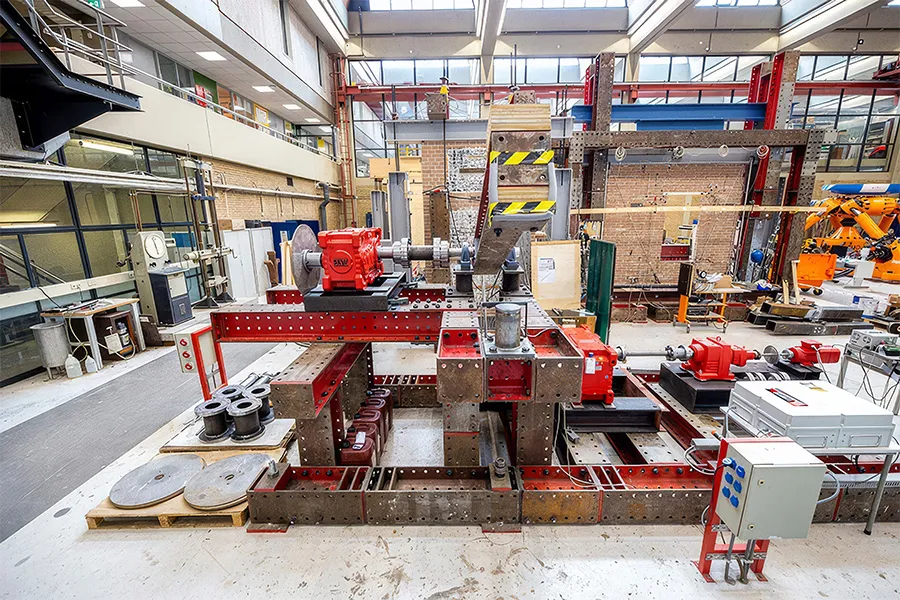
The research has been under way for several years, and rightly so, because good work takes time. As part of his research into the dynamics of movable bridges, Sektani developed a numerical calculation method that provides a more realistic estimate of dynamic loads in operating mechanisms. The method was developed in MATLAB and then verified at TU Delft using precise measurements and laboratory tests. “The test rig we used for verification is ideally suited to collecting data and measurements reliably and reproducibly,” says Sektani. “The experimental research showed that the calculation results are correct. The method has therefore been verified. In 2024, I also validated it in practice to assess whether it can be applied under realistic conditions.”
Peak loads brought into focus
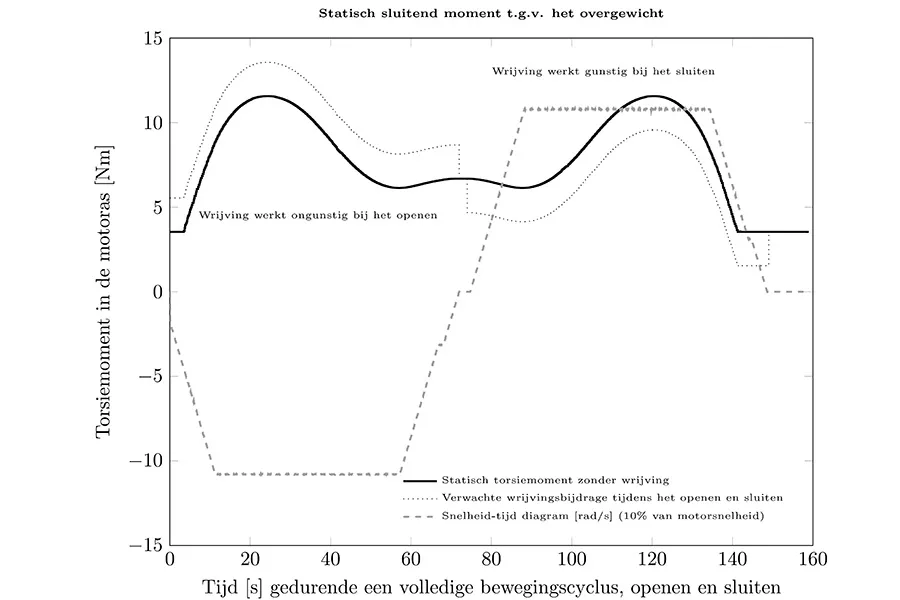
As part of the validation study, measurements were taken on the Crolesbrug. “The research focused specifically on mapping the dynamic loads in the operating mechanisms that occur when the bridge opens, closes and makes an emergency stop,” Sektani explains. “Significant peak loads arise during acceleration and deceleration, particularly at the motor shaft, just before the flywheel. Current calculation rules treat this peak as governing for the entire drive train, whereas in reality it occurs only locally. Further along the drive train, the governing loads can be four to five times lower. This systematic overestimation stems from several inaccurate assumptions underlying the calculation rules. Measurements on the Crolesbrug have now also demonstrated this in practice. They show that the peak load predicted by calculation actually manifests as an internal torque at the block brake, with barely any effect on the drive itself. This finding supports the choice of a single-mass spring system, in which the bridge, rather than the drive, plays the dominant role in determining the loads.”
Better decision-making
The results confirm that more targeted calculations can significantly reduce loads in the drive train. “This leads to better decisions about asset management and maintenance,” Sektani concludes. “It can help prevent operating mechanisms from being rejected unnecessarily or overdesigned.” Sektani says it is important to carry out similar validation studies on other types of movable bridges and operating mechanisms. “We have now received approval from the municipality of Amsterdam to take measurements on a drawbridge with a rack-and-pinion mechanism. In future, I would also like to study swing bridges.”
Revision of design codes
The ultimate aim is to translate the findings of this research into widely applicable codes for the design and assessment of movable bridges. The current calculation rules in NEN 6786 can be revised on this basis, providing a more realistic and reliable foundation for new design codes in the Netherlands. A logical next step would be to establish a technical committee of experts to evaluate and implement the research findings and share them with bridge owners and other stakeholders.
Question about this story? Ask your question
Keep following this
Get an email when a new story is published. No account needed.
- ThemeExtending the life of roads and civil engineering structures
- SubjectBridge construction







