









Getting the most out of bridges through proof load testing
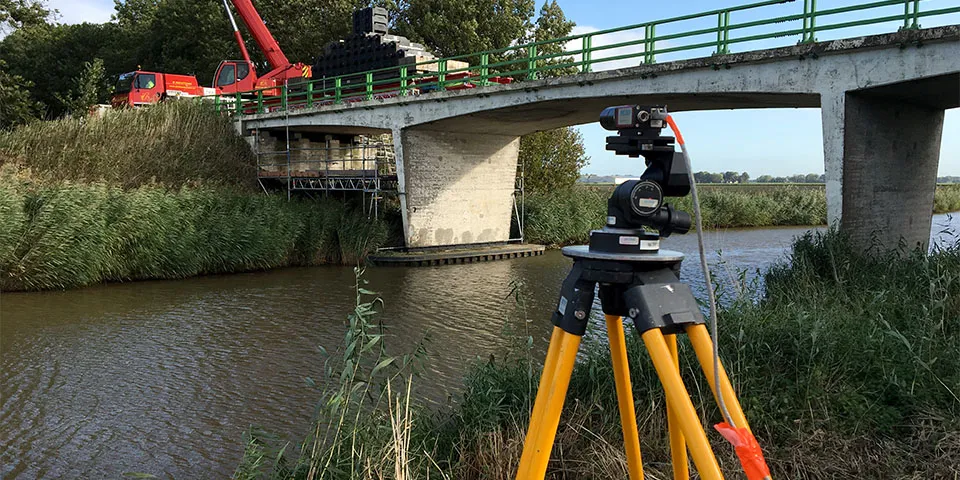
A significant proportion of the approximately 55,000 road bridges owned by local authorities in the Netherlands are ageing. A lack of design information means that the load-carrying capacity of these bridges is often difficult to determine. Uncertainties about, among other things, the forces acting within the structure, material properties and the geometry of the foundations and abutments often make it necessary to adopt conservative assumptions. Extensive further on-site investigations of the structure can sometimes reduce these uncertainties. However, the associated costs and disruption to the surrounding area do not always justify the expected improvement in the calculation: many uncertainties cannot be eliminated, meaning that only a limited increase in calculated load-carrying capacity can be achieved.
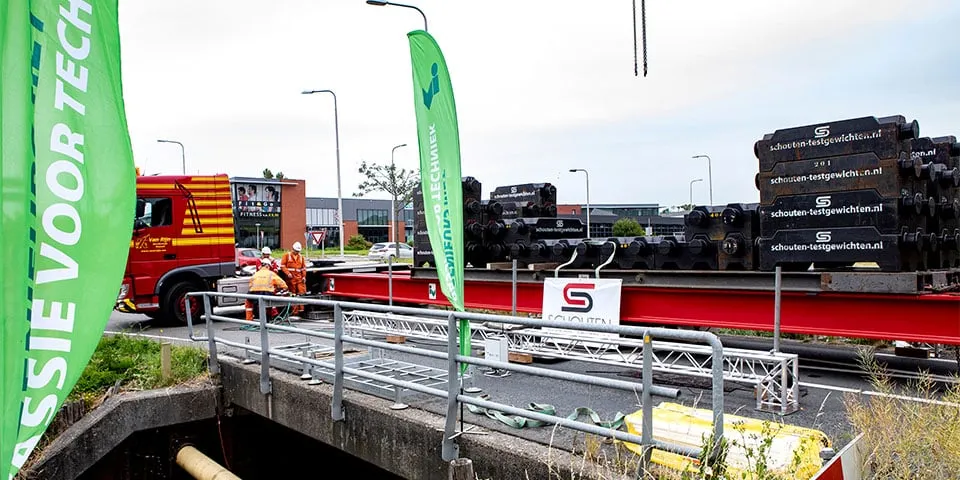
Zuidelijke Rondweg Bridge in Waddinxveen.
Demonstrating load-carrying capacity
Bridge owners are required to demonstrate that their bridges can safely carry the required loads. But bridges are often deemed inadequate because of overly conservative assessments and wrongly added to the replacement list. This results in wasted capital and unnecessary CO2 emissions from new construction. In such cases, the bridge’s full potential has certainly not been realised. Reassessments and further investigations are also regularly postponed because of budget constraints. Proof load testing provides a fast, cost-effective way to determine a bridge’s load-carrying capacity and resolve these problems, particularly when little or no design information is available, or when it is difficult or even impossible to obtain. Even where information is available, proof load testing can potentially demonstrate a higher load-carrying capacity than a reassessment. Where detailed reassessments have been carried out and a bridge falls just short of the strength requirements for existing structures, proof load testing can still demonstrate that it is structurally safe. In short, it is important to draw on the hidden strength of road bridges to keep them in service safely and demonstrably, and to prevent unjustified replacement. Proof load testing reveals what a bridge is capable of.
The principle of proof load testing
Proof load testing of a concrete bridge is carried out specifically to determine the moment capacity of the bridge deck. The deck’s shear capacity is calculated in advance, based on its geometry and structural type, to ensure that it does not govern during the test. If necessary, limited additional investigation can be carried out into the shear reinforcement and/or concrete strength class. Proof load testing is particularly suitable for bridges with spans of up to 15 metres.
For proof load testing, Iv-Infra makes use of the fact that a bridge exhibits linear elastic deformation behaviour. A steadily increasing load is applied at the centre of the span, creating a controlled load effect (moment, shear force, deflection) in the bridge deck. The load is positioned to generate the greatest moment in the deck. Ideally, this moment is brought up to the same level as the moment generated in the deck by the standard load (lane 1: 2 axles of 30 tonnes and a uniformly distributed load of 900 kg/m2), including safety and reduction factors (Eurocode, NEN 8700/8701).
The proof load testing process has now been standardised as far as possible. However, every bridge is unique, so each test still requires a degree of bespoke planning. The first step is to assess whether proof load testing is suitable for demonstrating the required capacity, or whether there are factors that might limit its effectiveness. The bridge is then inspected to record its condition and gather basic information. The abutments must not give cause to suspect foundation problems, and the bridge deck itself must show no signs of damage indicative of overloading. The abutments and foundations are closely monitored during the test.
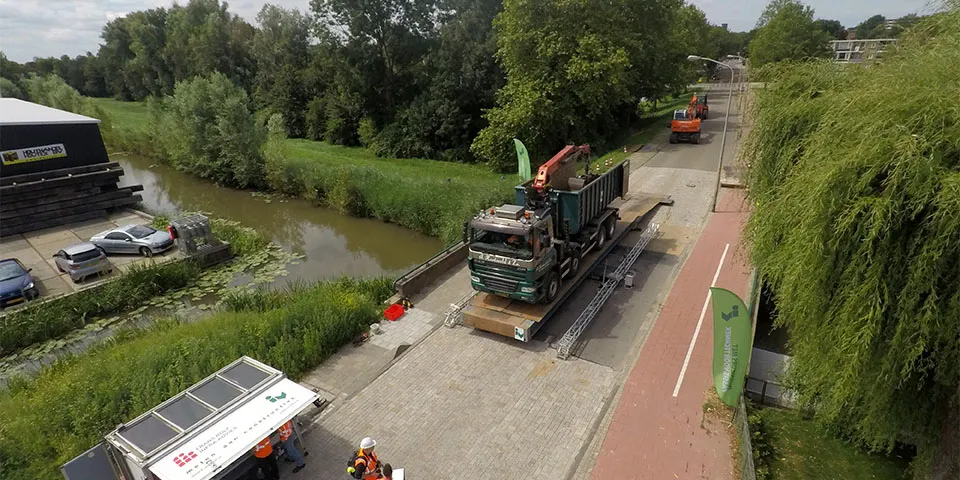
Willem de Zwijgerlaand Bridge in Waddinxveen.
Results
The proof load tests carried out by Iv-Infra to date have consistently demonstrated a higher load-carrying capacity than expected beforehand, based on either the type of structure or a calculation. The bridges behave more stiffly than predicted by rules of thumb or a calculation model. All the bridges continued to exhibit elastic deformation behaviour under the highest loads. It should be noted that no more load was applied than was necessary to demonstrate the required capacity of each bridge. Every bridge was shown to be suitable for unrestricted traffic in accordance with the Eurocode, whereas calculations carried out at an earlier stage would have indicated that significant load restrictions were necessary. No significant foundation settlement was observed at any of the bridges.
Discussion: a ‘new’ loading model for existing short-span bridges
The proof load to be applied to the bridge deck is currently related to the standard load under the Eurocode and the NEN 8700 series, with reductions applied for trends, remaining service life and use. This traffic loading model is suitable for designing new structures safely for a 100-year service life, or for assessing existing structures for a remaining service life of, for example, 30 years. In practice, applying these standards to existing bridges with shorter spans of up to around ten metres results in loading scenarios that cannot physically occur in reality. This is because, in practice, the load from a vehicle is always distributed more favourably across the bridge deck. One example is a 4- or 5-axle sand lorry weighing 50 tonnes and measuring around ten metres in length. Overloaded agricultural vehicles with high axle loads remain a concern. This can lead to existing bridges being wrongly rejected. The Netherlands has many bridges whose load-carrying capacity is unknown and for which no archived design information is available. Regardless of whether proof load testing or reassessment is used, many bridges will not meet the standard loading requirements. For bridges with spans of up to around ten metres, a pragmatic approach to the loads that actually occur would be desirable, alongside the existing “TNO report on local-authority bridges without annual exemptions”. In short, a maximum loading scenario should be established based on actual vehicles and an acceptable probability of exceedance. This will help ensure that the Netherlands can meet all its replacement needs over the next 10-20 years.
Delivering significant savings on bridge replacement
The bridges on which proof load tests have been carried out are, of course, not representative of the entire stock of 55,000 bridges. Iv-Infra is therefore certainly not drawing any general conclusions. However, the results were very favourable in every case. As expected, the proof load tests revealed substantial hidden strength. Every bridge, without exception, proved to have considerable residual capacity. The significant potential of proof load testing is clear: it is expected to deliver substantial savings on the replacement programme.
Question about this story? Ask your question
Keep following this
Get an email when a new story is published. No account needed.
- ThemeExtending the life of roads and civil engineering structures
- SubjectBridge construction







