









Computational Fluid Dynamics: certainty in every aspect of tunnel safety

A good smoke control/ventilation system is essential in tunnels, so that in an emergency road users can escape safely from the tunnel and the emergency services can gain safe access. Colt International BV focuses on fire safety and supplies, among other things, smoke control solutions for road, rail and metro tunnels.
Colt International designs and supplies complete smoke control systems. These systems can operate by moving air, using pressurisation, extracting air or generating thrust to move air. The latter is widely used in tunnels and car parks. Such installations need to be calculated. ProTuVem calculations are generally used as a starting point. They are suitable for an initial indication, but have some limitations. Colt International therefore validates ProTuVem designs using CFD, or ‘Computational Fluid Dynamics’.
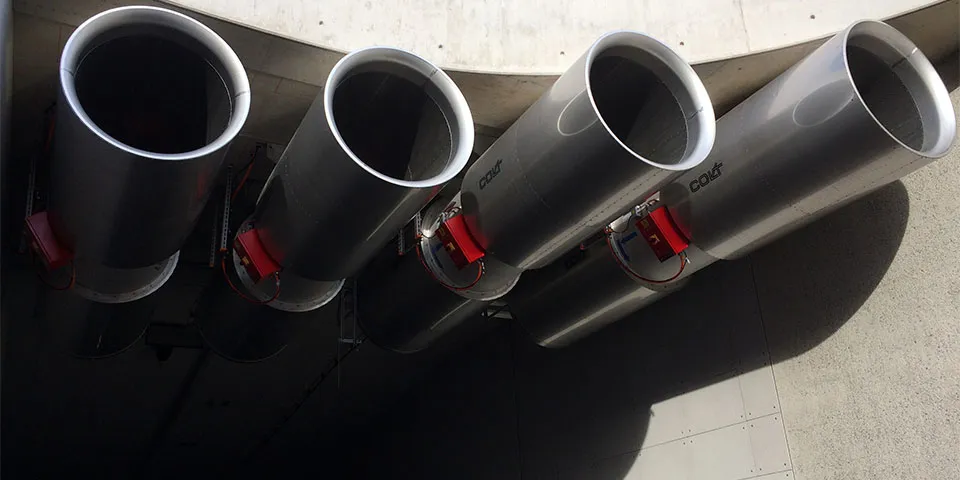
Thrust ventilation fans in the Spaarndammertunnel, Amsterdam.
Optimising designs
As noted, tunnel ventilation systems are generally designed using ProTuVem. This is used to carry out probabilistic calculations, but these have a number of drawbacks. For example, ProTuVem does not account for variations in geometry or for cars, lorries and buses not being in line. It also fails to take sufficient account of how the fans need to be installed. However, ProTuVem is suitable for an initial impression.
Colt International uses CFD to optimise a ProTuVem design. CFD simulations make it possible to predict the effectiveness of a tunnel ventilation system more accurately.
They also provide insights into, for example, the effect of tunnel wall roughness and niches, and the positive effect of fire-resistant cladding on the tunnel walls or ceiling. CFD can be used to identify possible improvements or system optimisations. Colt International considers CFD the best available method for predicting airflows and energy transfer in situations that do not yet exist. Carrying out this work at an early stage removes the need for costly on-site tests.
Even more benefits
Using CFD offers several further benefits. It can shorten the design time for a tunnel ventilation system. On-site tests are largely unnecessary, and different scenarios can be simulated almost immediately, such as fire, traffic type and outside temperatures. Different ventilation methods can also be tested, including longitudinal, transverse and semi-transverse ventilation, as well as the number of fans and/or extraction ducts, fan locations and mounting methods. Another major benefit is that working more efficiently makes it possible to meet the required completion date. Knowing the ideal configuration in advance also makes it easier to prepare an accurate budget. This means you know exactly what costs will be incurred to meet the safety requirements.
These safety requirements for a tunnel ventilation design can be met more quickly because CFD enables more reliable calculations. A fire safety system must also have an inspection certificate issued by an ISO17020 Type A accredited inspection body. The body assesses the derived objective. This assessment can be carried out during the design phase, based on the CFD results. This significantly shortens the time needed to obtain the certificate.
Question about this story? Ask your question
Keep following this
Get an email when a new story is published. No account needed.
- ThemeUnderground construction
- SubjectBridge construction







