









Zwijndrecht continues to reuse lava road sub-base
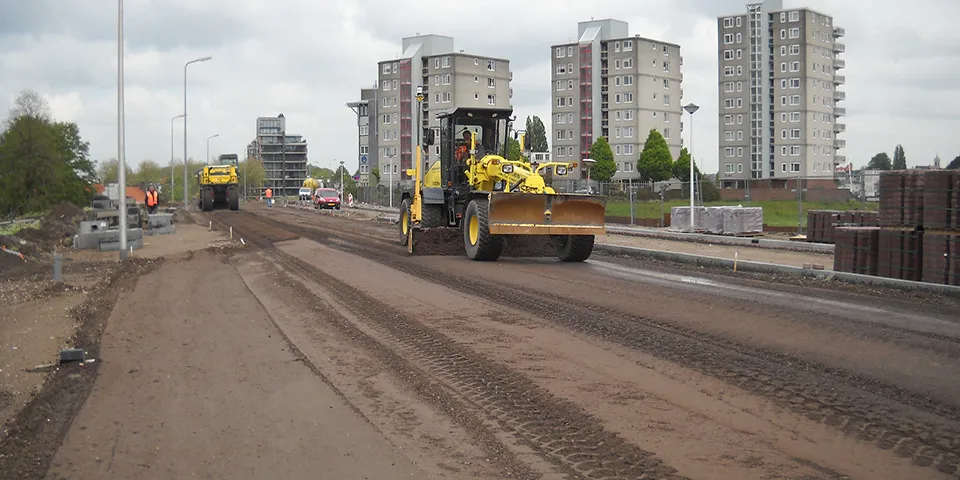
The municipality of Zwijndrecht manages and maintains around 2,500,000 m² of paved surfaces, approximately 650,000 m² of which is asphalt. Lava was used as a road sub-base material beneath many asphalt roads in the past. A number of roads with lava sub-bases were due for major maintenance.
When preparing preliminary cost estimates for the maintenance projects, Zwijndrecht found that the conventional method would require large quantities of lava to be excavated, removed and disposed of. Poor access to neighbouring residential areas and business parks was another undesirable consequence. Falling weight deflectometer tests were carried out on Ringdijk, Molenweg and Lindtsedijk. The average measured stiffness of the lava sub-base was only 45 MPa, too low for the lava to be reused directly as road sub-base material.
Investigating reuse
Zwijndrecht needed expert advice on how best to deal with the existing road sub-bases and had to look for alternative construction methods. One solution was to investigate reusing the existing lava. A number of studies were carried out to assess whether this was feasible. These included:
- Measuring the stiffness of existing road sub-bases using falling weight deflectometer tests;
- Preparing and testing samples in a laboratory;
- Selecting a trial section.
Testing
Wegbouwkundig Advies Bureau Van den Boom BV, now Lavaplus BV, proposed a possible solution: reusing the lava in situ by mixing it with cement. In 2007, the consultancy had commissioned laboratory tests in which lava was mixed with cement. The measured stiffness values averaged 3,500 MPa. These values were submitted to the water authority responsible for the flood defences on which the municipal roads are located (WSHD). WSHD considered an average stiffness of around 3,500 MPa far too high for a (stiff) foundation layer in a dike pavement. Dikes are always moving, which could lead to significant cracking in the foundation and road surface.
The consultant proposed mixing the lava with foamed bitumen and cement.
This makes the foundation layer more flexible than if it were mixed with cement alone. The team looked for examples of similar work carried out elsewhere. Online research and a search of various trade journals showed that lava mixed with cement and/or foamed bitumen had not been used anywhere before.
The next step was to test the idea in a laboratory. Trial tablets were made and initially tested to determine their Marshall value. The results were promising. The tablets were then used to determine stiffness, and this test was also successful. The stiffness measured 750 MPa, higher than the values for commonly used foundation materials such as mixed aggregate (400 MPa) or hydraulically bound mixed aggregate (600 MPa).
Trial section
Following the positive laboratory results, Zwijndrecht selected a 150-metre trial section on a dike embankment (Ringdijk) in 2011. The municipality and the consultancy tested the laboratory results in practice. The trial section is monitored annually, and the road structure still meets the requirements set by the municipality in 2011.
Projects using upgraded lava sub-base
Drawing on the experience gained from the trial section, the decision was taken to carry out the Herinrichting Ringdijk project (1.3 km) in 2013. Here too, the existing lava sub-base was mixed with foamed bitumen and cement. The same method was used on Molenweg in Heerjansdam (0.4 km) in 2014 and on Lindtsedijk (3.5 km) in 2018.
In summary, the following conclusions can be drawn:
- Reusing the lava sub-bases as part of a circular approach meant that very little material had to be transported to or from the site;
- CO2 emissions were significantly lower;
- Construction times were shorter;
- Disruption to residents and businesses was significantly reduced;
- Around €1 million, including VAT and other project costs, was saved on the construction costs for the three projects compared with conventional construction methods;
- The road surface is expected to have a longer service life thanks to the good stiffness of the new road sub-base.
Question about this story? Ask your question
Keep following this
Get an email when a new story is published. No account needed.
- ThemeLower emissions and more reuse
- SubjectBouwMat







