









Zwijndrecht continues to reuse lava road foundations
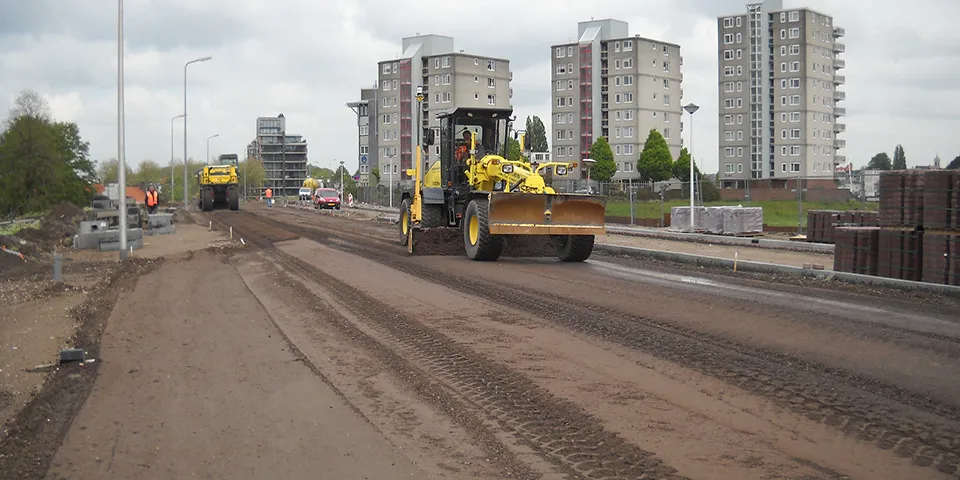
The municipality of Zwijndrecht manages and maintains around 2,500,000 m² of paved surfaces. Approximately 650,000 m² is asphalt. Lava was used as a road foundation material beneath many asphalt roads in the past. A number of roads with lava foundations required major maintenance.
When preparing preliminary cost estimates for the maintenance projects, Zwijndrecht discovered that the conventional method would require large quantities of lava to be excavated, removed and sent to landfill. Poor access to neighbouring residential areas and business parks was another undesirable consequence. Falling weight deflectometer tests were carried out on Ringdijk, Molenweg and Lindtsedijk. The average measured stiffness of the lava road foundation was just 45 MPa, too low for the lava to be reused directly as road foundation material.
Investigating reuse
Zwijndrecht needed expert advice on how best to deal with the existing road foundations and had to look for alternative working methods. One possible solution was to investigate the reuse of the existing lava. A number of studies were carried out to assess whether this was feasible. These included:
- Determining the stiffness of existing road foundations using falling weight deflectometer tests;
- Preparing and testing samples in a laboratory;
- Designating a trial section.
Testing
Wegbouwkundig Advies Bureau Van den Boom BV, now Lavaplus BV, proposed a possible solution: reuse the lava in situ by mixing it with cement. In 2007, the consultancy had laboratory tests carried out on lava mixed with cement. The average stiffness measured was 3,500 MPa. These values were submitted to the water board responsible for the flood defences on which the municipal roads are located, Waterschap Hollandse Delta (WSHD). WSHD considered an average stiffness of around 3,500 MPa far too high for a (stiff) foundation layer in a dike pavement. Dikes are always moving, which could cause significant cracking in the foundation and road surfacing.
The consultant proposed mixing the lava with foamed bitumen and cement.
This makes the foundation layer more flexible than if it were mixed with cement alone. The team looked for references to similar work carried out previously. Online research and searches through various trade magazines showed that lava mixed with cement and/or foamed bitumen had not been used anywhere before.
The next step was to test the approach in a laboratory. Test specimens were made and initially tested for their Marshall value. The results were promising. The specimens were then used to determine stiffness. This test was also successful, producing a stiffness value of 750 MPa. This is higher than the values for conventional foundation materials such as crushed concrete and masonry aggregate (400 MPa) and hydraulically bound aggregate (600 MPa).
Trial section
Following the positive laboratory results, Zwijndrecht designated a 150-metre trial section on a dike embankment at Ringdijk in 2011. The municipality and the consultancy tested the laboratory results in practice. The trial section is monitored annually, and the road structure still meets the requirements set by the municipality in 2011.
Projects using upgraded lava foundations
Building on the experience gained from the trial section, the decision was made to carry out the Herinrichting Ringdijk project (1.3 km) in 2013. Here too, the existing lava foundation was mixed with foamed bitumen and cement. The same approach was used on Molenweg in Heerjansdam (0.4 km) in 2014 and on Lindtsedijk (3.5 km) in 2018.
In summary, the following conclusions can be drawn:
- The (circular) reuse of lava foundations meant that almost no materials, including soil, had to be brought in or taken away;
- CO2 emissions were significantly lower;
- Construction times were shorter;
- Disruption to residents and businesses was significantly reduced;
- Construction costs for the three projects were around € 1 million lower (including VAT-related costs) than with conventional construction methods;
- The road surfacing is expected to have a longer service life thanks to the good stiffness of the new road foundation.
Question about this story? Ask your question
Keep following this
Get an email when a new story is published. No account needed.
- ThemeLower emissions and more reuse
- SubjectBouwMat







