









Why renew timber structures when they can be repaired?
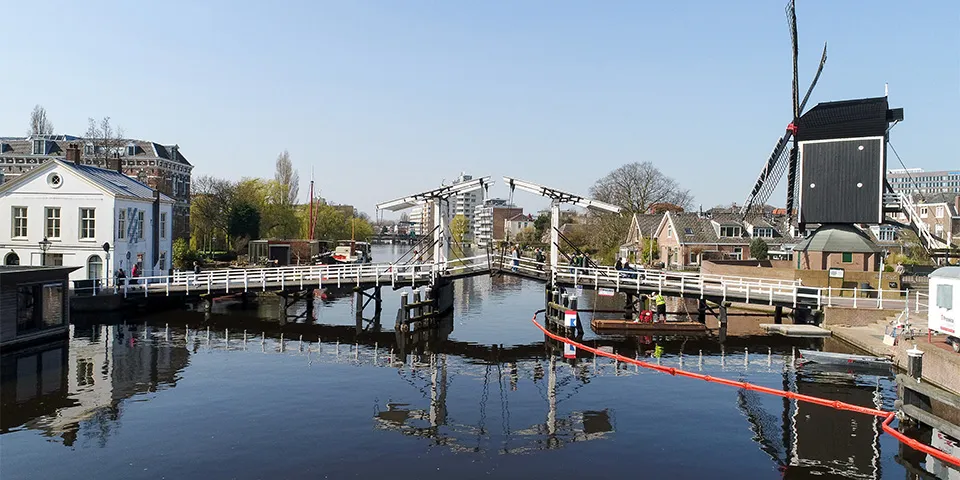
The Netherlands and water: two elements inextricably linked. We protect ourselves from water by building dykes, bridges and locks. We make the most of water with our ports, rivers and canals. To keep doing so in the future, many water engineering structures need a thorough overhaul. Although these structures are often only partly damaged, many municipalities, provinces and water boards still opt to replace timber structures rather than repair them. This not only costs a great deal, but also results in high CO2 emissions and the waste of tropical hardwood.
As well as being more cost-effective, repair is also better for the environment.
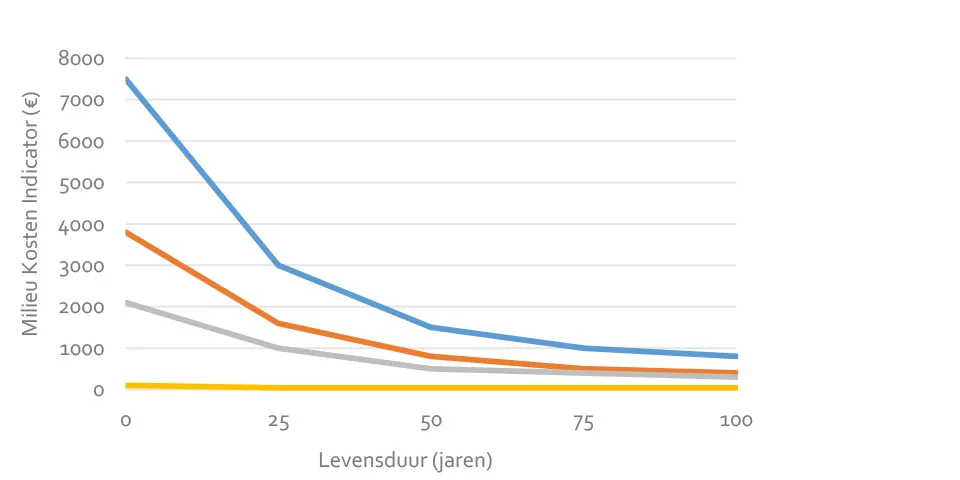
Figure 2 Environmental costs of cycle bridges over different service lives. Timber cycle bridges have by far the lowest environmental impact over all service lives, even when they are replaced during that period. Source: ‘Comparative LCA study: determining the sustainability score of bridges built in steel, concrete, composite and timber’, commissioned by the Rijksdienst voor Ondernemers (RvO).
Timber in water engineering
When timber structures are replaced, materials such as concrete, composite and steel are often chosen. As well as being costly, these materials have a high environmental impact, as shown by the comparative Life Cycle Assessment (LCA) of mooring piles in Fig. 1. Replacement with composite causes by far the greatest environmental damage, followed by replacement with steel, concrete and timber. Timber repair, by contrast, has by far the lowest environmental impact.
The service life of timber
When replacing timber with steel, concrete or composite, it is often argued that timber has a short service life, making steel, concrete or composite more sustainable. However, research commissioned by the Rijksdienst voor Ondernemers (RvO) shows that timber still has the lowest environmental impact when replaced or renovated during its service life, making it the most sustainable option (see Fig. 2). In addition, replacing timber with composite, steel or concrete causes considerable disruption to the surrounding area due to pile extraction and driving.
Repair rather than replacement
In collaboration with TU Eindhoven, Protekta developed a restoration method for timber structures in 2009, following extensive testing. The method restores the structure to its original strength and is patented as the Protek Aqua® method. It uses a specially developed epoxy that has been tested for tensile and flexural strength, bond durability, environmental impact and the effects of temperature differences (coefficient of thermal expansion). Protekta provides a twenty-year guarantee on the work carried out using this repair method.
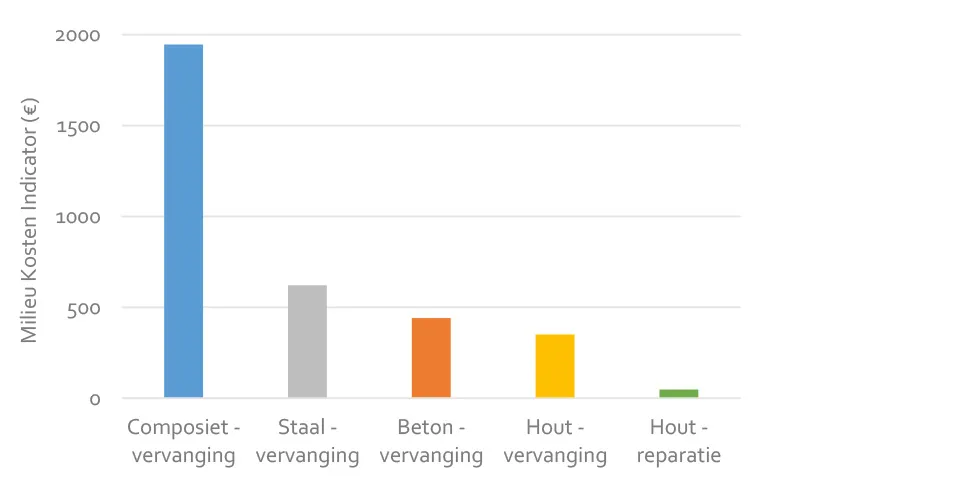
Figure 1 Environmental costs of mooring piles, comparing replacement and repair. Repairing a timber mooring pile has 7 times less environmental impact than replacing it with a new timber pile. Source: ‘Comparative LCA of mooring piles (repair, timber, steel, concrete, composite)’, conducted by Stichting Hout Research Wageningen (SHR).
Water engineering timber repair specialist
Restoration rather than replacement preserves historic timber structures. This helps us retain protected village and townscapes in the Netherlands. Repair rather than replacement also reduces environmental damage, including through much lower CO2 emissions. As well as being the most sustainable option, restoration is also the most cost-effective, because the problem is dealt with locally and no sound tropical hardwood is wasted.
For these reasons, over the past ten years an increasing number of municipalities, provinces, contractors and water boards have chosen our Protek Aqua® repair method to restore locks, bridges, fendering structures, mooring piles and dolphins. Protekta is working with its clients towards a sustainable future.
Protekta
Dommel 29, 5422 VH Gemert
T +31 492 36 42 92
www.protekta.nl
Question about this story? Ask your question
Keep following this
Get an email when a new story is published. No account needed.
- ThemeFlood protection and climate-resilient water management
- SubjectBouwMat







