









“We reused the locally recycled aggregate in the new cycle path”
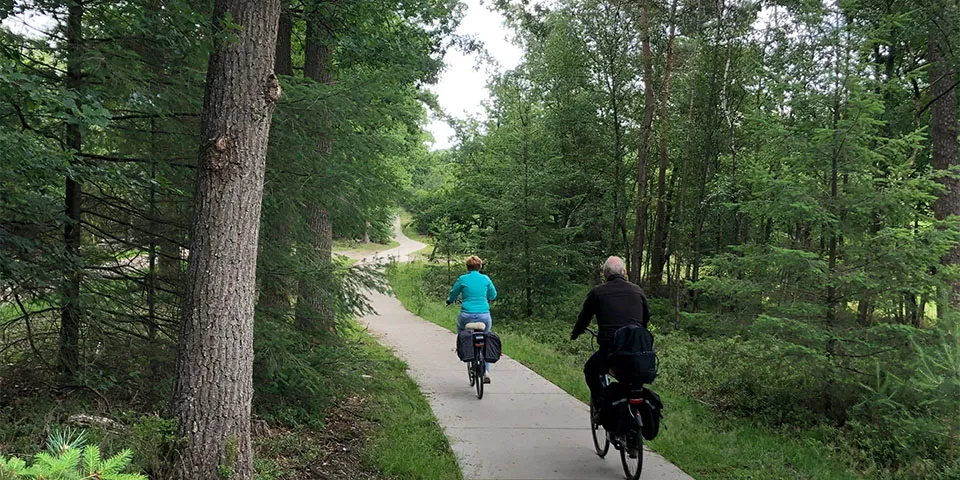
That is true both literally and figuratively. Not only does the new cycle path along Krimweg and Spoekweg in Hoenderloo…
Sustainable concrete cycle path is an asset to the Municipality of Apeldoorn
That is true both literally and figuratively. The new cycle path along Krimweg and Spoekweg in Hoenderloo has turned out beautifully, and it was also built using sustainable concrete. This reflects well on the Municipality of Apeldoorn, which is leading the way in seeking sustainable solutions.
We discuss this sustainable, circular cycle path with John Assink, roads and structures specialist at the Municipality of Apeldoorn. “On behalf of the municipality, I can award contracts for this kind of work in my role as budget holder,” Assink begins.

Core group focuses on circularity
“Apeldoorn is always looking for sustainable options. Since last year, a core group has been working on circularity. In the broadest sense of the word, too: they are even looking at recycling workwear,” says Assink. The cycle path in question used to be asphalt and was intended for recreational use. “In 2010, the recreation board transferred the cycle path to the Municipality of Apeldoorn. It needed renovating, giving us a great opportunity to make the project as sustainable as possible.”
At the time, a large quantity of concrete slabs became available from the De Parken project in Apeldoorn. “De Parken is a neighbourhood in the centre of Apeldoorn. The carriageway there was made of concrete slabs, which were being lifted by tree roots. A new road therefore had to be built. From a circularity perspective, we first looked at whether we could reuse the old slabs, but their undersides turned out to be irregular. They were not flat enough to be reused, so we decided to crush and granulate them. We reused this aggregate in the new cycle path,” Assink explains.
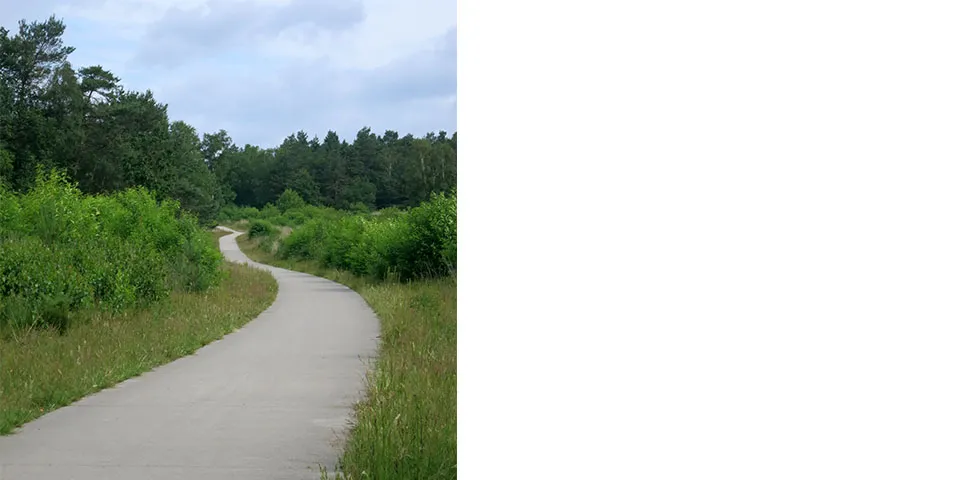
“We knew from the composition of the concrete mix that it would need more time to cure.”
Good communication within the project team is half the job
“The project team for the cycle path comprised several companies. We knew from the composition of the concrete mix that it would need more time to cure. We wanted to finish before the main cycling season and knew that would mean a very tight schedule. Good communication within the project team enabled us to deliver everything. The team also came up with additional measures to protect the uncured concrete from external conditions, such as installing an electric fence to keep wildlife away from the cycle path while it was still curing.”
The cycle path has been a valuable learning experience for the core group. “We will carry on in the same way,” says Assink. “We are now working on the cycle path on Imbosweg, where we are also using as much recycled local concrete as possible. We do not yet know whether we can manage with 100% Apeldoorn concrete, but there will certainly be recycled concrete from the region. We have to consider the CO2 footprint. We take a lot of concrete from demolition projects to the crusher, so we can genuinely describe the resulting material as ‘locally sourced’.”
Recycled concrete aggregate also used in concrete paving slabs
The De Parken project also benefits from sustainable concrete, in the form of concrete paving slabs for footpaths containing aggregate from Apeldoorn. “A local company buys these in for us, to our specifications,” Assink explains. “We want our work to be future-proof. We are currently renovating a bridge. This raises the interesting question of how circular we can make the project. Can we use concrete, or should we use timber? The good thing about this discussion is that, within the Municipality of Apeldoorn, it has become second nature to consider whether something can be done circularly. That is why we carefully record the recyclable materials generated in the municipality and region, so we can identify in good time where they could be reused. A good example is concrete setts from a carriageway that we were able to reuse in the construction of parking bays. Reuse is just as important to us as recycling. We always assess whether to recycle or reuse materials from demolition, based on their intended function.”
Materials passport
Assink and his team are currently developing a ‘materials passport’. He explains: “We document everything in advance, for example by recording the composition of asphalt before it is laid. That way, we will know which materials it contains if it is ever demolished. This allows us to map exactly what materials are present in our asset base. Recording materials at the start of the supply chain helps facilitate their recovery at the end.”
In this way, Apeldoorn is sending a positive message and showing that anything is possible. “As long as everyone is pulling in the same direction and you keep your eyes on the goal, anything can be done. Apeldoorn is large enough to generate a mass of raw materials of its own, and small enough to manage that resource flow itself,” Assink concludes.
Betonhuis
Betonhuis is the trade association for the cement and concrete industry, the construction sector’s largest supplier. By sharing knowledge and expertise, Betonhuis responds to current issues such as circular construction, climate adaptation and sustainable building. Find out more at Betonhuis.nl
Question about this story? Ask your question
Keep following this
Get an email when a new story is published. No account needed.
- ThemeLower emissions and more reuse
- SubjectBouwMat







