









‘We make what others won’t or can’t’
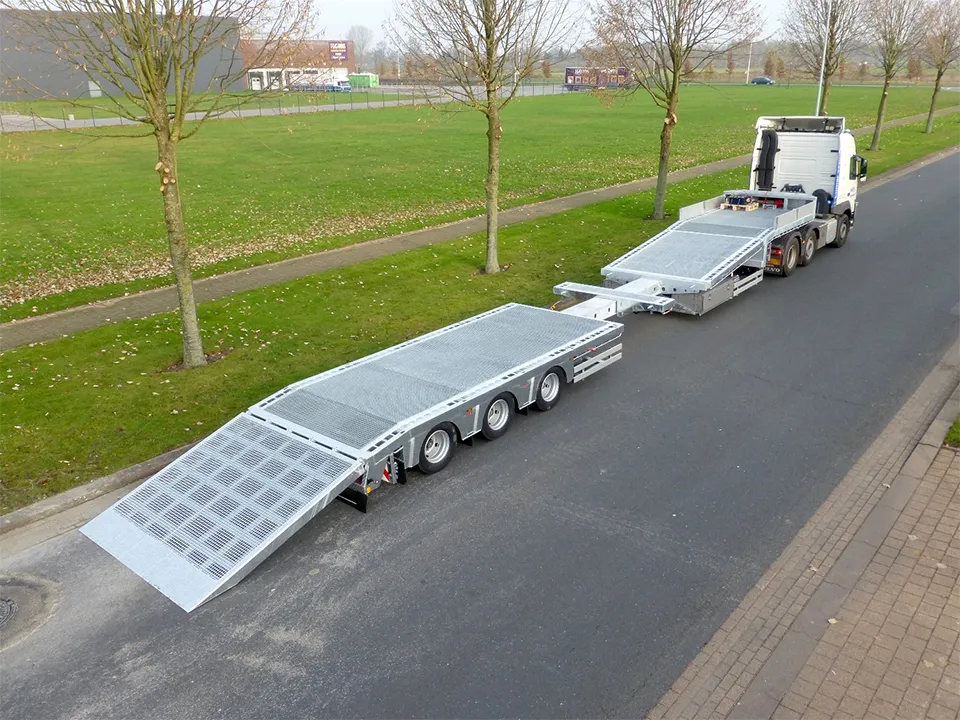
“We make trailers that others won’t or can’t make,” says Leo Oosterkamp, owner of Trias Trailers in Apeldoorn.
“Ideally, we make something that doesn’t exist yet, then make sure it can safely go on the road.” Trias Trailers does this so well that a second site, measuring no less than 3,000 m² and featuring a brand-new welding hall, will soon open, enabling carbon-neutral production.
Trias Trailers has been in business since 1959. In its early years, the company produced so-called iron dogs: three-wheeled carts used by milkmen, scrap collectors, bakers and other door-to-door sellers to make their rounds in the 1950s and 1960s. Later, it moved on to building chassis for trailers and semi-trailers for mobile businesses, such as fish and chip stalls and refrigerated vehicles.
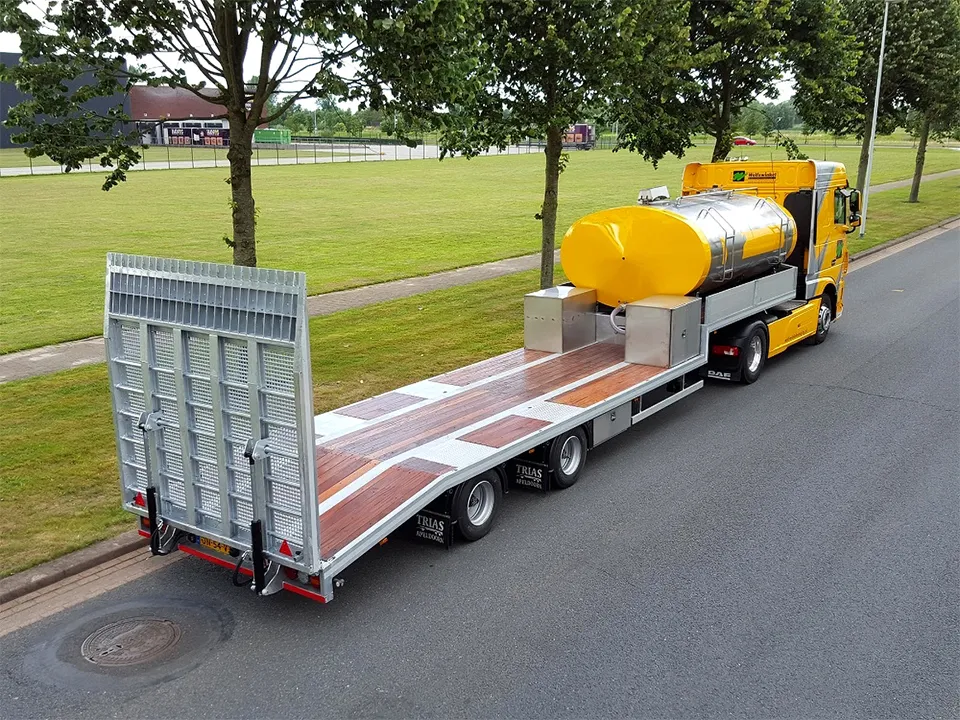
Oosterkamp started at Trias in 1989 on a holiday job and took over the company in 1996. “Since then, we’ve grown it into a business that now employs 25 people and manufactures between 100 and 120 vehicles a year,” says Oosterkamp. “And we use ‘vehicles’ in the broadest sense of the word, from equipment carriers for transporting things like scaffolding components to ballast trailers for tower cranes and carriers for telescopic handlers and earthmoving machinery. We’re very versatile.”
HYDRAULICALLY LIFTABLE
To illustrate the point, Oosterkamp describes one of the company’s latest projects: a semi-trailer built for a business that collects chunks of polystyrene and processes them into the insulation beads used in cavity walls. “The body on the trailer can be raised hydraulically by 1.25 metres. At the collection site, it’s loaded with polystyrene, and once it’s full, we lower the roof again to a height of 4 metres. This allows the company to carry 240 cubic metres of material instead of 180. That’s no problem, because the stuff weighs virtually nothing. The same vehicle combination also has a bag into which they can blow the processed insulation beads, ready for use on site.”
Another example: Trias is currently manufacturing chassis for Air Liquide België, a company that transports gas cylinders. Oosterkamp says: “We make chassis that lock automatically, so the crates of gas cylinders no longer need to be secured with ratchet straps. We also make a lot of chassis for Theo Mulder, which builds trailers for refrigerated transport.” Trias also builds semi-trailers for transporting steel road plates, fitted with a crane. “The crane can be used to put the plates in place. It can also be used to manoeuvre the vehicle combination, so the driver doesn’t have to keep returning to the cab to reverse a short distance. That saves a lot of time.”
CUSTOM-MADE ONLY
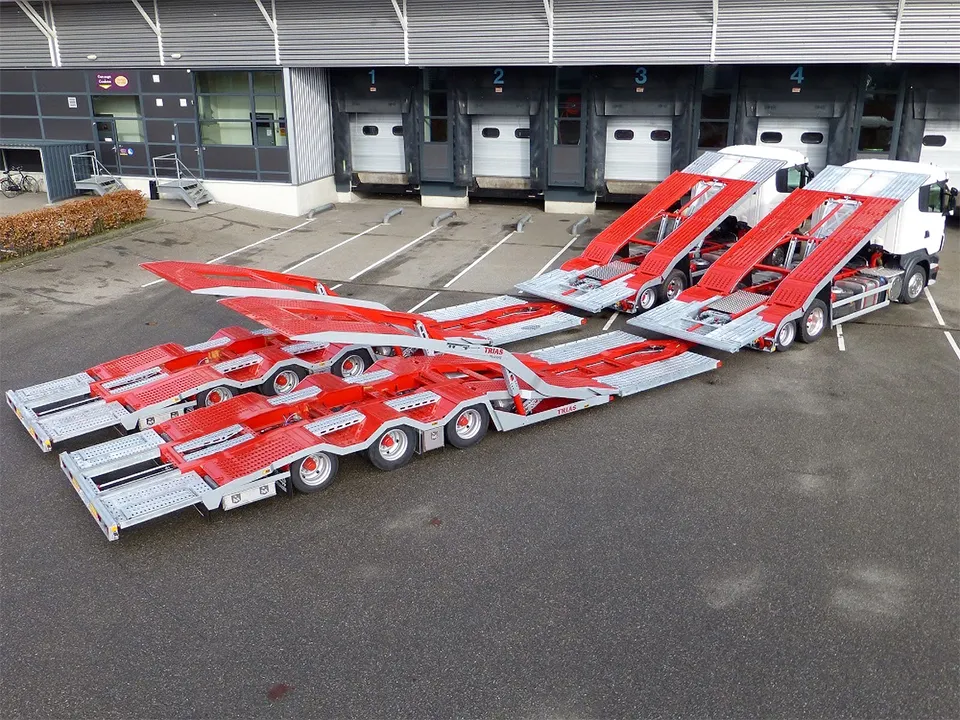
Trias builds almost exclusively custom-made chassis and trailers, and rarely makes them in series. “We once made a batch of 24 semi-trailers for one customer, but we quickly find that kind of work a bit dull,” Oosterkamp laughs. The company would rather build special extra-long, extendable or folding trailers for cars, trucks and heavy machinery. “We’ve just started building a three-axle semi-trailer that can be split apart. The rear two axles can be extended, leaving a single-axle semi-trailer that’s highly manoeuvrable in urban areas. That single axle is steered too, just like the rear axle.”
Trias has a healthy order book. It’s no coincidence that the company is investing in a new site with a brand-new welding hall. Oosterkamp attributes its success to the fact that Trias listens carefully to what its customers want. “And we genuinely want to build what the customer wants. We operate in the space between what the regulations require and what is technically possible, and we often make things that others won’t or can’t. Many other companies opt for standard production, which means fewer headaches. But we find this kind of work enjoyable and challenging.”
Another unique selling point for Trias is that all its chassis are hot-dip galvanised, inside and out. “All the hollow sections in our chassis are completely immersed in a zinc bath. That includes the extendable sections. So none of our trailers can corrode from the inside. The only parts that won’t last more than 20 years are wear parts such as the axles. The rest of the chassis is indestructible.”
Question about this story? Ask your question
Keep following this
Get an email when a new story is published. No account needed.
- ThemeConstruction equipment and transport in motion
- SubjectBouwMat







