









Want to dig cheaply? Hire the largest excavator you can!
It may sound like strange advice. But if I may offer you a tip… always hire the largest excavator you can!
You might think I’m trying to drive up your costs. After all, a quick look at our website shows that the bigger the machine, the more it costs to hire. Yet in many cases, the opposite is true. Choosing the right machine, which may mean going slightly larger, can save you a lot of money. In this blog, I’ll explain exactly how.
Once you know what the job is and where it needs to be done, you can work out how large your machine needs to be. You obviously can’t use a 15-tonner to landscape a small city garden. It simply won’t fit. On the other hand, using a (too) small machine for a large job wastes a lot of time and fuel.
DIGGING CHEAPLY? HOW DOES THAT WORK?
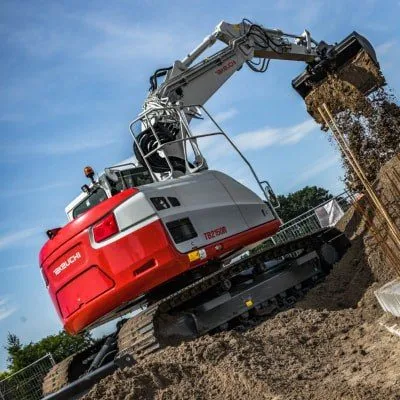
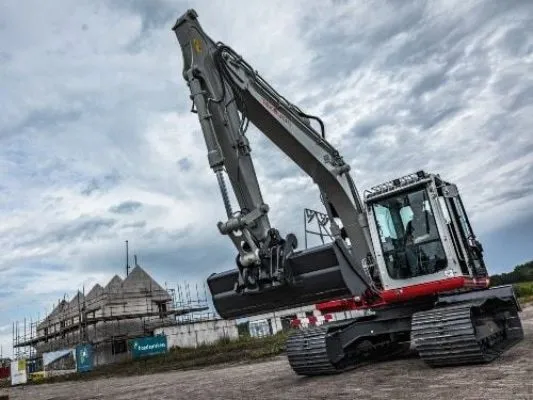
A small machine needs to be repositioned much more often during the job. A 2-tonner, for example, needs to be moved twice as often as a 10-tonner, which has a much greater working range. Repositioning takes time and fuel. And while you’re moving the machine, you’re not digging.
Here’s a simple calculation to illustrate the point:
- With a 1.5-tonner and a ditching bucket about 1 metre wide, you move around 100 litres per bucket and 4 buckets per minute. But because the machine needs to be repositioned, the effective rate is only 3 buckets per minute.
- At 6 hours of intensive work, that amounts to 108 m3 per day. Daily fuel consumption will be about 20 litres. That works out at 0.185 litres per m3 of excavated soil.
- With a 10-tonner and a 2-metre ditching bucket, you move around 450 litres per bucket and 3.5 buckets per minute. Including the necessary repositioning, the effective rate is 3 buckets per minute.
- At 6 hours of intensive work, that amounts to 486 m3 per day. Daily fuel consumption will be about 40 litres.
- That works out at 0.08 litres per m3.
- This example shows that a 10-tonner works more than 4 times as fast and uses only half as much fuel per m3 of soil moved as a 2-tonner.
This example shows that a 10-tonner works more than 4 times as fast and uses only half as much fuel per m3 of soil moved as a 2-tonner.
Once again, this is a theoretical example of a job that doesn’t actually exist. But the difference is so great that it’s worth giving some thought to your choice of machine.
Of course, there are a few factors to take into account when choosing your machine.
SITE CONDITIONS
How large is the site? You have more room on an estate than in a city garden. Are you working inside a building, under trees or beneath overhead power lines? If so, bear height restrictions in mind. Do you need to dig alongside a wall, road or railway? If so, choose a zero-tail-swing excavator. Are you working on a construction site or a golf course? On a construction site, ground rutting isn’t usually a problem, but it won’t go down well on a golf course.
SIZE OF THE JOB
You don’t need a 15-tonner to dig a hole for a trampoline. But you do for excavating the foundations of a mega-barn.
TRANSPORT COSTS
Transporting a machine can be costly. The cost of a low-loader for a 15-tonner is considerably higher than that of a small trailer for a 2-tonner. You’ll probably finish much sooner with the 15-tonner, but in this case the benefits, finishing sooner and therefore hiring the machine for less time, probably don’t outweigh the drawback of the high transport costs. So ‘bigger’ isn’t always ‘better’.
Looking to hire an excavator near you? Visit www.graaver.com to see what’s available and check the prices!
This blog was written by Graaver, in collaboration with Dick Kroesbergen
Question about this story? Ask your question
Keep following this
Get an email when a new story is published. No account needed.
- ThemeConstruction equipment and transport in motion
- SubjectBouwMat







