









The road to zero has its bumps
Text Kees Beijer Image UMS
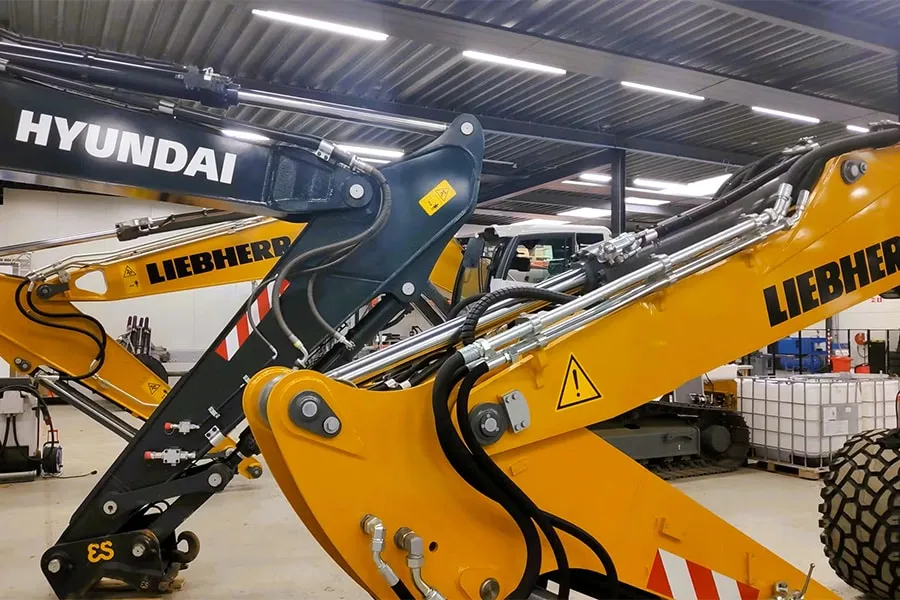
Interview with heavy equipment specialist and entrepreneur Lars Kool
2024 is drawing to a close. A good time to sit down with Lars Kool over lunch, look back on a turbulent year and look ahead to 2025. Is this outspoken visionary still full of ideas, or does the owner of Urban Mobility Systems in Oss feel a little like the Don Quixote of the energy transition?
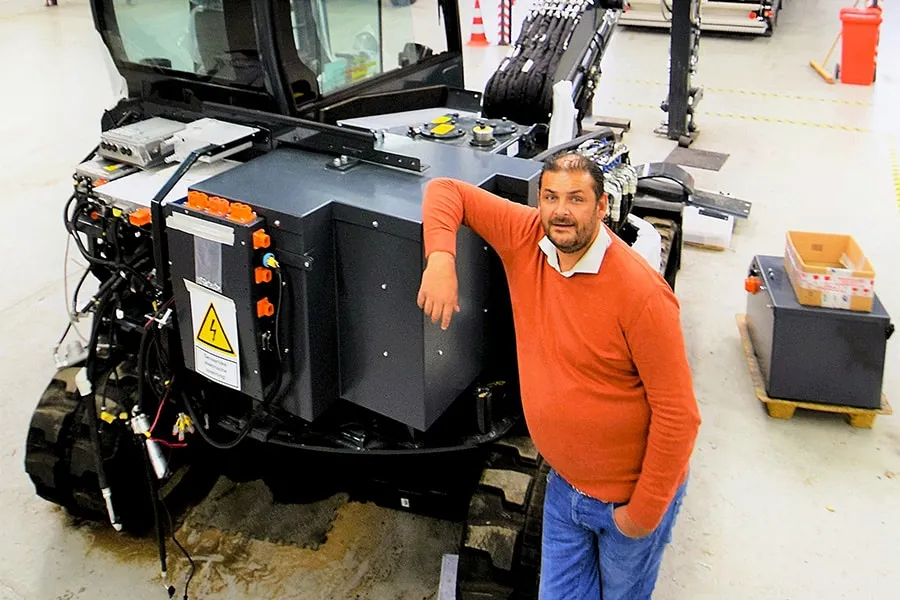
After a flying start, with major construction companies piling into zero-emission equipment, sales of electric machines now seem to be slowing somewhat.
“In the Netherlands, yes, but the rest of the world has woken up and is now overtaking us on all sides. The Netherlands is only a small player in the market, of course, but as a test bed for developing zero-emission solutions for construction, we should be better placed to capitalise on our pioneering role.”
So where are things going wrong?
“The road to zero was never going to be a six-lane motorway, but one with bumps along the way. The transition moves in waves. A lot is going well in the Netherlands, such as requiring zero-emission construction equipment in tenders. There is even a substantial subsidy fund available to make the investment easier. The shame is that the money is not being used to reward the use of zero-emission machines rather than their purchase. As things stand, the available budget goes to a relatively small group, with some opportunists applying for subsidies both to develop and to buy machines. I’m not proud of what we are all doing in that respect. Don’t get me wrong, I’m not talking about the technical side of electrification.”
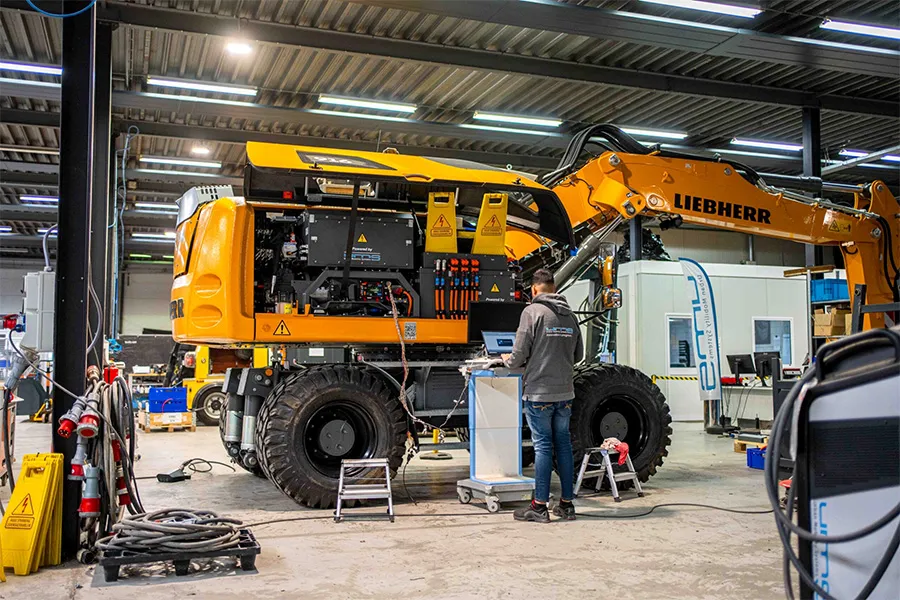
How do you view competition from Asia?
“Chinese brands are now also bringing electric machines to market at attractive prices. Even so, I don’t see them as an immediate threat. The lower purchase price is largely offset by a lower residual value. The Chinese are certainly making great strides in build quality, and cars from China are now barely inferior to familiar European models. I expect to see a similar trend in construction equipment. Various Chinese manufacturers will undoubtedly gain a foothold here, but even so, I don’t consider it a serious threat.”
Could you explain that in more detail?
“We are creative enough to counter the Chinese advance. But to do that, it is important to join forces and make the most of Western expertise. If we each play to our strengths, we can beat this economic superpower. We are not machine builders, but we are top of the bill when it comes to efficient electric drivetrains. It is up to the OEMs to package them in an attractive product, while companies such as Shell, Total and BP should take on the role of electricity supplier and handle battery pack swapping. They generate enough green electricity to play a significant role in charging infrastructure.”
Are swappable battery packs the key to success?
“Absolutely! UMS will soon unveil a completely new design that will astonish the market. It will take the concept of battery-electric equipment to an even higher level, both in terms of safety and ease of use. A swappable pack has many advantages over a fixed battery pack. Swapping takes much less time than recharging, so a machine can get back to work sooner. And you can charge the packs wherever you want, without the hassle of a heavy-duty grid connection or huge battery containers on site. It also offers TCO benefits. By leasing a swappable pack and paying per kWh, the base machine becomes significantly cheaper, even less expensive than a diesel model.”
That could give a huge boost to the energy transition, which is still largely being held together by subsidies.
“A different allocation of the subsidy fund would make it much easier to persuade small businesses to green their fleets too. Shift the budget from purchasing to use, and it immediately becomes part of day-to-day business. We need to start treating the purchase of electric equipment as a business model, just as we do with diesel machines. The TCO has to stack up. I’d go so far as to say that it should even be possible to make it pay without subsidies, as long as we work together as an industry.”
Can you give an example of what that kind of collaboration can achieve?
“The first thing that comes to mind is the ART-E asphalt train. An electrically powered machine that mills out the old asphalt on site, recycles it and lays it back down as a ‘new’ layer. How circular can you get? Just think of the reduction in machine movements and, above all, transport movements. All those asphalt tipper trucks become redundant overnight. If all asphalt works were carried out by the Asphalt Recycling Train, we would save €5 million a day! It is no coincidence that Rijkswaterstaat is strongly promoting this initiative and virtually all road construction companies want to get on board.”
A great step forward, then.
“My view is that there is room in the world for everyone. We don’t need to keep our cards close to our chest, we should be working together on solutions for an emission-free construction site. I want to move forward and involve as many parties as possible. Schools, for example. In preparation for the new factory in Arnhem, we have already taken on lots of young people. They all feel the same way: ‘This is the future. I want to be part of it.’ How great is that? I also see an important role for banks and insurers in monitoring and enforcement. Every machine that leaves here bears the manufacturer’s name. That is quite something, you know. But that’s how it should be. It sets the bar high. Many conversion companies still use NMC batteries, which are a fire hazard. If one of those machines catches fire near a Natura2000 site, the consequences, both environmental and financial, would be incalculable.”
That would put a serious dent in those ambitions.
“We are not going to meet the 2030 targets. We all need to be honest about that. Nor will we meet those for 2035 and 2040. Charging infrastructure is already a problem, so how on earth are we supposed to scale up further? The Netherlands also has some of the best infrastructure in the world, both above and below ground. There is a reason manufacturers have put the launch of electric models on the back burner.”
Aren’t you afraid you’ll end up like Don Quixote, fighting a hopeless battle in pursuit of your goals?
(Laughing:) “We mustn’t sit back and wait, we have to keep going. There is plenty of good news in the pipeline for 2025. UMS will start the year in a brand-new factory in Arnhem, where up to 3,000 battery kits can be built each year. If we move to three shifts, that figure rises to 9,000 kits. As I said, we will introduce completely revamped battery technology for battery-electric machines, and we will soon announce a new partnership with a major manufacturer. More on that later, but one thing is certain: we’re going to hit the ground running.”
Question about this story? Ask your question
Keep following this
Get an email when a new story is published. No account needed.
- SubjectBouwMat







