









The Key Register of the Subsurface will be a “game changer” for geotechnical engineering
Digital data flows: A vision for data in geotechnical engineering, by Kees-Jan van der Made, chairman of the Vereniging Ondernemers Technisch Bodemonderzoek (VOTB).
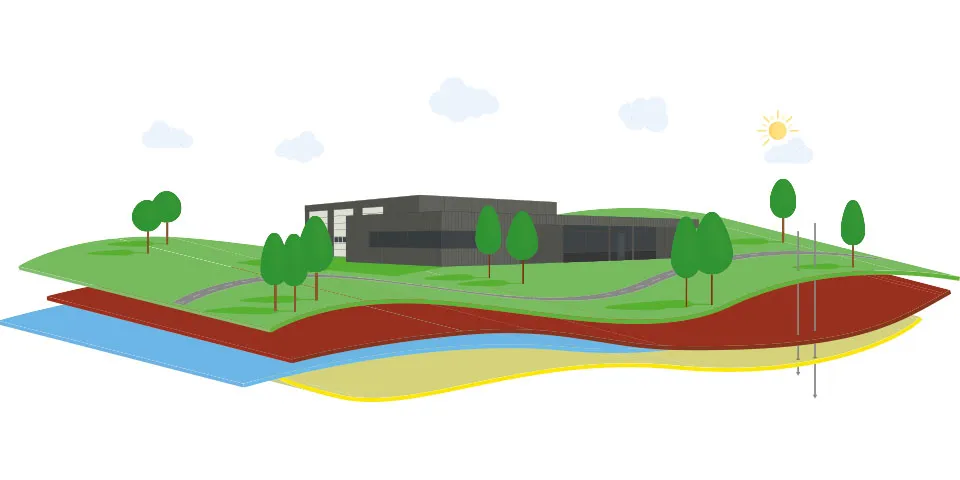
Subsurface data will be crucial to the construction sector’s survival. The nitrogen and PFAS crises are serious warnings. After the coronavirus crisis, climate targets will come back into focus. And rightly so. The construction sector will be expected to reduce emissions: less nitrogen, less PFAS,
less CO2.
So should we build less, at the cost of jobs and ambitions such as housebuilding? Or should we seize the opportunities offered by digital subsurface data now? More digital data and knowledge of the subsurface will enable us to carry out better risk analyses, allowing us to keep building on the scale we do today while reducing our ecological footprint. Geotechnical investigation companies, represented by their trade association VOTB, and geotechnical consultants can play an important role here, applying their expertise to the correct interpretation of measurements, the development of models and the performance of calculations.
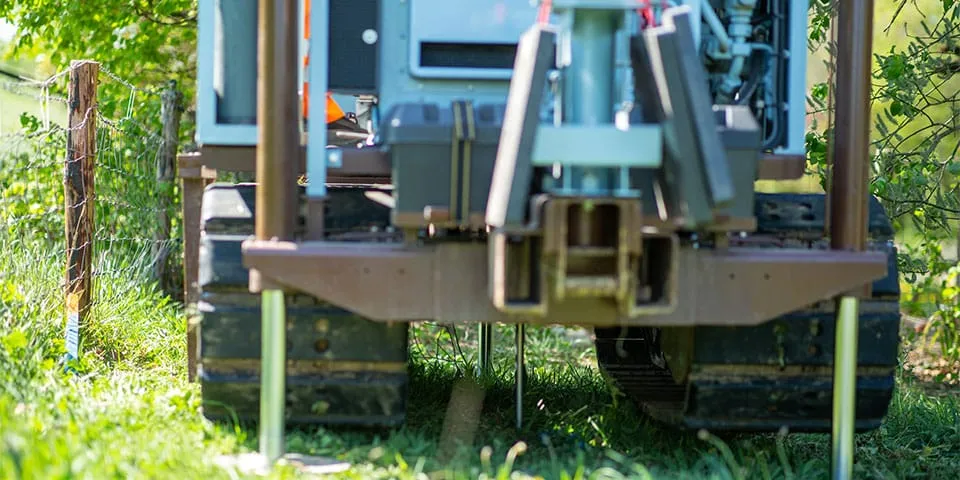
Since 2018, digital subsurface data have been actively collected under the Key Register of the Subsurface Act. The clock is ticking: all that data needs to be converted into 3D subsurface models for projects, making the uncertainties visible in a 3D spatial computer model so that targeted additional ground investigations can reduce them and lower the probability of failure. Clients have an important role in this process: they should specify a maximum level of uncertainty for ground models in their contracts before design work begins and a final design is approved.
“There is no benchmark at present. You can design a structure on the basis of just 2 cone penetration tests, but that leaves you with an unknown risk and makes it unnecessarily expensive to build in extra safety margins or take costly mitigation measures. As taxpayers, we always end up paying the price as part of BV Nederland. None of the parties involved in a project represents our interests, even though we fund everything, including when things go wrong.”
So it is time to seize the opportunity. Everyone stands to benefit. Research institutions, public authorities such as water boards, and commercial organisations must now play their part, because the BRO will be complete in 2022. To prevent unfair competition funded by taxpayers’ money and encourage development, it is important to align the roles of all parties in a long-term vision.
Changes on the horizon
The geotechnical world is undergoing major change. The BRO is bringing changes to our market, including:
- Data suppliers are responsible for publicly available data in the BRO for 10 years, and the data are more readily accessible than they were in the past;
- Data in the BRO are “raw” data, unlike the synthesised information customers are used to;
- Field descriptions and sample tubes are kept separate rather than being combined;
- The data are in a different format from what we are used to. This has implications for presentation and calculation software;
- Additional data are being made available digitally through the BRO, with an obligation to use them;
- Software for automated calculations using the BRO is becoming available. The new drilling standard 14688 is also bringing changes to our market:
- Some soil type designations are being discontinued, breaking with the past;
- Fine-grained soils are classified by their behaviour rather than by the percentages of their fractions;
- The proportions of the fractions used to define soil types have changed (GRAVEL-SAND);
- The designations for secondary fractions are limited;
- New fields are mandatory (layer boundaries, lime, moisture, etc.), and there are other requirements for describing layering, among other things;
- There are different class descriptions;
- Part 2 specifies index tests for classifying soil
- A more detailed description is needed to ensure tenders are consistent, particularly in relation to the index tests.
- With the advent of the BRO, STOWA-style tables can be generated automatically from this raw data, based on current insights, and kept up to date.
- The Eurocode, which is currently being developed at European level, is also bringing changes to our market:
- Desk studies will become more important, particularly in the Netherlands, thanks in part to the BRO;
- Ground investigation reports will be required to include a ground model and a synthesis of the data.
These changes are both a threat and an opportunity. Time is running out to respond to them. The paragraphs below offer some initial ideas.
A vision for ground investigation
The subsurface is one of the major risks in infrastructure projects, while ground investigation typically accounts for less than 1% of construction costs. The Geo-Impuls programme (2009-2014) successfully helped to establish practices such as risk-based ground investigation and the reduction of geotechnical failure in the civil engineering sector.
What next? As more data become available in the BRO, standards change, 3D design, BIM and automated calculations become more widespread, and knowledge increases, there is a growing need to take a different view of future ground investigation, building on CUR247.
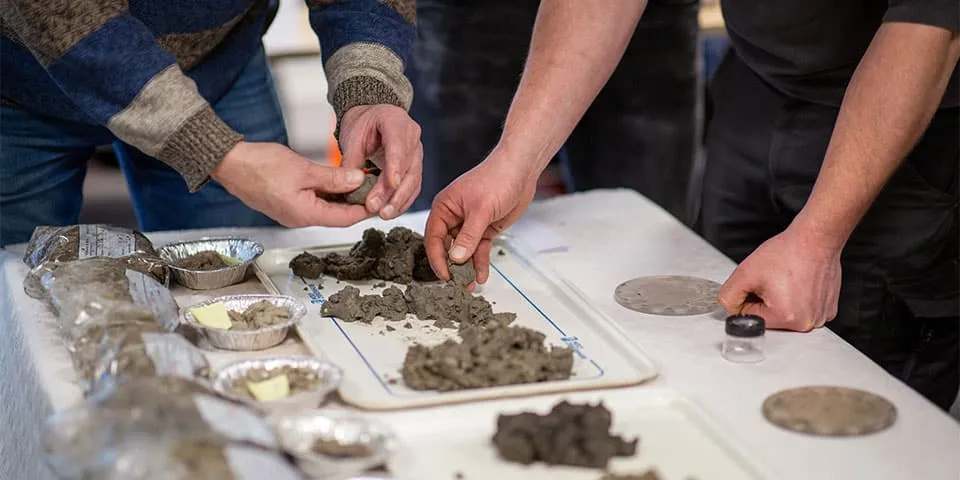
A countrywide subsurface model based on stratigraphic scenarios, with associated probabilities of occurrence and default parameter values, is already available for dikes and is expected to be extended to the civil engineering sector. To refine it for specific project sites, it makes sense to start with a desk study and then build up a targeted collection of test results for geotechnical units, alongside a better understanding of their spatial distribution. Thorough investigations at selected pilot sites, including high-quality cone penetration tests, boreholes with index tests, sufficient laboratory testing of strength parameters, and monitoring of pore water pressures, provide an early insight into optimal geotechnical units, possible correlations and links to existing data. This is already being done for dike investigations, but not yet for other civil engineering projects.
The future
The clock is ticking: all that digital data needs to be converted into 3D subsurface models for projects, making uncertainties visible in a 3D spatial computer model so that targeted additional ground investigations can reduce them. Clients can then specify a maximum level of uncertainty in a ground model before design work begins. By avoiding unnecessary safety margins in designs and reducing uncertainty about the subsurface, we can produce cheaper designs and deliver more construction plans.
To design geotechnical works responsibly in the future using new digital technologies such as artificial intelligence, automated calculations, BIM and 3D models, and to realise the benefits for BV Nederland, databases such as the BRO and high-quality investigations are essential. The vision for ground investigation on publicly funded projects, where the data are stored in the BRO and made available to everyone, should reflect this. The current approach to ground investigation can sometimes seem “penny wise, pound foolish” for the taxpayer.
Question about this story? Ask your question
Keep following this
Get an email when a new story is published. No account needed.
- ThemeUnderground construction
- SubjectBouwMat







