Grond/Weg/Waterbouw Nederland is part of Louwers Mediagroep: 45+ trade platforms in the Netherlands, Flanders and Wallonia. Trade magazines, websites, newsletters, video and podcasts, since 1987.
Mijnwater B.V. is building a new pipeline network in Heerlen to supply heating and cooling to homes, offices, shops and industrial businesses.It is a circular energy network that harvests waste heat from the surrounding area and stores surplus heat or cooling for later use.Such a heating and cooling network can save 65 to 90% of energy, in Heerlen and in other cities too. A good underground pipeline network is essential to making this work.
Mijnwater BV now has 30 professionals on its team to deliver this work. Their expertise includes mechanical engineering, urban planning, instrumentation and control, finance, innovation, civil engineering and infrastructure. The company is growing and can expand Heerlen’s existing pipeline network to connect new buildings as well as existing homes to sustainable energy.
The importance of good underground infrastructure
The Infra department is responsible for installing (shallow) wells, the main pipeline (backbone) and various branches to neighbourhoods and buildings. This is also known as installing a cluster network and a sector network. The European project Heatnet-NWE (Interreg-NWE) helped fund the launch of one of the cluster networks in Heerlen.
Preparing and installing an underground pipeline may not seem particularly difficult, but appearances can be deceptive. During installation of the network for Cluster D, project manager Infra Hubert Blom encountered numerous challenges. The route crosses a catchment area of the Geleenbeek with high natural value, and Heerlen has a rich Roman history. In addition, mining industries of the past left mine spoil and gravel in the ground in several locations in Parkstad-Limburg. These were the obstacles overcome underground. Above ground, traffic diversions were a daily occurrence. Keeping the adjoining industrial areas accessible 24/7 while carrying out the work was quite a feat.
Natura 2000 site
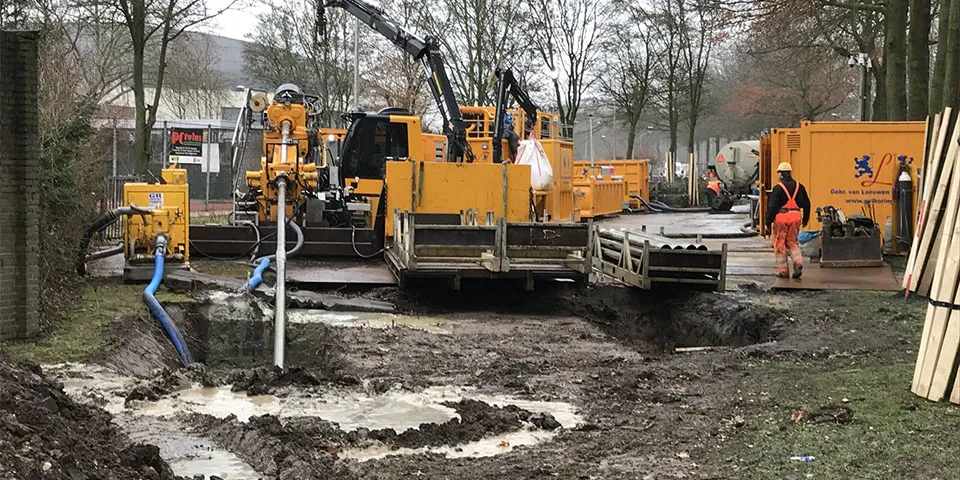
One of the challenges was crossing a Natura 2000 site, where excavation is not permitted. To cross the site, a full-length underground bore had to be completed.
Drilling technology
The preliminary design specified HDD (Horizontal Directional Drilling). Drilling techniques for projects and challenges of this kind are now among Mijnwater BV’s standard construction methods. Tenderers could distinguish themselves during the award process by varying the depth, length, start point and end point of the bore. As part of the Heatnet-NWE project, we presented the challenges to the different bidders during the tender process. The contractors’ proposed solutions were assessed and taken into account when awarding the contract.
A perfect end result
The solutions proposed involved bores of different lengths and depths, with different start and end points. As the bore forms part of an overall project plan, the assessment considers not only the best price, but also awards points for the quality offered by the contractor. The successful contractor designed a bore that was longer than the concept design. This meant the start point was located on a site where disruption to local residents and traffic was significantly reduced. This earned the contractor the most points. When surveying the site after the contract had been awarded, the contractor discovered a large concrete culvert beneath the Geleenbeek. A sewer? There was no record of it on the drawings. Further investigation revealed that a second stream, the Caumerbeek, flowed through it. In the past, part of the Caumerbeek had been diverted underground. The bore therefore had to be modified, making it deeper and longer still. Unfortunately, this meant extra work for us, but the end result was perfect.
Contaminated ground
Mine spoil underground
One challenge in Parkstad-Limburg is the presence of mine spoil underground. This waste product of the former coal-mining industry is still visible in the landscape as the mountains and hills in Heerlen. They are now covered with a layer of soil and are mostly used as nature reserves and walking areas. But when you start digging, you encounter the mine spoil again. It contains various iron compounds and carbon compounds, which make it unsuitable for other uses. There are several recycling companies in the region with the permits and certification required to accept and process it.
Thorough ground investigation in advance
Mine spoil is sharp and coarse. This means you cannot simply lay pipes in it, as they would be damaged immediately. A ground investigation in advance provides a better estimate of the additional costs, because bringing in sand and removing mine spoil is expensive. The mine spoil is taken to specialist processors in the region, who then transport it to a quarry or another mine spoil heap in Brunssum.
Excavating and replacing the material, or removing it from site, is therefore unavoidable. It is essential to map ground contamination in advance and in collaboration with other parties. This enables more effective and strategic operations, and, above all, helps avoid (major financial) risks.
Keeping adjacent businesses accessible
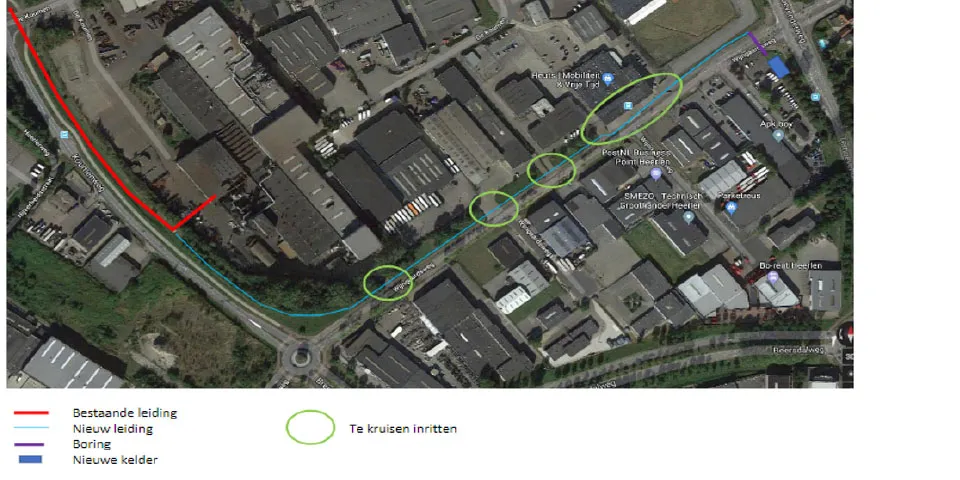
In addition to underground obstacles, this industrial area also has obstacles above ground. Many businesses receive or deliver goods 24/7. Blocking an access route can quickly result in business losses. This can be taken into account when choosing the route. It may also be possible to block only part of an access route, and later block another part, or drill beneath a driveway.
Targeted communication with businesses and the local authority
The biggest challenge along the route through this industrial area, between VDL and the new energy basement, was communicating with businesses. During the preparation phase, each business was contacted individually, and the local authority was also informed about the pipeline installation and the disruption it would cause. The road is busy, with many businesses and their access roads, and very little room to work. As the contractor was responsible for the detailed design and construction on this project, responsibility for final coordination and communication with all parties also rested with them. This was, of course, done in close collaboration with Mijnwater B.V. After the contract was awarded, the contractor completed the detailed design and presented the plans to all stakeholders, including permit authorities and neighbouring businesses. A substantial list of requirements and conditions meant that various measures were indeed used during construction to minimise traffic disruption and ensure all businesses remained accessible. These included drilling beneath driveways, carrying out work on wide driveways in two halves, using traffic marshals and diversion routes, working at night and creating temporary access roads at alternative locations. Mijnwater covers these costs. A business or landowner is not normally compensated for disruption, unless pipelines are laid on their land. However, if a business suffers losses as a result of our work, that is a different matter. Fortunately, Mijnwater was able to prevent this.
Keep communicating with each other
As a route installation project always involves people and the dynamics among people working at nearby businesses, it is advisable to inform the relevant contacts at those businesses about the upcoming work in advance. This helps prevent them from making demands afterwards.
Installing an infrastructure route through a built-up area is not easy. There are many obstacles, and even with thorough preparation and investigation, you will encounter unexpected issues. Recommendations from project manager Hubert Blom:
Be prepared. Map out your route or, better still, carry out an underground survey of the area where you will be working. A 3D survey is recommended.
Always be flexible when dealing with businesses or making changes to your route. Work together and communicate clearly. Make sure you assemble your project team accordingly. Give the contractor sufficient freedom within the project team.
Always set aside sufficient financial headroom to maintain this flexibility.
Be mindful of the surrounding area, provide information in good time and listen carefully to feedback from neighbouring businesses, permit authorities and local residents. This makes it possible to resolve complaints more quickly, and often to prevent them altogether.
Looking to the future
The success of Mijnwater technology is an example for other cities urgently seeking alternatives to natural gas. In principle, the same kind of network could be built in other cities, linking existing thermal energy storage (TES) systems, for example, with homes along the route and other heat sources in the city, such as (cooled) supermarkets, data centres and office buildings. This is known as a 5th-generation district heating and cooling network (DHC).
Installing a local circular thermal energy network brings substantial savings for everyone involved. The major investments are shared, making this an opportunity worth seizing. Setting up this kind of partnership does, however, require a well-organised coordinating role. Research by CE-Delft and IF-technologie shows that 5GDHC could enable up to 3 million homes in the Netherlands to switch away from natural gas.
In November 2019, Mijnwater B.V. received the ‘grand prize for sustainable infrastructure’ in Paris at the Green Solution Awards 2019 ceremony.
Find the right company in the sectorSearch by product, field, region or project in the company directory and across all Grond/Weg/Waterbouw Nederland articles.
We use cookies to keep the site working properly. With your consent, we also use cookies for statistics and third-party banners. Read more in our privacy and cookie statement.