Grond/Weg/Waterbouw Nederland is part of Louwers Mediagroep: 45+ trade platforms in the Netherlands, Flanders and Wallonia. Trade magazines, websites, newsletters, video and podcasts, since 1987.
How can we meet our climate and circularity targets for 2030 and 2050 when almost 96% of all infrastructure tenders have no sustainable selection criteria? This is the damning conclusion of Bouwend Nederland’s study ‘Sustainability in public procurement’1). We can catch up by developing and applying criteria more quickly, linking them to existing solutions and verifying them against reliable, fact-based data. The timber sector is therefore working to make this data available and help clients in civil engineering make the most of the ‘low-hanging fruit’. There is work to be done.
Circularity is about taking action
Key award criterion: CO2 reduction
In its report ‘Bringing Embodied Carbon Upfront’, the World Green BuildinCouncil2) concludes that using timber for materials and structures could cut the CO2 emissions they generate by 40% by 2030. These claims are also supported by national and international life cycle assessment (LCA) studies. The Province of Groningen has already acted on this, using CO2 performance and the results of LCA studies as award criteria for the 800-metre-long, 3.5-metre-wide iconic cycle and pedestrian link, the ‘Blauwe Loper’. The result was the selection of sustainably produced tropical hardwood as the most environmentally friendly material option.
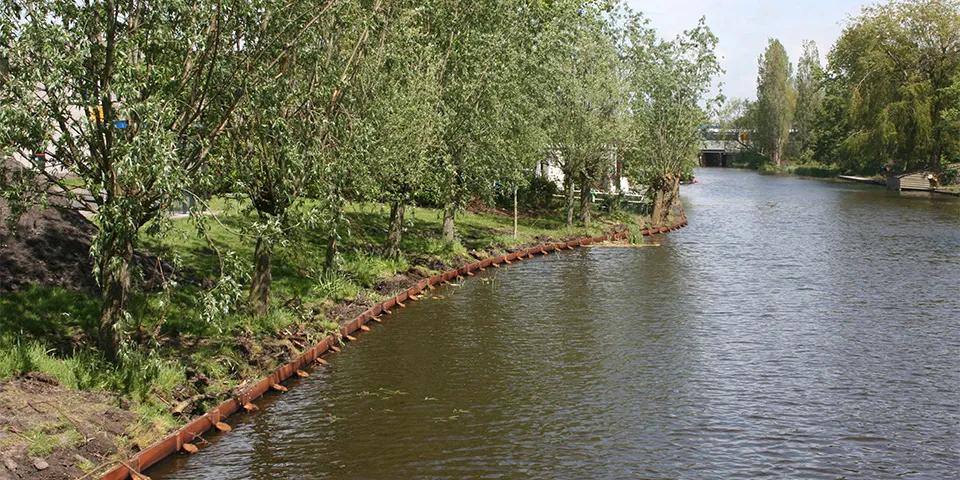
‘Timber bank protection performs well environmentally’. (Image: Centrum Hout)
Proposed measure has at least a lower environmental cost indicator (MKI) than existing solutions
With this in mind, Rijkswaterstaat (RWS) commissioned a study into the benefits of replacing the road furniture currently used as standard with existing bio-based alternatives. The conclusion was that this could deliver significant environmental (MKI) and climate benefits (CO2 emissions) (see Table 1). RWS is therefore now consistently including timber solutions in its option appraisals. Municipalities and provinces are also showing growing interest in installing timber road furniture. For example, the Province of South Holland has opted for timber safety barriers, noise barriers, road portals and bus shelters as part of the redesign of the N211. More and more provinces and municipalities are interested and joining the ‘Hout in de gww’ supply-chain collaboration.
Environmental data for timber safety barriers, road portals, decking (for bridge decks and boardwalks) and 12 types of timber bank protection (Photo 1) have also recently been added to the national environmental database3), making it possible to include them in calculations.
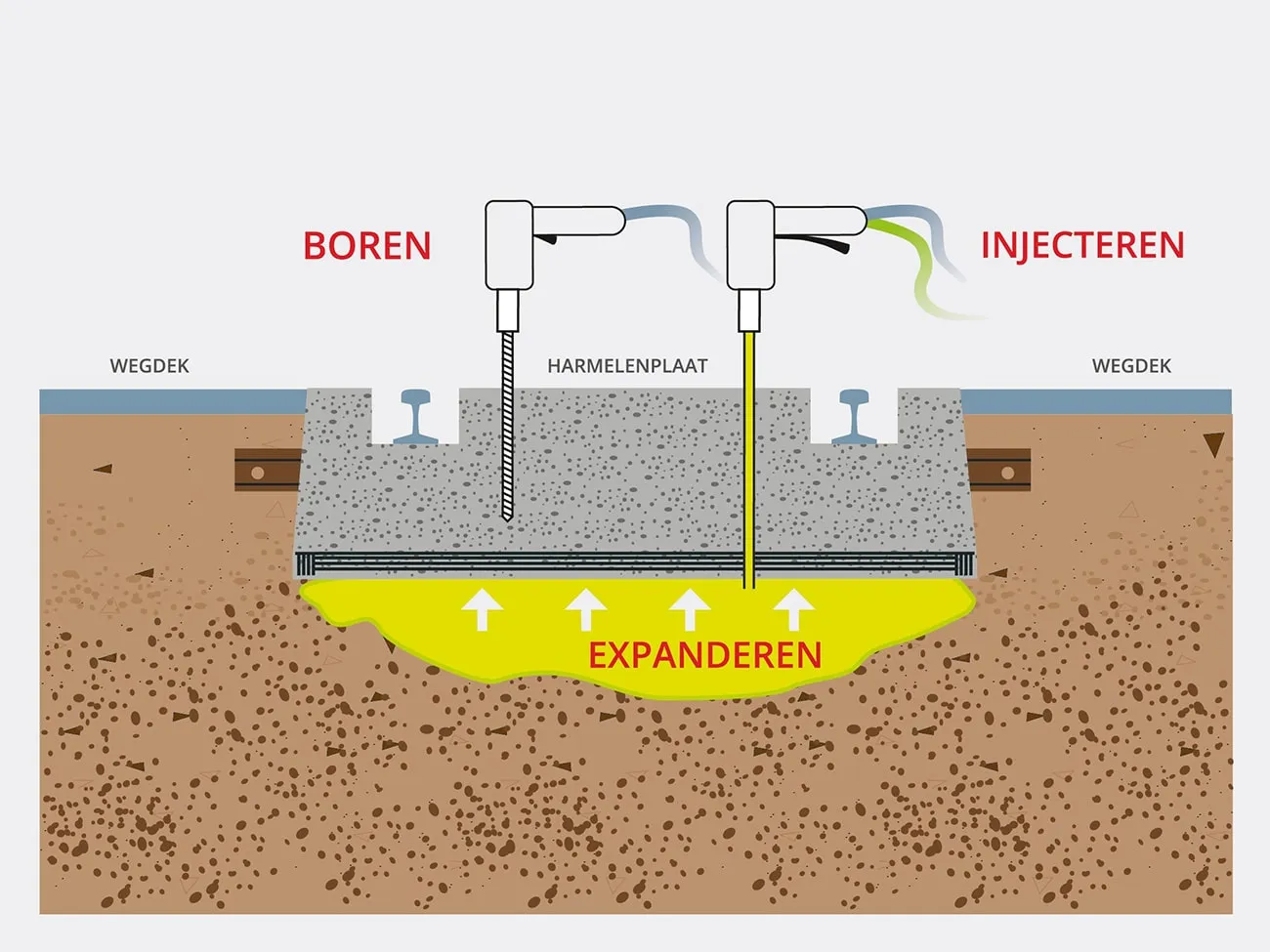
De floorlift-methode is heel breed inzetbaar en geschikt om verzakkingen in betonconstructies te verhelpen.Proposed measure is circular according to the principles of the McArthur Foundation
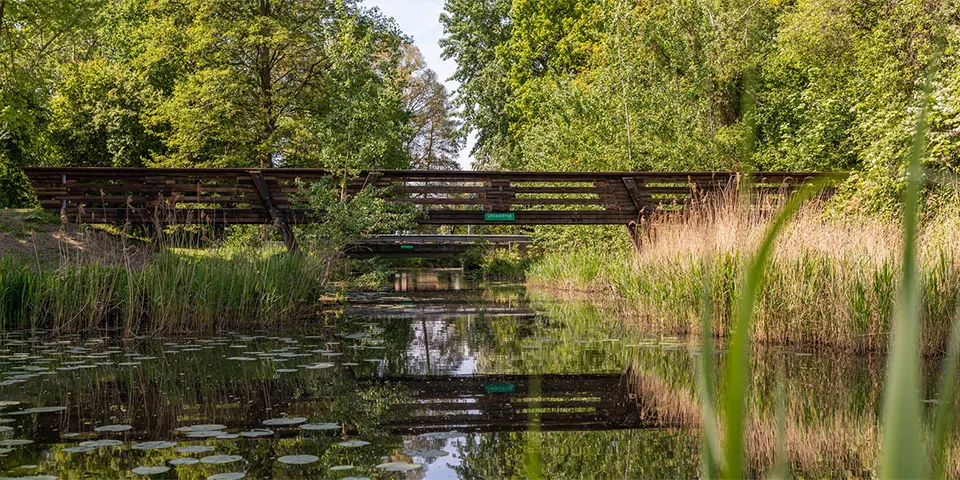
Timber and other bio-based materials from sustainably managed sources naturally form a closed loop (biological cycle) and are therefore inherently circular. Combined with their ability to perform well across the Technical Rs, timber is essentially ‘CirculaiR-Plus’ and is vital to meeting circularity targets. However, research by Nibe4), commissioned by the Netherlands Enterprise Agency (RvO Nederland), shows that 98% of the opportunities for bio-based materials in construction remain untapped. This presents opportunities, and practical experience shows that they are easy to realise: old bridges, some over 60 years old, have already been used to make new ‘circular’ bridges, for example in Almere (Photo 2), Westervoort and soon Nijmegen.
For more information on timber species, applications or environmental performance (LCA and CO2 reduction), visit: www.houtindegww.nl and www.houtdatabase.nl.
To receive updates on supply-chain collaboration in civil engineering, join the LinkedIn group #ketensamenwerkinghoutindegww.
Sources
Bouwend Nederland: ‘Sustainability in public procurement: analysis 2018’, September 2019: www.bouwendnederland.nl/publicatiespublicaties.
WorldGBC: ‘Bringing Embodied Carbon Upfront’, April 2019: www.worldgbc.org/embodied-carbon
Nibe (July 2019), 18 LCA studies and EPDs for safety barriers, road portals, decking and timber bank protection (12 types), prepared for inclusion in the NMD: www.houtindegww.nl
Nibe, ’Potential for bio-based materials in construction: a study of the opportunities and impact’, commissioned by the Netherlands Enterprise Agency, 14 June 2019: https://www.nibe.org/nl/nieuws/potentiebiobased
Find the right company in the sectorSearch by product, field, region or project in the company directory and across all Grond/Weg/Waterbouw Nederland articles.
We use cookies to keep the site working properly. With your consent, we also use cookies for statistics and third-party banners. Read more in our privacy and cookie statement.